
That tension sits at the heart of every 1099 sales decision.
Whether you're a sales professional weighing your options or a company building out a sales team without the overhead of full-time hires, understanding how 1099 sales work matters. This guide breaks down exactly what a 1099 sales job is, how it differs from W2 employment, what the tax picture actually looks like, and how to determine if this model fits your situation.
Key Takeaways
- A 1099 sales rep is an independent contractor paid by commission — not a salaried employee
- They receive IRS Form 1099-NEC instead of a W-2 and handle all their own taxes
- 1099 reps gain flexibility and uncapped earning potential, but take on tax responsibility and lose traditional benefits
- Companies use 1099 reps to reduce overhead, access specialized talent, and scale sales faster
What Is a 1099 Sales Job?
A 1099 sales job is a role where an individual sells products or services on behalf of a company as an independent contractor — not a direct employee. The term comes from IRS Form 1099-NEC (Non-Employee Compensation), which businesses use to report payments made to contractors. Per current IRS instructions, any independent contractor paid $600 or more in a calendar year must receive this form, with a filing deadline of January 31.
Despite being commonly called "1099 employees," these individuals aren't employees in any legal sense. They're self-employed professionals operating under a contract or agreement with the companies they represent.
How 1099 Sales Reps Operate Day-to-Day
The day-to-day reality looks quite different from a traditional sales job:
- Schedule control — reps decide when they work, with no set hours or check-ins
- Method autonomy — they choose how to prospect, pitch, and close deals
- Multiple clients — many reps represent several non-competing companies simultaneously, spreading income risk
- Self-managed expenses — tools, travel, and business costs typically come out of pocket
- No administrative overhead — unless the client provides tools or back-end support
That last point — administrative overhead — varies significantly by company. Consolidated Design West, an Anaheim-based commercial printing and packaging solutions provider with over 34 years in business, structures its 1099 sales roles to reduce that burden directly. Reps receive company-supplied warm leads and have all order processing handled by CDW's team, so the focus stays on closing rather than prospecting or fulfillment.
1099 vs. W2 Sales Jobs: Key Differences
The W2 vs. 1099 distinction goes well beyond tax forms. It fundamentally changes the nature of the working relationship, earning potential, financial risk, and daily freedom.
Employment Status and Control
Under IRS rules, W2 sales employees are classified as employees — meaning the company controls not only what work gets done but how it gets done. The IRS evaluates three factors to determine proper classification: behavioral control, financial control, and the type of relationship between the parties.
1099 reps, by contrast, retain control over their methods, schedule, and workflow. That independence is what legally defines contractor status under the IRS framework.
Misclassifying a W2-style worker as a 1099 contractor can trigger IRS audits, back taxes, and significant penalties. Several states — including California, New Jersey, Connecticut, and Massachusetts — apply ABC Tests that presume employee status unless specific conditions are met. Companies in those states should review classification requirements carefully before structuring any 1099 sales arrangement.
Compensation Structure
| Feature | W2 Sales Rep | 1099 Sales Rep |
|---|---|---|
| Base salary | Yes (typical) | No |
| Commission | Yes (variable) | Yes (primary or only income) |
| Tax withholding | Employer withholds | Rep pays quarterly |
| Pay mix | Often 60/40 or 70/30 base/incentive | Commission-only |
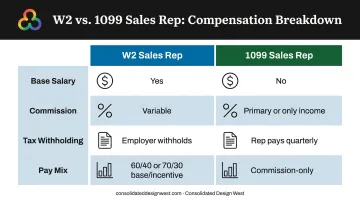
W2 reps typically receive a base salary plus commission, with federal, state, Social Security, and Medicare taxes withheld automatically. 1099 reps receive commission only — no withholding, no safety net — and must set aside funds for quarterly estimated tax payments.
To compensate for that added burden, commission rates for 1099 reps are typically higher. According to RepHunter, independent reps in manufactured products earn 7%–15% of sales price, or 20%–40% of gross margin. Service-based products can reach 50% or more. Companies save on payroll taxes, benefits, and overhead, so they can share more of the margin with the rep.
Benefits and Protections
The compensation difference is significant — but the benefits gap can be even larger. W2 employees typically receive:
- Employer-sponsored health insurance (employer-paid premiums averaged $7,885/year for single coverage and $20,143/year for family coverage, per the KFF 2025 Employer Health Benefits Survey)
- Paid time off and sick leave
- 401(k) matching (median employer match was 4.0% of pay in 2024, per Vanguard's How America Saves report)
- Workers' compensation coverage
- Unemployment insurance eligibility
1099 reps must self-fund all of these — which can easily add $15,000–$25,000+ per year in out-of-pocket costs. That's a real number to weigh before comparing any commission offer against a W2 salary.
Pros and Cons of a 1099 Sales Job
Advantages of 1099 Sales Work
- No income ceiling. ZipRecruiter data shows independent sales reps earning an average of $100,576 annually, with top performers at the 90th percentile hitting $152,000. W2 wholesale and manufacturing reps had a BLS median of $74,100 in May 2024 — a real gap for high-output closers.
- Reps decide when, where, and how they work — no commute, no micromanagement, no arbitrary cap on earnings.
- Independent reps can carry a portfolio of complementary product lines, diversifying income and reducing exposure to any single client relationship.
- Many 1099 arrangements pay ongoing commissions for repeat purchases or renewals, so a single closed deal can generate income well past the initial transaction.
The tradeoffs are real, though. Here's what to weigh on the other side.
Drawbacks to Consider
- No floor on income. During ramp-up or slow cycles, earnings can drop to zero. Sales professionals switching from W2 should have at least 60–90 days of financial runway in place first.
- Self-employment tax hits hard. The IRS self-employment rate is 15.3% — both the employee and employer shares of Social Security and Medicare. W2 employees see only 7.65% withheld because their employer absorbs the other half. As a 1099 rep, you cover both sides.
- Health insurance premiums, retirement contributions, business tools, and travel expenses all come out of your pocket — costs that W2 employees rarely think about because they're handled automatically.
Tax Responsibilities for 1099 Sales Reps
Taxes are where many new 1099 reps get caught off guard. Here's what to know:
Self-Employment Tax
The SE tax rate is 15.3% (12.4% Social Security + 2.9% Medicare), applied to net self-employment income. The Social Security portion applies up to $176,100 in 2025. The IRS does allow a deduction for half of SE tax, which reduces your adjusted gross income but not the SE tax itself.
Quarterly Estimated Taxes
Since no employer withholds taxes, 1099 reps must pay quarterly estimated taxes directly to the IRS. Due dates fall on:
- April 15
- June 15
- September 15
- January 15 (of the following year)
Missing these can result in underpayment penalties. To avoid them, you need to have paid either 90% of your current-year tax liability or 100% of the prior year's tax (110% if your income exceeded $150,000).
The simplest way to stay ahead: set aside 25–30% of gross commissions each month in a dedicated account earmarked for taxes.
Deductible Business Expenses
A real financial upside of 1099 status is the ability to deduct legitimate business costs, including:
- Home office — $5/sq ft simplified method, up to 300 sq ft ($1,500 max)
- Business mileage — 70 cents per mile (2025 IRS standard rate)
- Phone and internet — business-use portion
- Client meals — 50% of qualifying business meal costs
- Professional development — training, conferences, subscriptions
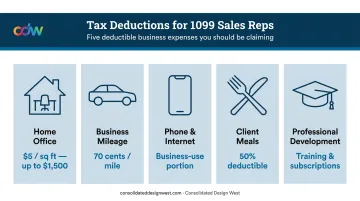
Taken together, these deductions can cut your taxable income substantially. A CPA who works with self-employed clients will help you capture every eligible write-off without missing anything.
Who Should Consider a 1099 Sales Job?
The Right Profile
1099 sales work rewards people who already have the skills, network, and discipline to operate without a manager setting their schedule.
Strong candidates typically:
- Have proven closing experience in their target industry
- Carry an existing book of business or professional network
- Can sustain 60–90 days without income during ramp-up
- Are genuinely motivated by performance-based pay, not just tolerant of it
- Prefer autonomy over the security of a fixed schedule and salary
If you're earlier in your sales career, a W2 role first makes sense — build the skills, accumulate savings, and develop industry relationships before transitioning.
Industries That Use 1099 Sales Models
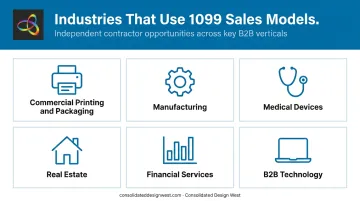
Knowing which industries use this model helps you target the right opportunity. Several depend on independent reps — their products require relationship-driven, consultative selling:
- Commercial printing and packaging — companies like Consolidated Design West partner with independent reps to reach brands across beauty, food and beverage, electronics, pet care, and apparel
- Manufacturing — MANA (Manufacturers' Agents National Association) lists thousands of active independent rep agencies across the U.S.
- Medical devices — independent reps are common where product expertise and physician relationships drive sales
- Real estate — licensed agents are classified by the IRS as statutory nonemployees, treated as self-employed by default
- Financial services — independent contractor models are widespread among registered representatives
- B2B technology — commission-based roles appear across SaaS and software, though structure varies widely
A Simple Self-Assessment
Before committing, answer these honestly:
- Do you have 90 days of savings to cover living expenses?
- Do you have an existing client network or book of business?
- Are you experienced in this product category or industry?
- Are you comfortable with income variability for potentially months at a time?
- Do you have a clear understanding of your tax obligations as a self-employed person?
If you answered yes to most of these, you're likely ready to make the move. If several answers are no, build those foundations first — the upside of 1099 income only materializes when the groundwork is already in place.
Frequently Asked Questions
What does 1099 sales mean?
"1099 sales" refers to a commission-based sales role where the rep is classified as an independent contractor. The name comes from IRS Form 1099-NEC, which businesses use to report contractor earnings instead of issuing a W-2.
How do 1099 sales reps get paid?
Reps are paid commissions on closed sales. Common structures include a flat fee per deal, a percentage of revenue or gross margin, tiered rates based on volume, and residual payments for repeat or recurring business.
What is the difference between a 1099 and W2 sales job?
W2 reps are employees; taxes are withheld and benefits are provided by the employer. 1099 reps are independent contractors responsible for their own taxes and benefits, with greater schedule flexibility and typically higher commission rates.
Do 1099 sales reps pay their own taxes?
Yes. 1099 reps pay all their own taxes, including the 15.3% self-employment tax, plus federal and state income tax. No withholding occurs, so quarterly estimated payments to the IRS are required.
Can a 1099 sales rep work for multiple companies at once?
Yes. Most 1099 reps represent multiple companies at once, often building a portfolio of complementary lines. Individual agreements may include exclusivity clauses, so always review contract terms before signing.
What happens if a company misclassifies a 1099 sales rep?
Misclassification can expose companies to IRS back taxes, employment tax penalties, and DOL liability including back wages and liquidated damages. Companies should follow IRS classification guidelines (or consult legal counsel) before structuring any contractor arrangement.