
This scenario plays out constantly in independent sales — and a properly drafted 1099 sales commission agreement is the document that prevents it. This article covers what that agreement must contain, how commission structures work, and what both companies and reps need to watch before signing.
Key Takeaways
- A 1099 sales commission agreement is a legal contract covering commission rates, payment terms, territory, and termination conditions between a company and an independent sales rep
- Unlike W-2 employees, 1099 reps handle their own taxes, making the contract each party's only real protection
- The single most dispute-preventing clause: when a commission is "earned" vs. when it's "paid"
- Always scrutinize chargeback clauses, territory definitions, and post-termination commission language before signing
What Is a 1099 Sales Commission Agreement?
A 1099 sales commission agreement is a formal contract between a company (the principal) and an independent sales representative — not an employee — that defines how the rep is compensated for driving sales. The "1099" refers to IRS Form 1099-NEC, which companies use to report payments of $600 or more made to non-employees. Any company paying a contractor that threshold or above in a calendar year is required to issue this form.
How It Differs from W-2 Employment
The distinction matters legally and financially:
- No income tax withholding from the rep's pay
- No Social Security or Medicare contributions from the company
- No employee benefits — no health insurance, no unemployment eligibility
- The rep is responsible for self-employment tax, which the IRS sets at 15.3% (12.4% Social Security + 2.9% Medicare)
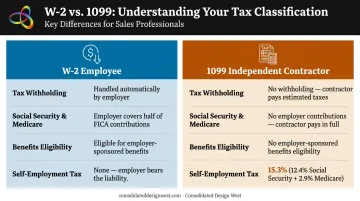
That 15.3% self-employment tax is a number reps frequently underestimate when evaluating a commission offer. A 60% commission rate shrinks noticeably once you factor in what's owed at filing.
Why the Written Contract Is Non-Negotiable
Misclassifying a worker — treating an employee as a contractor — carries real consequences. The DOL's penalty schedule lists $2,515 per repeated or willful FLSA violation (as of January 16, 2025), and willful violations can escalate to criminal prosecution.
The written agreement also establishes the nature of the relationship itself. A contract that says "independent contractor" but gives the company full behavioral and financial control won't hold up. The operating reality must match the contract.
This is why companies like Consolidated Design West — which structures its entire national sales network around 1099 reps — treat the written agreement as the starting point of every rep relationship.
Must-Have Clauses in a 1099 Sales Commission Agreement
These are the clauses that, when missing or vague, generate every dispute worth having a lawyer over.
Scope of Work and Contractor Relationship
The agreement must explicitly state that the rep is an independent contractor — not entitled to benefits, unemployment insurance, or tax withholding. It should also:
- Require the rep to submit a signed IRS Form W-9 before work begins
- Define which products or services the rep is authorized to sell
- Specify which customer types or channels are in scope
Territory and Exclusivity
Vague territory language creates conflict. "The Western U.S." is not a territory definition — it's an argument waiting to happen. The contract should specify:
- Geographic scope: states, counties, zip codes, or named metro areas
- Exclusivity: is the rep the sole seller, or can others work the same region?
- House accounts: pre-existing direct clients the company retains should be listed in an attached exhibit, so the rep knows from day one which accounts don't qualify for commission credit
California's Civil Code Title 1A actually requires written independent wholesale sales rep agreements to specify the territory, any exceptions, and chargeback provisions — making written specificity a legal mandate, not just good practice.
Commission Structure and Payment Terms
This clause must answer four questions:
- What is the commission rate? A flat percentage, tiered rate, or margin-based calculation
- What is it calculated on? Gross revenue, net revenue, or gross margin — these produce very different numbers
- When is it "earned"? Contract signature, shipment, or receipt of customer payment
- When is it "paid"? The exact schedule — for example, on the 15th of the month following the quarter in which full customer payment was received
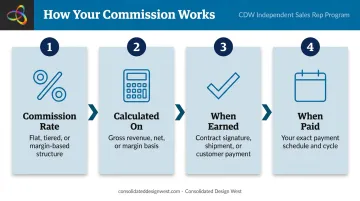
Consider how this plays out in practice. A rep closes a deal in February. The commission is "earned" when the customer pays the invoice in April. It's "paid" on May 15th per the schedule. That rep waits three months from close to payment — a gap worth calculating before accepting the role, not after.
Chargeback and Return Policy
If a customer returns a product or cancels after a commission has been paid, the agreement must address it. A standard chargeback clause lets the company deduct the relevant commission from the rep's next payment. Without this clause:
- The company absorbs the loss with no clear recourse
- The rep faces unpredictable clawbacks with no defined rules
That ambiguity benefits neither side. California requires chargebacks to be specified in writing for covered independent wholesale sales reps. Name the trigger events — returns, cancellations, nonpayment, credit memos — and set a defined time window for each.
Term, Termination, and Post-Termination Commissions
The agreement needs a start date, duration, and both termination paths:
- For cause: breach of contract, fraud, misrepresentation
- Without cause: typically 30–60 days written notice
The clause that most reps overlook is the trailing commission provision — commonly called a "tail." This defines the window after termination during which the rep still earns commissions on deals they originated. Illinois law under the Sales Representative Act (820 ILCS 120) requires payment of commissions due at and after termination, with noncompliance potentially creating liability for up to three times the unpaid commissions plus attorney fees.
No universal standard sets the trailing window length. Negotiate it against your typical sales cycle — a six-month deal pipeline warrants a longer tail than a 30-day transactional one.
Common Commission Structures for 1099 Sales Reps
The commission model embedded in the agreement shapes rep behavior. Choose the one that aligns incentives with your business goals.
Straight Commission
The rep earns a percentage of every sale, no base salary. This model:
- Works best for reps in high-activity, short-cycle environments who close fast and move on
- Keeps company costs variable: if no revenue comes in, no commission goes out
- Can drive turnover if leads are scarce or cycles run long
- Requires strong lead flow and operational support to remain sustainable
Consolidated Design West uses this model, offering reps 60% of net profits per closed deal with no earnings cap — a structure that works because the company supplies warm leads and handles order processing, removing the overhead that typically makes pure commission unsustainable.
Tiered Commission
The rate increases as the rep hits higher sales thresholds. For example:
- 5% on the first $50,000 in monthly sales
- 8% on the next $50,000
- 12% on everything above $100,000
Tiered structures motivate mid-level performers to push for the next bracket without raising the commission rate across all sales.
Gross Margin Commission
Commission ties to profitability rather than top-line revenue. This works well in categories with variable product costs or where reps have pricing flexibility — it stops reps from winning deals through unnecessary discounting. RepHunter notes that gross margin commission rates typically fall in the 20% to 40% of gross margin range.
Draw Against Commission
Unlike the models above, a draw against commission addresses cash flow rather than rate structure. It's an advance against future commissions, typically used in long-cycle sales or new territory development. Two types exist:
| Draw Type | How It Works |
|---|---|
| Recoverable | Functions like a loan; deficit carries forward until earned commissions cover it |
| Non-recoverable | Functions like a temporary salary; deficit is forgiven at the end of the draw period |
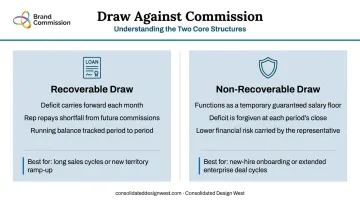
Draw terms must be explicitly written into the agreement: amount, duration, and what happens to any unpaid balance at termination.
How to Protect Your Pay as a 1099 Sales Rep
Before signing any 1099 sales commission agreement, work through this checklist.
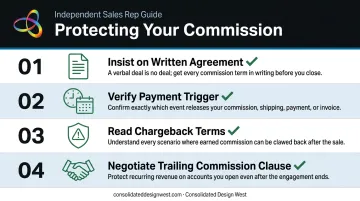
Insist on a written agreement. Verbal commission promises have no legal standing in most states — they're not just unenforceable, they're illegal. New York's Freelance Isn't Free Act (effective August 28, 2024) and Illinois' Freelance Worker Protection Act (effective July 1, 2024) both require written contracts. If a company won't put commission terms in writing, that tells you something.
Verify the payment trigger before signing. Confirm whether commission is paid at deal signature, invoice date, or customer payment receipt. Then model your cash flow honestly. A rep closing deals in January but collecting payment in April (net-60 terms) faces real working capital pressure.
Read chargeback terms carefully. A bounded chargeback window tied to defined events (returns, cancellations, credits) is fair. An open-ended clause with no time limit is not. Also look for a dispute resolution provision specifying mediation or arbitration before litigation — it protects both parties from expensive courtroom outcomes.
Negotiate your trailing commission clause before accepting the role. This is where reps most commonly leave money behind. A fair provision covers commissions on deals you were actively working at termination, for a defined period tied to your typical sales cycle.
Reps in competitive verticals — packaging, beauty, consumer goods — should pay particular attention to territory and exclusivity protections, given how frequently account overlap creates disputes in these categories.
Common Pitfalls to Avoid
Vague Definitions of "Sale" and "Earned"
If the contract doesn't explicitly define what constitutes a completed sale and when commission triggers, disputes are nearly certain. Test every key clause with this question: If we disagreed on this tomorrow, what would the contract say? If the answer is unclear, rewrite the clause before signing.
Missing Territory Language
A rep who assumes they own a region because they've worked it for two years has no contractual protection without written territory terms. Vague territory language invites conflicts between reps competing for the same accounts. Document both geographic and account-level exclusivity.
No Post-Termination Commission Language
One of the most expensive disputes in independent sales arises when a deal the rep nurtured for months closes after they've left — and the agreement says nothing about it. Wisconsin's statute Section 134.96 requires payment of post-termination commissions within 30 days after they become due, with damages reaching twice the unpaid amount plus attorney fees.
Define a clear post-termination window in writing before you sign. It gives the rep fair protection and gives the company a defined end date for its exposure.
Frequently Asked Questions
What is a 1099 sales commission agreement?
It's a written contract between a company and an independent (non-employee) sales rep defining commission rates, payment timing, territory, and the overall terms of the relationship. The "1099" references the IRS tax form used to report the rep's earnings each year.
Are sales commissions reportable on Form 1099?
Yes. Any company paying a 1099 independent contractor $600 or more in commissions within a calendar year must issue a Form 1099-NEC rather than a 1099-MISC. The rep then reports that income and pays self-employment taxes on it.
What should I expect when working under a 1099 sales commission agreement?
You operate as your own business — you set your schedule, pay your own taxes, and receive no employer-provided benefits. Your only compensation comes from the commissions defined in the agreement. Territory, payment timing, reporting expectations, and dispute procedures should all be spelled out in writing before you start.
What is a fair commission rate for a 1099 sales rep?
Rates vary widely by industry, product margin, and sales cycle length. Manufacturers' representatives typically see rates ranging from 5% to 40% of sales depending on the product category and deal complexity. Higher rates generally go to specialized products with longer sales cycles or significant technical demands.
Can a 1099 sales commission agreement be changed after signing?
Yes, but any modification must be in writing and signed by both parties. The original agreement should include a modification clause establishing this process. Verbal changes or email-only amendments are typically unenforceable — which means a company that tells you verbally they're adjusting your rate has given you nothing.
What happens to commissions if the agreement is terminated?
It depends on whether the agreement includes a trailing commission clause. Without one, a rep may receive nothing for deals in progress at termination. With one, the rep is entitled to commissions on deals they were the procuring cause of — within whatever window was negotiated and written into the contract.