The shift isn't philosophical. It's financial. Profitability ranked as the top driver of compensation plan changes at 49%, ahead of sales strategy shifts and new product launches.
Yet pay-for-performance (P4P) is widely discussed and inconsistently executed. The real question isn't whether it works in theory — it's whether your plan is designed well enough to produce the outcomes you actually need.
This article covers why P4P works in practice, what it costs to ignore it, and how to get the most from it.
Key Takeaways
- P4P ties variable pay to measurable results — reps earn more when they produce more, and less when they don't
- Core advantages include stronger ROI on comp spend, better talent retention, and tighter alignment between rep behavior and company goals
- Common P4P components include commissions, bonuses, accelerators, and profit-sharing — often combined in a hybrid model
- Without P4P, companies end up rewarding average output, losing top performers to competitors, and carrying fixed payroll costs regardless of results
- Success depends on realistic quotas, transparent measurement, and regular plan reviews — the structure alone isn't enough
What Is Pay-for-Performance?
Pay-for-performance is a compensation model that links a portion of a salesperson's variable pay directly to specific, measurable outcomes:
- Revenue quotas hit or exceeded
- New accounts closed within a period
- Profit thresholds reached on individual deals
- Some combination of the above
It's most common in roles with clear output metrics, but it extends naturally to customer success, account management, and business development where individual contribution is measurable. Some companies, like Consolidated Design West, take this to its logical endpoint: 1099 sales reps earn 60% of net profits on every deal they close, with no cap and no base salary — every dollar earned ties directly to deals closed.
P4P ensures compensation spend delivers a return. The structure rewards results over presence, and gives top performers a clear, uncapped path to higher earnings.
Key Advantages of Pay-for-Performance Sales Compensation Plans
The advantages below aren't motivational theory — they're operational and financial outcomes that sales leaders, finance teams, and HR track directly. And they compound: a well-designed P4P plan doesn't just fix one problem, it drives better performance, attracts stronger talent, and builds tighter financial discipline simultaneously.
Advantage 1: It Converts Compensation Spend Into Measurable ROI
Fixed salary structures pay the same regardless of output. The company absorbs the full cost of underperformance with no automatic financial recourse. P4P moves a portion of compensation to the outcome side. Payout scales with results, making the cost of sales proportional to the revenue it generates.
Alexander Group benchmarks cross-industry B2B Compensation Cost of Sales at 7.9% of revenue, with cash compensation representing roughly 40% of total sales costs. That's a significant line item — and without P4P mechanics, it's largely disconnected from performance.
How P4P creates this advantage in practice:
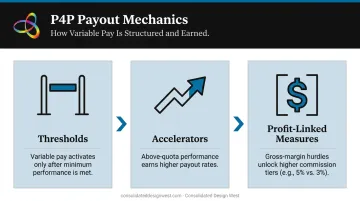
- Thresholds ensure variable pay only activates once minimum performance standards are met
- Accelerators reward above-quota performance at higher payout rates, incentivizing reps to push past the minimum
- Profit-linked measures — such as Alexander Group's example of a 12.5% gross-margin hurdle to unlock a 5% over-quota commission rate (vs. 3% below the hurdle) — ensure reps sell not just more, but better
The built-in cost control is real: when a rep underperforms, variable pay is reduced or withheld automatically. Finance doesn't need to wait for a management decision. The plan handles it.
KPIs most impacted: compensation cost as a percentage of revenue, gross margin per deal, quota attainment rate, return on sales investment.
Growth stages, margin-pressure environments, and rapid headcount scaling are all scenarios where this cost-control mechanism pays off most visibly.
Advantage 2: It Attracts High Performers and Gives Them a Reason to Stay
Top sales talent gravitates toward environments where output is recognized financially. A flat-salary structure offers the same ceiling to every rep — which drives away the ones most confident in their ability to outperform.
A Harvard Business School review found that high performers are specifically better motivated by large goals, overachievement commissions, and uncapped pay. They self-select into P4P environments precisely because they're confident they'll earn more.
Beyond recruitment, P4P improves retention of the right people through a natural filtering mechanism:
- High performers stay because their output is directly rewarded
- Lower performers either improve or self-select out
- Management spends less time addressing chronic underperformance
The turnover cost argument is concrete. DePaul University's sales effectiveness survey reported an average replacement cost of $97,690 per salesperson — accounting for recruiting, lost pipeline, and ramp time. Average time to fill an open field sales role was 5.42 months. An open territory isn't neutral; it's actively losing revenue.
Roles like CDW's 1099 sales position — where reps earn 60% of net profits with no cap — are specifically designed to attract experienced closers who want their income to reflect what they actually produce. The structure itself screens for self-starters who perform without hand-holding.
KPIs most impacted: seller turnover rate, time-to-productivity for new hires, percentage of reps achieving quota.
When attrition is above average or a new vertical demands proven closers fast, the talent-selection signal built into P4P does a lot of the recruiting work automatically.
Advantage 3: It Aligns Individual Effort with Company Revenue Goals
One of the most common breakdowns in sales organizations is the gap between what the company needs — new logos, expansion revenue, specific product mix — and what individual reps prioritize on any given Tuesday. P4P closes this gap by making company objectives the direct driver of personal earnings.
When measures are designed around the outcomes that matter, it becomes financially rational for reps to prioritize exactly what the business needs. Pay mix reinforces this: a 60/40 base-to-variable split creates stronger behavioral alignment than a 90/10 split, because more of the rep's income depends on hitting the right targets.
66% of organizations are increasing P4P emphasis precisely because of this alignment property — it connects compensation spend directly to financial goals and ROI, rather than simply rewarding volume.
When the plan includes measures tied to specific strategic priorities:
- A new product launch → weight new product sales more heavily
- A margin recovery initiative → add a gross-margin hurdle or accelerator
- Expansion revenue focus → include upsell/cross-sell metrics
- Customer retention goals → link up to 20% of bonus payouts to churn-risk thresholds (a McKinsey-cited example)
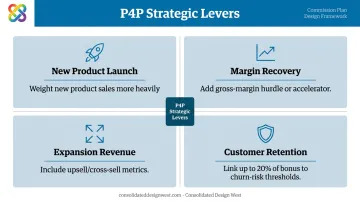
Each of those levers lets leadership redirect rep behavior within a pay period — without a new management initiative or retraining cycle.
KPIs most impacted: quota attainment distribution, revenue from target accounts, cross-sell/upsell rate, net revenue retention.
New product launches and segment shifts are where this advantage compounds fastest: the plan design does the redirecting, and reps follow the money.
What Happens When Pay-for-Performance Is Ignored
When compensation is flat or only weakly variable, the consequences don't arrive all at once. They accumulate.
A rep who consistently exceeds quota earns the same as a rep who barely hits 70%. Over time, the message is clear: performance doesn't pay. Here's what tends to follow:
- Top performers leave for organizations that reward output proportionally
- Recruiting gets harder — competitive talent evaluates comp structure before accepting offers
- Average output becomes the implicit standard, and a mediocrity baseline sets in
- Compensation costs scale with headcount, not revenue, so the cost-to-sales ratio worsens as the team grows
Only 21% of companies rated their 2023 sales compensation plans as very effective, and the Sales Management Association reports that only about one-third of sales organizations consider their compensation programs effective overall. Weak P4P design is the primary driver of that gap.
There's also a financial exposure issue. Without variable mechanics, compensation is a fixed cost that persists even when revenue declines. During downturns — exactly when cost control matters most — companies without P4P structures absorb the full cost of underperformance with no automatic offset.
How to Get the Most Value from Your Pay-for-Performance Plan
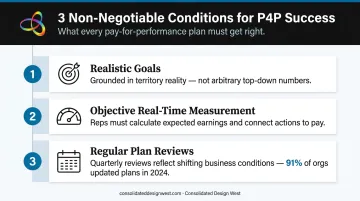
Even a well-designed P4P plan fails without the right conditions in place. Three are non-negotiable:
- Goals must be grounded in territory reality — not arbitrary top-down numbers. In 2023, only 49% of sellers achieved or exceeded full quota. If half your team can't reach the target, the problem is likely the target, not the team.
- Measurement must be objective and visible in real time — not a black box revealed at payout. Reps who can't calculate their expected earnings can't connect daily actions to their paycheck.
- Plans must be reviewed regularly — ideally quarterly. 91% of organizations updated plans in 2024, reflecting how quickly business conditions, team structures, and strategic priorities shift.
Common design pitfalls to avoid:
- Rewarding volume while ignoring margin or retention — reps optimize for what's measured
- Quotas set so high they're perceived as unachievable, which kills motivation entirely
- Plans with too many measures — Alexander Group recommends three or fewer for most roles; complexity breaks the link between daily action and paycheck
Those measurement principles apply directly to complex B2B sales cycles — packaging, manufacturing, supply chain — where each customer relationship carries value well beyond the first transaction. Aligning the P4P plan to that full lifetime value produces better long-term outcomes than rewarding the close alone.
The plan isn't a set-and-forget document. It's a management tool that requires the same ongoing attention as the sales strategy it's designed to support.
Frequently Asked Questions
What is a pay-for-performance model?
A pay-for-performance model is a compensation structure where a portion of pay — typically a commission, bonus, or incentive — is tied directly to achieving specific measurable results.
What is an example of pay-for-performance?
A rep earns a base salary plus a commission percentage on every deal closed, with an accelerated rate once they exceed their quarterly quota. Higher performance means higher earnings, with no ceiling on what strong output can produce.
How do you measure sales team performance in a P4P context?
Key metrics include quota attainment rate, revenue generated versus target, new customer acquisition, average deal size, and expansion or retention revenue. The right metrics depend on what your compensation plan is specifically designed to incentivize.
What is the ideal pay mix in a pay-for-performance sales plan?
Pay mixes typically range from 70/30 (base/variable) for roles with longer cycles or significant non-selling responsibilities, to 50/50 for high-activity new-business roles. A more aggressive variable component signals a stronger P4P orientation. Role influence and sales cycle complexity should drive the decision.
What are the biggest risks of pay-for-performance plans?
The most common risks are plans that reward volume over quality, quotas that are unachievable and demoralize the team, and confusing or unclear payout calculations. All three are addressable through careful plan design, regular review, and clear communication with reps.