
This guide is for both sides of that problem. If you're a job seeker deciding whether B2B sales is the right career, you'll get an honest picture of what the work actually demands. If you're a hiring manager writing a job description, you'll understand what responsibilities, skills, and traits to prioritize — and why the usual checklist falls short.
We'll cover what the role truly involves, the skills that move the needle, what a realistic workday looks like, role types and their differences, and how compensation actually breaks down.
Key Takeaways
- B2B sales means selling to buying groups, not individuals — the average deal involves 13 stakeholders across multiple departments
- Core responsibilities span prospecting, navigating multi-stakeholder deals, presenting solutions, and managing post-sale relationships
- The skills that actually predict success: business acumen, active listening, resilience, and consistent pipeline discipline
- Compensation scales dramatically by role — from ~$55K OTE for SDRs to $255K+ OTE for Enterprise AEs
What Is a B2B Sales Representative?
A B2B sales representative sells products or services on behalf of one business to other businesses, government agencies, or institutions. Per the Bureau of Labor Statistics, wholesale and manufacturing sales reps — the closest occupational category — had a median annual wage of $74,100 as of May 2024, with technical and scientific product specialists earning a median of $100,070.
The real difference between B2B and consumer sales is the decision structure — who's involved, what they care about, and how long it takes to get to yes.
B2B vs. B2C: The Core Difference
| Factor | B2B | B2C |
|---|---|---|
| Decision-makers | Multiple (committees, departments) | Usually one person |
| Buying motivation | ROI, operational outcomes | Emotion, personal preference |
| Sales cycle | Weeks to months | Minutes to days |
| Deal values | Higher, often complex | Typically lower |
| Trust-building | Prolonged, relationship-driven | Often transactional |
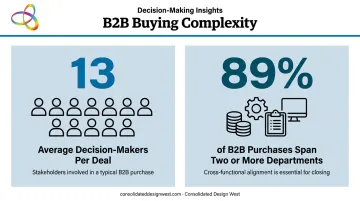
Forrester's 2024 State of Business Buying found that an average of 13 people are involved in a B2B buying decision and 89% of purchases involve two or more departments. That means a B2B sales rep must navigate competing priorities, internal politics, and multiple approval layers — not just persuade a single buyer.
Closing a deal is the end of one cycle, not the job itself. The actual work is building enough trust across enough stakeholders that a complex organization chooses to move forward — and comes back when the next need arises.
Core Responsibilities in a B2B Sales Rep Job Description
Opportunity Creation
Prospecting and pipeline generation consume a significant portion of every B2B rep's week. Cold calls, email sequences, LinkedIn outreach, and referral networking all serve the same goal: reaching the right decision-maker with a relevant reason to engage.
The math here is unforgiving. Gong's analysis of 300M+ cold calls found that average reps connect with just 5.4% of prospects — top-quartile reps reach 13.3%. The average rep needs 19 cold call attempts to land one conversation. Top reps need 8.
That context matters for anyone writing a job description: outbound prospecting is a volume-and-quality game, and realistic expectations should reflect the actual math.
First meetings in B2B aren't product demos. They're executive briefings. A rep who walks in talking about features has already lost credibility. The job in the first meeting is to demonstrate enough industry knowledge to ask intelligent questions, identify real pain points, and earn a second conversation. Research happens before the meeting, not during it.
Opportunity Capture
Navigating the buying committee is where most deals are won or lost. Because 89% of purchases span multiple departments, the rep's job is to identify every relevant stakeholder — end users, procurement, finance, operations — and build enough consensus to move the deal forward.
Ebsta and Pavilion's 2024 B2B benchmark report found that closed-won deals averaged 9 engaged contacts by the solution-presented stage. Lost deals averaged 2. Top performers were also 489% more likely to engage the economic buyer before presenting a solution. Multi-threading is the job — not a bonus tactic reserved for complex accounts.
Presenting, handling objections, and closing should all follow what was uncovered during discovery. An effective B2B rep connects the client's specific challenges to the proposed solution rather than running a generic pitch. Objections get addressed on their merits — not dismissed with discounts. Closing in B2B is a process that builds across multiple conversations, not a single high-pressure moment.
Post-Sale Responsibilities
In many B2B roles, the rep's involvement doesn't end at contract signature. Client onboarding support, expectation alignment, and relationship maintenance often fall to the same person who closed the deal.
In industries like commercial packaging and co-manufacturing — where projects involve production timelines, materials specifications, and logistics coordination — the rep frequently serves as the ongoing bridge between the client and internal teams. In these environments, clear follow-through is what keeps accounts from churning.
Not every B2B role is structured this way, though. CDW's 1099 commission-only sales roles are built around a different model: reps focus exclusively on closing warm, company-supplied leads, while CDW's internal team handles all post-sale order processing and fulfillment. It's a structure designed specifically for experienced closers who want to spend their time closing rather than processing paperwork.
Key Skills and Traits Hiring Managers Actually Look For
Salesforce's 2024 research found that 86% of B2B buyers are more likely to purchase when a company understands their business goals — and 59% say reps don't understand their unique challenges. That gap is where most B2B sales careers either accelerate or stall.
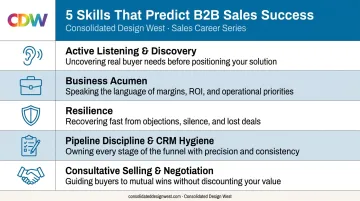
The traits that separate top performers from average reps aren't always obvious on a resume. Here's what hiring managers are actually evaluating:
- Active listening and discovery: The best B2B reps listen more than they talk. They ask precise discovery questions, summarize what they've heard, and build a clear picture of the client's situation before recommending anything — which is distinct from simply being a "good talker."
- Business acumen: A rep who can speak credibly about a client's industry pressures, KPIs, and competitive context will consistently outperform one who leads with product features. This takes deliberate effort to develop, especially across multiple verticals.
- Resilience: Most B2B prospecting generates far more rejection than response. Deals stall without warning, and emails go unanswered for weeks. Reps who treat each setback as data — rather than a verdict on their ability — build more durable careers than those with stronger resumes but thinner skin.
- Pipeline discipline and CRM hygiene: Managing 20+ deals at different stages simultaneously requires real organizational skill. Updating records accurately, prioritizing the right accounts, and tracking follow-ups consistently separates steady performers from one-hit closers. Familiarity with tools like Salesforce or HubSpot is a baseline expectation in most roles.
- Consultative selling and negotiation: Consultative selling means uncovering the client's actual needs and recommending solutions accordingly, not leading with price. Effective negotiation creates terms both sides can commit to without defaulting to discounts. Both skills develop through structured training and deliberate repetition.
A Day in the Life of a B2B Sales Representative
Morning: Prospecting and Pipeline Review
The day typically starts in the CRM. Priority accounts get reviewed, new outreach goes out, and prospecting calls begin while attention is sharp. Account research — recent news, leadership changes, known pain points — happens in this window, not minutes before a meeting.
Midday: Meetings, Discovery, and Demos
A well-run B2B sales meeting looks like a facilitated conversation, not a presentation. Discovery questions drive the agenda. Any demo or proposal that follows is shaped by what the rep learned from asking — not from a template.
The habit that separates reps who advance deals from those who stall them is simple: a follow-up recap email with clear next steps, sent the same day. Over a full pipeline, that one discipline adds up fast.
Afternoon: Follow-Ups and Internal Coordination
The back half of a B2B rep's day typically involves:
- Following up on outstanding proposals
- Coordinating with internal teams (product, logistics, project management) to address client questions
- Updating the CRM with accurate deal status
- Preparing for tomorrow's priority meetings
In complex B2B environments, the rep acts as the translator between what the client needs and what internal subject matter experts can deliver. Job descriptions rarely capture that coordination work — but it drives deal outcomes more than most reps expect.
The Reality
Salesforce's 2024 State of Sales data shows reps spend 70% of their time on non-selling tasks. Deals stall, contacts go dark, and priorities shift mid-week. A B2B rep's planned schedule and their actual day rarely look the same by 3 PM.
That's why self-management, persistence, and the ability to stay composed when deals go sideways aren't soft skills — they're what the job actually runs on.
Types of B2B Sales Rep Roles
"B2B sales representative" is an umbrella term covering several distinct roles with different entry points and responsibilities:
| Role | Core Focus | Typical Structure |
|---|---|---|
| SDR/BDR | Outbound prospecting, meeting booking | Feeds pipeline to AEs |
| Inside Sales Rep | Full-cycle selling, done remotely | Phone, email, video |
| Outside/Field Sales Rep | In-person meetings, territory management | Travel-dependent |
| Account Executive | Full sales cycle, first call to close | Quota-carrying |
| Account Manager | Post-sale retention, upsell, renewal | Existing book of business |
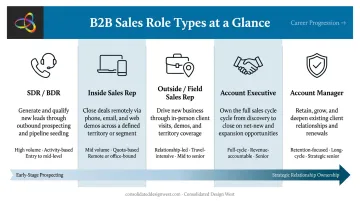
Role structures vary significantly by company size. At Salesforce, for example, AEs are segmented into Small Business, Commercial, and Enterprise tracks — each with different deal complexity and stakeholder dynamics. At a smaller B2B company, one rep may carry responsibilities across all of the above, handling everything from prospecting to close with minimal structural support.
On the opposite end of the spectrum, some companies deliberately remove prospecting from the equation entirely — letting reps focus purely on converting. Consolidated Design West's 1099 sales positions work this way: reps receive company-supplied warm leads and focus entirely on closing, with order processing handled on the back end.
B2B Sales Rep Salary and Career Path
Compensation by Role
B2B sales compensation typically follows a base + commission structure. According to RepVue's Q3 2024 Salary Guide:
| Role | Median Base | Median OTE |
|---|---|---|
| SDR | $55,000 | $83,000 |
| SMB Account Executive | $68,000 | $130,000 |
| Enterprise Account Executive | $130,000 | $255,000 |
| Strategic Account Executive | $145,000 | $280,000 |
SDRs typically run a 70/30 pay mix (base/commission), while AEs often move to 50/50 as commission potential increases. High performers at the AE and enterprise levels can exceed their OTE substantially — top performers routinely blow past target numbers in uncapped structures.
If you're weighing traditional W-2 roles against independent-contractor arrangements, the math looks different. Consolidated Design West's 1099 roles carry no base salary — reps earn 60% of net profits per closed deal with no cap. For strong closers who don't need an income floor, that structure can deliver higher per-deal income than most salaried AE roles.
Career Progression
The typical B2B sales career ladder:
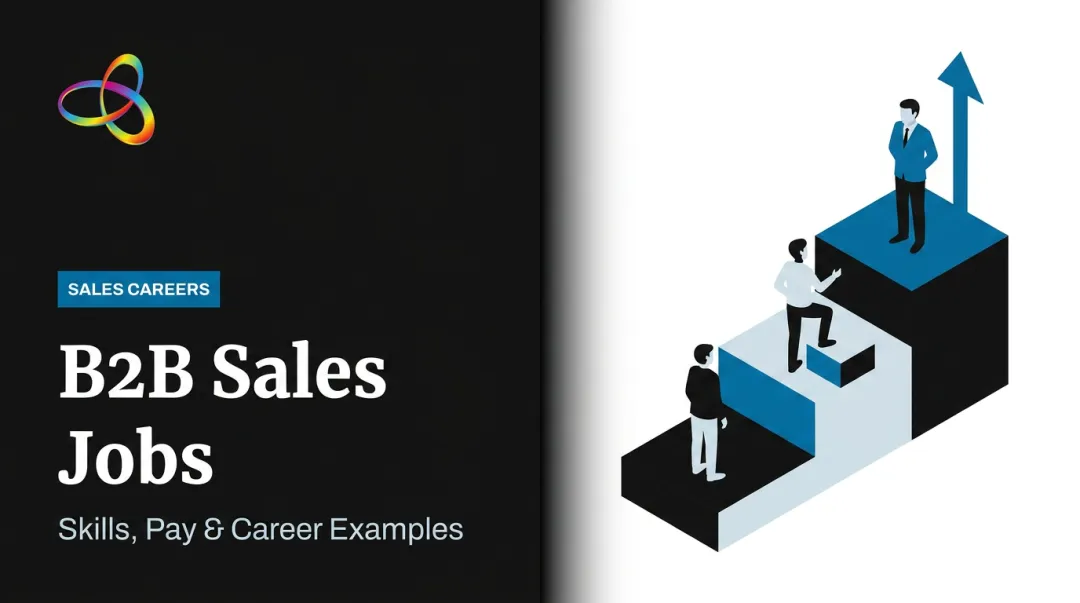
- SDR/BDR — Prospecting and pipeline generation
- Account Executive — Full sales cycle ownership
- Senior AE or Account Manager — Larger accounts, more complexity
- Sales Manager or Director — Team leadership, quota management
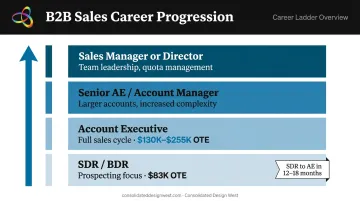
Top-performing SDRs can move into AE roles within 12–18 months at many companies, making B2B sales one of the faster career progression paths out there. That timeline assumes consistent quota attainment and active skill-building — tenure alone won't get you there.
Frequently Asked Questions
What is B2B sales salary?
Entry-level B2B sales reps (SDRs) typically earn $55K–$83K OTE, while experienced Account Executives range from $130K–$255K OTE depending on market segment. Compensation is almost always base + commission, with the commission percentage increasing as you move up the role ladder.
Is B2B sales cold calling?
Cold calling is one tool in the prospecting toolkit, not the whole job. Modern B2B sales combines phone outreach, email sequences, LinkedIn engagement, and referral-based prospecting. Phone outreach remains effective — 69% of buyers accepted calls from new providers in a recent RAIN Group study — but works best as part of a coordinated multi-channel approach.
What is a B2B sales job description?
A B2B sales job description covers prospecting for new business, managing relationships across multiple stakeholders, presenting solutions, negotiating contracts, and hitting revenue targets — all within a business-to-business context. The best ones reflect the day-to-day reality of the role honestly, not just the desired outcomes.
What is a B2B job description for a resume?
Frame your résumé around measurable outcomes and actions: "generated X meetings per month," "managed pipeline of Y accounts," "closed deals averaging $Z." Highlight consultative selling experience, CRM proficiency, and relevant industry knowledge. Avoid vague descriptors — show the numbers.
What are the 4 types of B2B?
The four main B2B buyer categories are producers (buy to manufacture other goods), resellers (buy to resell), governments, and institutions. Sales strategies differ meaningfully across these segments — what works with a CPG brand won't necessarily translate to a government procurement process.
What is the 95-5 rule for B2B?
The LinkedIn B2B Institute, drawing on Ehrenberg-Bass Institute research, established that roughly 95% of potential B2B buyers are not actively in-market at any given time — only 5% are ready to buy now. Effective B2B sales means building brand familiarity with the 95% so your company is the first call when they enter that buying window.