Introduction
Many brands shipping internationally with USPS First Class Package International Service (FCPIS) discover too late that packaging is the critical variable. Wrong dimensions, excess weight, or poor structure can disqualify a shipment before it ever leaves the counter. A 2024 USPS compliance audit found that dimensional violations account for approximately 23% of rejected FCPIS shipments, with most traced back to packaging decisions made months earlier during product development.
The financial hit compounds fast: rejected shipments require upgrades to Priority Mail International, increasing costs by 40–60% per package.
This guide covers how to design custom packaging that meets every FCPIS requirement: dimensional rules, material choices, customs label placement, and weight optimization, so your international shipments clear the counter on the first attempt.
Key Takeaways
- FCPIS ships packages under 4 lbs to 180+ countries, but only if packaging meets strict dimensional limits (L+H+T ≤ 36 inches)
- Dimensional weight determines your rate, meaning packaging design directly impacts shipping cost—not just what's inside
- Custom boxes and mailers must use plain or branded materials; USPS Priority Mail packaging is prohibited
- Reserve exterior space for customs forms (CN22 or CN23); leaving this area clear is required for every shipment
- Check destination-specific prohibited items before packing—restrictions vary by country and override all other requirements
What FCPIS Requires from Your Custom Packaging
USPS First Class Package International Service is the most affordable option for small, lightweight international parcels, but it runs on tighter packaging constraints than domestic services. Knowing these limits before finalizing your packaging design prevents rejections and costly service upgrades.
Service Eligibility Basics
FCPIS enforces a strict 4 lb (64 oz) maximum weight and $400 maximum declared value. Exceeding either threshold forces an upgrade to Priority Mail International. The dimensional rule is equally rigid: non-roll packages must have a minimum 6" × 4" face, a maximum 24" length, and a combined length + height + thickness not exceeding 36 inches.
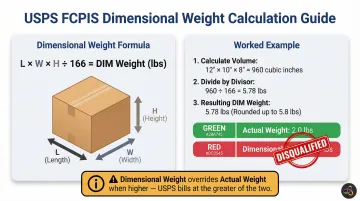
Since January 2021, USPS calculates FCPIS rates using dimensional weight (L × W × H ÷ 166). A light but bulky box can be rated at a higher weight class than its actual weight suggests. For example, a 12" × 10" × 8" box weighing 2 lbs carries a dimensional weight of approximately 5.8 lbs, which disqualifies it from FCPIS even though the actual weight falls well under the 4 lb cap.
Key distinctions:
- FCPIS vs. domestic First Class Package Service: Domestic First Class (now part of USPS Ground Advantage) handles parcels up to 15.999 oz domestically; FCPIS serves international destinations up to 4 lbs
- FCPIS vs. Priority Mail International: Priority Mail International accommodates packages up to 70 lbs and higher declared values, but costs 40-60% more per shipment
Prohibited Items and Country-Specific Rules
Certain product categories cannot ship via FCPIS regardless of packaging quality. USPS universally prohibits perfumes, nail polish, aerosols, and perishables from international mail. Lithium batteries are conditionally restricted — allowed only when properly installed in the equipment they operate, with a maximum of 4 cells or 2 batteries per package.
Beyond universal prohibitions, each destination country maintains its own restricted items list. Always verify against the USPS Individual Country Listings before finalizing product catalogs for international shipping. A shipment rejected for prohibited contents faces return or seizure, delaying delivery by weeks and often requiring customers to reorder entirely.
Packaging Format Eligibility
Eligible formats:
- Plain or custom-branded boxes, cartons, and tubes
- Padded envelopes and poly mailers
- Rigid setup boxes and folding cartons
Prohibited formats:
- USPS-branded Priority Mail or Express Mail packaging (using these for FCPIS is a compliance violation unless you pay the higher Priority Mail rate)
- Reused packaging with previous labels or markings still visible (all prior labels must be completely removed or completely covered)
How to Design Custom Packaging for USPS First Class Package International Service
Each design step must be completed in sequence—earlier decisions (product dimensions, format selection) constrain later ones (branding, label placement).
Step 1: Profile Your Product's Dimensional and Weight Footprint
Measure the product in its final ready-to-ship state, including any inner packaging, tissue wrap, or inserts. Record length, width, height, and weight. This baseline is the non-negotiable input for all subsequent design decisions.
Calculate combined length + girth before any structural design begins:
- Girth = 2 × (width + height)
- Combined L+G = length + 2 × (width + height)
- Check this figure against the 36-inch FCPIS ceiling
Example: A product measuring 10" × 6" × 4" yields a combined L+G of 10 + 2(6+4) = 30 inches—comfortably within the limit.
Step 2: Select the Right Custom Packaging Format
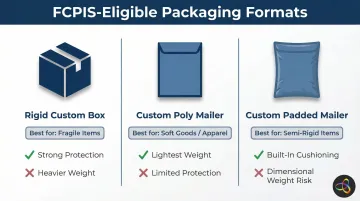
Three main format options:
Rigid custom boxes:
- Best for fragile products (cosmetics, electronics accessories)
- Provide strong structural protection with minimal void fill
- Require careful sizing to stay under the 36-inch dimensional cap
- Heavier than mailers, consuming more of the 4 lb weight allowance
Custom poly mailers:
- Lightweight and collapsible for efficient storage
- Ideal for soft goods (apparel, textiles)
- Minimal dimensional weight penalty due to flexibility
- Limited protection for fragile items
Custom padded mailers:
- Balance protection and weight efficiency
- Suitable for semi-rigid products (books, small electronics)
- Built-in cushioning reduces need for additional void fill
- Dimensional weight can exceed actual weight if oversized
Step 3: Engineer the Structure for Dimensional Compliance and Weight Minimization
Material selection directly impacts both protection and weight budget. Corrugated cardboard offers better crush resistance but adds weight; chipboard and kraft paperboard are lighter but provide less structural integrity. For products filling most of the 4 lb allowance, every gram of packaging material matters.
Calculate dimensional weight for proposed designs:
- Dimensional weight = (L × W × H) ÷ 166
- If dimensional weight exceeds actual weight, USPS uses the higher figure for rating
- Trim excess void space to reduce both dimensional and actual weight
Example: A 14" × 10" × 6" box has a dimensional weight of (14 × 10 × 6) ÷ 166 = 5.06 lbs—exceeding the FCPIS limit even if the package weighs only 3 lbs. Reducing the box to 12" × 9" × 5" yields a dimensional weight of (12 × 9 × 5) ÷ 166 = 3.25 lbs, bringing it back into compliance.
Getting these calculations right during the design phase—before tooling is cut—is where a structural packaging partner adds real value. Consolidated Design West has spent over 34 years translating shipping specifications like FCPIS into production-ready structural designs, helping brands from startups to established names avoid costly redesigns after tooling is committed.
Step 4: Integrate Custom Branding Without Exceeding the Weight Budget
Print choices affect weight measurably. Heavy ink coverage on thick coated stocks adds grams; a 1-color flexo print on kraft paperboard weighs significantly less than full-color offset on coated white board. For FCPIS shipments, this delta can determine eligibility.
Lightweight branding alternatives:
- Printed tissue paper (1-2 grams vs. 20-30 grams for a printed booklet)
- Lightweight inserts or hang tags
- Digital download cards instead of printed instruction manuals
- QR codes linking to unboxing videos or product guides
These elements maintain an engaging unboxing experience without pushing the package over the 4 lb threshold.
Step 5: Designate Space for Customs Documentation on the Exterior
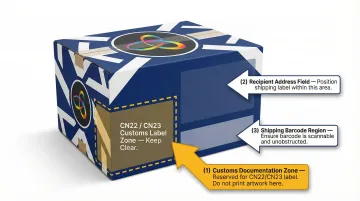
Every FCPIS shipment requires a CN22 (for declared values under $400) or CN23 affixed to the front exterior. Custom packaging designs must include a clear, unprinted or lightly printed zone—typically the lower-left front face—large enough to accommodate the customs label without covering barcodes or address fields.
For branded packaging, incorporate this documentation zone into the dieline artwork stage so it becomes a deliberate design element, not an afterthought that forces labels over branded artwork and causes scanning failures or customs delays.
Key Packaging Design Variables That Affect FCPIS Eligibility and Shipping Rates
Small packaging decisions compound quickly under FCPIS constraints. These four variables most often determine whether a shipment stays eligible — and whether it stays affordable.
Dimensional Weight vs. Actual Weight
Since January 2021, USPS rates FCPIS by dimensional weight (L × W × H ÷ 166). A large, lightweight box may be rated at a higher weight class than its actual weight suggests, directly increasing shipping cost. Minimizing internal void space and right-sizing the box to the product reduces dimensional weight and keeps the shipment in the lowest possible rate tier.
Box Wall Thickness and Material Grade
Single-wall corrugated boxes add more weight than chipboard or rigid setup boxes. Material grade selection must balance structural protection against the weight budget — particularly for products already near the 4 lb limit. An over-engineered box for a lightweight product wastes weight allowance that could go toward product quantity or inner padding instead.
Inner Packaging and Void Fill
Void fill materials all add weight:
- Tissue paper: 1-3 grams per sheet (most weight-efficient)
- Air pillows: 2-5 grams per pillow
- Crinkle paper: 15-25 grams per cubic foot (among the heaviest options)
- Kraft paper: 10-20 grams per sheet
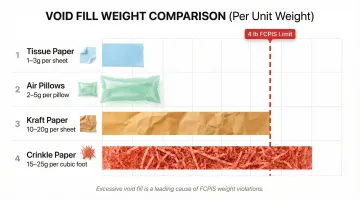
Excessive or poorly chosen void fill is a common reason lightweight products exceed the 4 lb FCPIS threshold.
Insert and Collateral Weight
Product inserts, instruction booklets, promotional cards, and thank-you notes all add to total shipment weight. Audit every enclosed item and consider digital alternatives — QR codes, digital booklets, or download links — for weight savings. Removing inserts entirely can hurt the unboxing experience, so the better approach is keeping only what earns its weight.
Common Custom Packaging Mistakes That Disqualify FCPIS Shipments
Over-Sizing the Package Relative to the Product
Ordering standard stock box sizes rather than right-sized custom boxes is the most common error. A box with significant void space inflates dimensional weight, pushing the shipment above FCPIS rate tiers or requiring reclassification. Custom-sized packaging eliminates this problem by matching the box footprint precisely to the product dimensions.
Omitting the Customs Label Zone from the Packaging Design
Brands that print full-bleed artwork across all exterior faces leave no room for the CN22/CN23. Shippers end up placing labels over branded artwork or barcodes, causing scanning failures and customs delays. Design the customs label zone directly into the dieline before print production.
Using Prohibited Packaging Materials or Heavy Embellishments
Foil stamping, embossing dies, thick laminations, and ribbon pulls all add weight that accumulates quickly on small packages. Packaging with built-in magnets or metal hardware may trigger customs scrutiny or prohibited-item flags in certain destination countries.
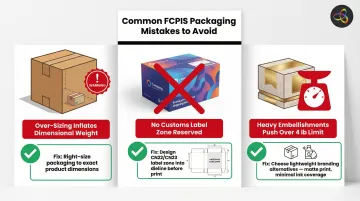
Catching these errors at the design stage — before production runs — keeps your shipments compliant and your customers' deliveries on time.
When to Upgrade Your Packaging Strategy Beyond FCPIS
FCPIS is not the right service for every international shipment. Certain product types or business scenarios require packaging designed for a higher service tier.
Triggers for upgrading to Priority Mail International or express carrier services:
- Shipments over 4 lbs
- Products with declared value over $400
- Time-sensitive orders where buyers expect 6-10 day delivery
- Fragile or high-value items that benefit from built-in Priority Mail insurance (up to $200 coverage)
- Destinations where FCPIS tracking coverage is limited (outside the approximately 66 countries with E-USPS DELCON INTL)
Once you move to a higher service tier, your packaging specs change too. Priority Mail International flat-rate boxes have fixed dimensions, while express carriers apply their own weight-to-size ratio rules. Packaging that worked for a lightweight FCPIS shipment may need structural reinforcement, adjusted fill materials, or a complete resize to meet those requirements without incurring dimensional weight surcharges.
Frequently Asked Questions
How long does USPS First-Class Package International Service take?
Delivery varies by destination. Canada typically receives shipments in 7-10 business days, Western Europe in 10-14 days, and East Asia/Oceania in 14-21 days. Customs processing and local carrier hand-offs are the main sources of variation.
Does USPS First-Class Package International Service go through customs?
Yes, all FCPIS shipments pass through the destination country's customs. You must affix a correctly completed CN22 or CN23 customs declaration to the package exterior on every shipment.
What is USPS First-Class Package International Service coverage?
FCPIS ships to 180+ countries. Full end-to-end tracking is available in approximately 66 major countries, including Canada, the UK, Australia, and most of Western Europe. Other destinations may receive limited scan updates.
What is the weight limit for USPS First Class Package International?
The maximum weight is 4 lbs (64 oz). Since 2021, USPS rates FCPIS by dimensional weight, so packaging design affects both eligibility and cost—not just the product's actual weight.
Can I use custom branded packaging for USPS First Class Package International?
Yes, custom-branded boxes, mailers, and padded envelopes are permitted and encouraged, provided they are not USPS Priority Mail or Express Mail branded packaging. Ensure the design includes a clear customs label zone on the exterior.
What items cannot be shipped via USPS First Class Package International?
Prohibited categories include perfumes, nail polish, aerosols, lithium batteries (unless installed in equipment), live plants, and perishables. Check the USPS Individual Country Listings for country-level restrictions before shipping.