
Introduction
The beverage industry faces unprecedented pressure to adopt sustainable packaging. The global sustainable packaging market reached $272.93 billion in 2023 and is projected to grow to $448.53 billion by 2030 at a 7.6% CAGR, driven by consumer demand and regulatory mandates. Brands that delay this transition face tangible commercial consequences: Walmart now enforces $200 admin fees plus $1 per affected unit for packaging non-compliance, while Kroger imposes fines starting at $2,000 to $3,000 per SKU for print quality violations.
Choosing the wrong packaging partner compounds that risk. This guide breaks down the top sustainable packaging manufacturers for beverage brands — covering material capabilities, certifications, and what to look for before signing a contract.
Key Takeaways
- Sustainable beverage packaging spans recyclability, recycled content, compostability, and reusable formats—each with distinct performance and regulatory requirements
- Leading manufacturers cover aluminum, paper-based, flexible, rigid, and end-to-end formats with strengths that vary by format and brand scale
- Prioritize third-party certifications, material breadth, MOQ flexibility, and scalability when evaluating partners
- Startups need turnkey partners combining custom design, co-manufacturing, and finished goods delivery in one place
What Is Sustainable Beverage Packaging?
Sustainable beverage packaging reduces environmental impact through one or more of four pathways: recyclability, recycled content, compostable materials, or reusable formats. No single format works for every brand — the right choice depends on beverage type, distribution model, and where your end consumers actually dispose of packaging.
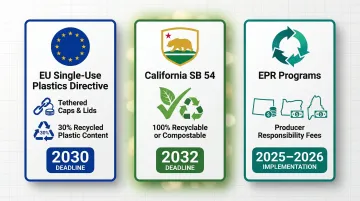
The beverage sector faces mounting pressure from single-use plastics legislation, Extended Producer Responsibility (EPR) frameworks, and retailer sustainability mandates. Key regulations already affecting sourcing decisions include:
- EU Single-Use Plastics Directive: Requires tethered caps on containers up to 3 liters and 30% recycled plastic in beverage bottles by 2030
- California SB 54: Mandates 100% recyclable or compostable single-use packaging by 2032
- Colorado, Oregon, and Maine EPR programs: Producer fees activated starting in 2025–2026
For brands pursuing national distribution, this means third-party certifications and verified recycled content aren't optional — they're increasingly a baseline requirement for retail shelf eligibility.
Top Sustainable Packaging Manufacturers for Beverage Brands
These five manufacturers were selected based on verified sustainability credentials, beverage-specific product range, scale of operations, and suitability across brand sizes—from startups to global labels.
Ball Corporation
Ball Corporation is a US-based global manufacturer of aluminum packaging with over a century of operations. Its beverage portfolio covers standard and specialty aluminum cans across carbonated drinks, energy beverages, beer, hard seltzers, and water. Ball achieved a 74% global average recycled content in 2025, with 72% in North America. The company operates 65 plants globally, including a new 2025 facility in Winter Haven, Florida.
Ball's sustainability edge lies in aluminum's infinite recyclability. The company's STARcan lightweighting technology reached 56% of total can production in 2025, saving 4,078 metric tons of aluminum. Ball holds SBTi-validated climate targets and sources 34% of its aluminum from ASI-certified suppliers, making it a reliable partner for high-volume US beverage brands with strong recyclability stories.
| Sustainability Credentials | Key Beverage Formats | Best Fit For |
|---|---|---|
| 74% recycled content (2025); 34% ASI-certified aluminum; SBTi-validated climate targets | Standard and specialty aluminum cans, aluminum cups; suitable for carbonated, still, and alcoholic beverages | High-volume beverage brands requiring consistent, scalable aluminum supply with strong recyclability story |
Amcor
Amcor is a Swiss-headquartered global packaging leader with extensive US operations. It produces both flexible and rigid packaging formats for the beverage sector, including lightweight PET bottles, pouches, and carton-based solutions.
Amcor committed to making all its packaging recyclable or reusable by 2025. As of 2024, 95% of rigid packaging by weight is recyclable in practice and at scale, and 94% of flexible packaging has a recycle-ready solution available.
Amcor's breadth is a key differentiator—it serves brands that need flexible format switching as product lines evolve. Its sustainability credentials include published life-cycle data, partnerships with major global beverage brands, and investment in mono-material designs (single-material formats that are easier to recycle). The company launched the AmFiniti portfolio in 2023-2024, delivering mechanically and chemically recycled PCR material options, including a one-liter PET bottle for carbonated soft drinks made from 100% PCR resins.
| Sustainability Credentials | Key Beverage Formats | Best Fit For |
|---|---|---|
| 95% rigid packaging recyclable; 94% flexible packaging recycle-ready; ISCC PLUS certified for mass-balance recycled content; Carbon Trust certified LCA tool | Flexible pouches, rigid PET bottles, carton-based formats; suitable for juices, still beverages, and ready-to-drink products | Mid-to-large brands seeking multi-format sustainable options with global supply continuity |
Ardagh Metal Packaging
Ardagh Metal Packaging is a global producer of recyclable aluminum and steel cans, operating 23 metal beverage can production facilities in 9 countries, including 11 in the Americas. Its beverage-focused product range covers standard sizes and specialty formats for craft beer, cider, hard seltzer, and single-serve beverages. Ardagh achieved a 78% average recycled content for its beverage cans in 2024—the highest among major aluminum manufacturers.
Ardagh's 100% recyclable metal cans and commitment to sustainable innovation—including new can size introductions to meet single-serve demand—make it a strong choice for brands competing in premium and craft beverage segments. The company launched the Standardised Beverage Can Recycled Content (BCRC) methodology, providing transparent recycled content reporting. All production facilities hold ISO 14001 certification, and Ardagh is ASI-certified.
| Sustainability Credentials | Key Beverage Formats | Best Fit For |
|---|---|---|
| 78% recycled content (2024); ASI certified; ISO 14001 certified at all facilities; BCRC methodology for transparent reporting | Aluminum and steel cans in standard and specialty sizes (including single-serve formats); suitable for beer, cider, seltzer, and carbonated beverages | Craft and premium beverage brands seeking sustainable metal packaging with specialty size options |

Graphic Packaging International
Graphic Packaging International is a US-based paper-based packaging specialist headquartered in Atlanta, Georgia, with over 100 years of manufacturing experience serving major global consumer brands. For beverage brands, its product range includes paperboard cartons, beverage carriers, multipacks, and plastic-replacement innovations. The company holds FSC Chain of Custody Certification and sources 89% of purchased forest products sustainably as of year-end 2024.
Graphic Packaging has positioned itself as a leader in transitioning beverage brands away from single-use plastic through fiber-based alternatives. Its KeelClip paperboard multipack carrier replaces plastic shrink wrap on multipacks—Liberty Coca-Cola Beverages adopted KeelClip to remove 75,000 pounds of plastic packaging annually across 3.1 million cases. In 2024, 34% of GPI's production consisted of recycled paperboard products. Suitable for brands with retail distribution needing both sustainability and strong shelf presence.
| Sustainability Credentials | Key Beverage Formats | Best Fit For |
|---|---|---|
| FSC Chain of Custody Certification; 89% sustainably sourced forest products; 34% recycled paperboard production (2024) | Paperboard cartons, fiber-based multipacks, beverage carriers, and plastic-replacement secondary packaging | Retail beverage brands transitioning away from plastic multipacks who need scalable fiber-based solutions |
Consolidated Design West
Consolidated Design West (CDW) is an Anaheim, California-based packaging solutions provider with over 34 years of experience serving beverage brands across the US—from early-stage startups to established labels. Unlike the material-focused manufacturers above, CDW offers end-to-end primary and secondary packaging solutions, including commercial printing, custom design, and co-manufacturing through its partnership with Respect Manufacturing.
CDW's turnkey model suits beverage brands that need a single partner managing sustainable packaging from concept through finished goods. Its US-wide project management team handles fulfillment, logistics, and warehousing—removing the coordination burden of juggling multiple vendors.
For sustainable packaging specifically, CDW helps brands identify and source eco-compliant formats matched to their beverage type, retail requirements, and budget. Options include:
- Eco-friendly secondary packaging for retail and e-commerce
- Glass packaging for premium and craft beverage lines
- Recyclable metal options (aluminum and steel cans)
- Custom primary packaging with sustainable material sourcing
| Sustainability Credentials | Key Beverage Formats | Best Fit For |
|---|---|---|
| 34+ years of packaging expertise; turnkey sourcing of eco-compliant formats; Respect Manufacturing partnership for co-manufacturing from formulation to finished goods; US-wide project management team | Custom primary and secondary packaging, commercial printing, co-manufacturing, fulfillment, and logistics—covering bottles, cartons, labels, and multi-component packaging solutions | Startups and growing beverage brands that need an end-to-end packaging partner—from sustainable packaging design to finished goods delivery—without managing multiple vendors |
What to Look for in a Sustainable Beverage Packaging Partner
Evaluate partners using three critical filters:
1. Verifiable Sustainability Credentials
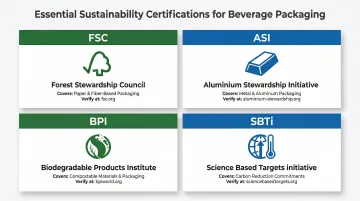
Third-party certifications matter more than self-reported claims. Look for:
- FSC for paper/fiber—verified via FSC's certification database
- ASI for aluminum—verified via ASI's Certifications Map
- BPI for compostables—verified via BPI's Online Product Catalog
- SBTi for climate targets—verified via SBTi Target Dashboard
2. Format Compatibility
The packaging must meet the performance requirements of the beverage—carbonation barrier, shelf life, fill line compatibility. Aluminum and glass remain the strongest options for carbonated beverages due to their gas barrier properties. Paper-based and flexible formats are not suitable for highly carbonated products without a specialized inner liner.
3. Scalability
The manufacturer must support your current volume and scale with you as you grow. Before committing, verify:
- Minimum order quantities and whether pilot runs are available
- Lead times at both small and high-volume tiers
- Whether the partner can manage packaging transitions (e.g., plastic to fiber)
Watch out for greenwashing: "Sustainable" is a marketing claim until proven otherwise. A package labeled compostable only delivers environmental benefit if commercial composting infrastructure exists in your distribution region.
Before committing to any format, request third-party certification documentation, published life-cycle assessment data, and supplier audit reports.
Cost Consideration: Sustainable packaging can carry a unit-cost premium, but lighter materials reduce freight costs, and co-packing or turnkey partners can offset operational overhead. Calculate total cost of packaging—design, production, logistics, compliance, and disposal—rather than unit price alone.
How We Selected These Manufacturers
Each manufacturer was evaluated on four factors:
- Sustainability credentials — certifications, material sourcing, and environmental commitments
- Beverage-specific product range — bottles, cans, pouches, and formats relevant to beverage applications
- Scale flexibility — ability to serve emerging brands, not just enterprise accounts
- US market relevance — US-based operations or strong supply chain presence for US brands
Rankings reflect practical fit for beverage brands, not company size or revenue.
A common mistake is choosing a manufacturer based on name recognition alone, while overlooking lead time reliability, minimum order requirements, and the partner's ability to support a packaging transition. Start with your beverage format and distribution model, then evaluate on capability and fit.

Conclusion
The right sustainable packaging manufacturer depends on your beverage format, volume stage, retail environment, and sustainability goals. The five manufacturers featured here represent distinct strengths across aluminum, paper-based, flexible, rigid, and end-to-end solutions.
Start with your performance requirements first—carbonation barrier, shelf life, fill compatibility—then layer in sustainability criteria, and finally assess the manufacturer's ability to scale alongside your business.
For beverage brands that want to avoid coordinating across multiple suppliers, Consolidated Design West covers the full scope—sustainable material selection, custom design, co-manufacturing, and logistics managed through a single point of contact.
With over 34 years of experience serving brands from startup to shelf, CDW brings the operational depth to support your packaging decisions at every growth stage.
Frequently Asked Questions
What makes packaging truly "sustainable" for beverage brands?
Sustainable packaging for beverages must meet one or more criteria: recyclability with accessible infrastructure, recycled content, compostability in commercial facilities, or reusability. Third-party certifications — FSC, ASI, BPI — give you the most reliable way to verify those claims.
Which sustainable packaging material works best for carbonated beverages?
Aluminum cans and glass remain the strongest options for carbonated beverages due to their gas barrier properties. Paper-based and flexible formats can't hold carbonation without a barrier liner — typically a thin aluminum or polyethylene layer — making them impractical for most sparkling beverages.
Are sustainable packaging options always more expensive than conventional packaging?
Unit costs can be higher, but lighter materials reduce freight costs and breakage. Turnkey partnerships can also lower overall production overhead. Brands should evaluate total cost of packaging rather than per-unit price alone.
What certifications should beverage brands look for in a sustainable packaging manufacturer?
The most credible certifications are FSC for paper/fiber, ASI for aluminum, BPI or TÜV for compostables, and science-based climate targets (SBTi) for overall carbon reduction commitments.
Can startup beverage brands access sustainable custom packaging?
Yes, several manufacturers and end-to-end packaging partners support low minimum orders and pilot runs. Startups benefit most from turnkey partners who can manage design, sourcing, co-manufacturing, and logistics without requiring enterprise-level volumes.
How do I verify a manufacturer's sustainability claims beyond their marketing materials?
Request third-party certification documentation, published life-cycle assessment data, and supplier audit reports. If a manufacturer can't produce independent documentation on request, assume the claims haven't been validated.