Introduction
Only 9% of plastic waste is ultimately recycled globally, yet brands across food, beauty, electronics, and e-commerce face mounting pressure from regulators and consumers to eliminate single-use plastics. The UK Plastic Packaging Tax now hits £228.82 per tonne for packaging containing less than 30% recycled content, while seven US states have enacted Extended Producer Responsibility (EPR) laws requiring producers to fund end-of-life management. Meanwhile, consumers across 11 countries believe brand owners should be held responsible for packaging sustainability, with recyclability viewed as the most critical trait.
That pressure is now translating into real commercial traction. This list is for brand owners, procurement leads, and packaging decision-makers who need to track startups that have moved beyond concept stage into active production and enterprise supply chains.
The 37 companies profiled here have secured significant funding and earned partnerships with brands that depend on their materials at scale—not pilot programs, but deployed solutions.
Key Takeaways
- Six technology categories define the 2026 landscape: biomaterials, paper alternatives, barrier coatings, circular systems, AI waste sorting, and carbon-capture polymers
- The 37 startups listed were selected based on funding traction, commercial deployments, and enterprise partnerships—not early-stage potential alone
- EU PPWR and US EPR laws are the primary regulatory drivers accelerating startup adoption
- Each category includes one featured startup with detailed profile plus additional companies worth watching
- Prioritize supply chain compatibility and total lifecycle cost over new materials alone
Why Sustainable Packaging Startups Are Booming in 2026
The global sustainable packaging market reached $272.93 billion in 2023 and is projected to hit $448.53 billion by 2030, growing at 7.6% annually. That growth is being driven by two forces hitting simultaneously: tightening regulations and consumer pressure — while traditional recycling infrastructure struggles to keep pace.
Regulatory Drivers Creating Urgent Demand
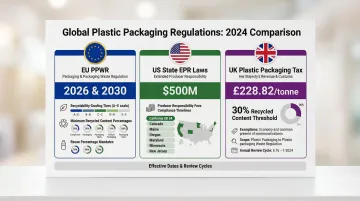
The EU Packaging and Packaging Waste Regulation (PPWR) entered force in February 2025 and applies from August 2026. By January 2030, it requires:
- All packaging recyclable within performance grades A, B, or C (grade C = ≥70% recyclability by weight)
- Minimum recycled content of 30% for contact-sensitive PET, 35% for other plastics
- Transport packaging at least 40% reusable by 2030, rising to 70% by 2040
In the US, seven states have enacted comprehensive EPR packaging laws—Maine, Oregon, Colorado, California, Minnesota, Maryland, and Washington. California's SB 54 requires a 25% reduction in single-use plastic by 2032 and mandates producers pay $500 million annually starting in 2027. Colorado producers must participate in the Circular Action Alliance and pay annual dues beginning January 2026.
Across the Atlantic, the UK Plastic Packaging Tax rises to £228.82 per tonne effective April 2026 for any packaging containing less than 30% recycled content — making non-compliant materials significantly more expensive to use.
Consumer Preference Driving Commercial Opportunity
McKinsey's 2025 survey across 11 countries found consumers believe brand owners and packaging producers should be held responsible for sustainability, with recyclability viewed as the most critical sustainability trait globally. That pressure is shaping purchasing behavior — particularly in beauty, food, and e-commerce, where packaging is the first thing consumers see and judge. Brands in these categories are actively sourcing sustainable alternatives to stay competitive, not just compliant.
37 Best Sustainable Packaging Startups to Watch in 2026
The following startups are organized into six innovation-driven categories to simplify comparison. Each featured startup profile includes founding year, headquarters, funding to date, and key corporate partnerships or named enterprise clients where available.
Biomaterials & Seaweed-Based Packaging
Biomaterials packaging covers seaweed bioplastics, mycelium composites, algae-derived coatings, and corn-husk or lignin-cellulose alternatives. The key advantage: these materials can biodegrade at home without industrial composting infrastructure, unlike most conventional biodegradable plastics.
Featured: Notpla
Notpla (founded 2014, London, UK) produces seaweed-and-plant-based packaging whose food containers, paper products, and consumer goods packaging offer the same grease and water resistance as traditional plastic but biodegrade naturally. The company secured £20 million ($25+ million) in Series A+ funding in September 2024, led by UB Forest Industry Green Growth Fund, to fund North American expansion.
Notpla's differentiators include no need for industrial composting infrastructure, proven use cases in takeaway food and luxury goods packaging, and partnerships with Just Eat to provide seaweed-coated takeaway boxes at major events including the UEFA Women's EURO 2022 Final.
| Category | Details |
|---|---|
| Founded / HQ | 2014 / London, UK |
| Funding to Date | £20M+ (~$25M+) |
| Key Partnerships / Clients | Just Eat, UEFA, major FMCG brands |

Additional Biomaterials Startups
Kelpi (founded 2020, Bristol, UK) creates marine-safe, home-compostable seaweed bioplastic packaging replacing multi-layer plastic in beauty and food tray applications. The company raised £4.35M ($5.5M) in May 2024 and holds R&D contracts with L'Oréal, Diageo, and Waitrose.
Ecovative (founded 2007, New York, US) uses AirMycelium™ technology bonding agricultural waste with mushroom roots to create compostable packaging for electronics and fashion. The company raised $14M+ in private equity and serves Dell and Steelcase.
growPack (founded 2019, Buenos Aires, Argentina) produces compostable packaging from lignin and cellulose extracted from corn husks, with a 12-week compost window. The startup raised $600K total including a $280K round in September 2024, with Ambev as a client.
Bloom Biorenewables (founded 2019, Marly, Switzerland) converts plant biomass into materials using Aldehyde-Assisted Fractionation (AAF). The company raised CHF 13M ($15M) in Series A funding in April 2025, with Amcor Ventures participating.
Sway (founded 2020, California, US) produces compostable seaweed-based alternatives to thin-film plastic. The startup raised $2.5M in 2021 and serves Graf Lantz and Alex Gray.
Paper, Pulp & Wood-Fiber Alternatives
Paper and fiber-based packaging is surging as a primary plastic replacement because it uses existing recycling infrastructure, can be manufactured on existing paper-production equipment, and offers a clear end-of-life story for brands making recyclability claims under EPR regulations.
Featured: PulPac
PulPac (founded 2018, Sweden) developed dry molded fiber technology converting paper or pulp fibers into plastic-free products—coffee cup lids, cutlery, food trays—using significantly less water and producing fewer emissions than conventional plastic manufacturing. Stora Enso opened a commercial Dry Molded Fiber production unit in Skene, Sweden, with production beginning in Q4 2024.
PulPac's differentiator is its licensing model: technology is licensed to manufacturers globally rather than sold as a product, giving it a scalable go-to-market approach. The company closed a €31 million private placement in 2022 led by Aliaxis, followed by Stora Enso, Amcor Ventures, and Teseo Capital.
| Category | Details |
|---|---|
| Founded / HQ | 2018 / Gothenburg, Sweden |
| Funding to Date | €31M+ (~$32M+) |
| Key Investors / Partners | Stora Enso, Amcor Ventures, Aliaxis |

Additional Paper & Pulp Startups
Paptic (founded 2015, Espoo, Finland) produces wood-fiber packaging material that outperforms paper in strength and is recyclable via paper/cardboard streams. The company closed €27.5M growth financing in 2023 and is backed by Ecolab and Itochu.
Tanbark (founded 2021, Maine, US) produces Type 3 Molded Fiber packaging using closed-loop water systems. The startup raised $1.7M in pre-seed funding in 2022.
Frugalpac (founded 2011, Ipswich, UK) creates the Frugal Bottle made from 94% recycled paper. The company launched a £5M investment round in August 2025.
Paboco (founded 2010, Denmark) develops paper bottle technology initiated by EcoXpac, with Carlsberg Group as a key partner.
Barrier Coating & Recyclability Technology
Multi-layer plastic packaging combines barrier plastics with base materials in ways that make the whole container unrecyclable. Barrier coating startups replace the barrier layer with a thin, chemically resistant coating applied to a mono-material base—preserving recyclability without sacrificing shelf life or product protection.
Featured: Nfinite Nanotech
Nfinite Nanotech (founded 2021, Ontario, Canada) applies ultrathin nanocoating that maintains the compostability and recyclability of food packaging while extending product shelf life. The technology uses Spatial Atomic Layer Deposition (SALD) and integrates into existing manufacturing lines without equipment overhaul.
The company closed a $6.5M USD seed round in May 2024 led by Collateral Good, with Suzano Ventures participating. Enterprise customers include Amcor, Mitsubishi, PepsiCo, and Unilever. Nfinite also received up to $3.87M CAD from NRC IRAP in December 2025.
| Category | Details |
|---|---|
| Founded / HQ | 2021 / Waterloo, Ontario, Canada |
| Funding to Date | ~$10M USD |
| Key Partnerships / Clients | Amcor, Mitsubishi, PepsiCo, Unilever |
Additional Barrier Coating Startups
IonKraft (founded 2021, Aachen, Germany) applies plasma-based, PFAS-free barrier coatings to plastic containers making multi-layer containers fully recyclable. The company raised €3.5M in November 2024 led by M Ventures and TechVision Fonds.
Melodea (founded 2010, Rehovot, Israel) produces cellulose nanocrystal (CNC) barrier coatings (MelOx NGen) that are FDA/BfR approved for food contact. The company raised $20M total capital as of 2022.
Sulapac (founded 2016, Helsinki, Finland) creates biodegradable, microplastic-free material and barrier coatings. The startup raised €15M in 2019 and serves Chanel, Byredo, and Schwan Cosmetics.
ReZorce (UK-based) develops recyclable mono-material replacing multi-layer plastics, though specific funding and client details are not publicly verified.
Circular, Refillable & Reusable Systems
Rather than replacing one single-use material with another, circular packaging startups eliminate repeated material production by designing packaging for multiple uses, return systems, and closed-loop refill programs—especially useful across e-commerce, beauty, and food service.
Featured: Packoorang
Packoorang (founded 2019, Oslo, Norway) produces reusable delivery pouches made from 100% recycled polyester (rPET) that replace single-use e-commerce mailers. The company operates a consumer reward program incentivizing return of pouches at designated collection points.
Consumer behavior design is embedded in Packoorang's business model—discounts and rewards for returns address the adoption challenge of reusable packaging. The startup raised $452K backed by Pinecone Ventures and the Norwegian Retailers' Environment Fund, directly targeting the e-commerce packaging waste problem.
| Category | Details |
|---|---|
| Founded / HQ | 2019 / Oslo, Norway |
| Funding to Date | $452K |
| Key Use Cases | E-commerce delivery packaging, retail return programs |

Additional Circular & Reusable Startups
RECUP (founded 2016, Munich, Germany) operates a nationwide reusable deposit system for to-go cups and bowls. The company raised €12M growth financing in 2022 and serves Shell, Alnatura, Aral, and Denn's.
Loop (TerraCycle) (founded 2019, Trenton, US) runs a global reuse platform for CPGs offering cleaning and refilling of durable packaging. The company raised $25M in Series A funding in 2020 and partners with P&G and Nestlé.
Algramo (founded 2013, Santiago, Chile) provides reusable smart packaging and IoT dispensers for home care products. The startup raised $7.3M in Series A funding in 2021 and serves Unilever, Nestlé, and Walmart Chile.
Returnity (founded 2016, Brooklyn, US) offers reusable shipping packaging and B2B logistics. The company raised $3.1M in seed funding in 2022 and works with Walmart, New Balance, and Estée Lauder.
RePack (founded 2011, Helsinki, Finland) produces reusable e-commerce packaging and was acquired by oceansix in 2024. The company previously served ASOS and Zalando.
AI-Powered Waste Sorting & Packaging Traceability
AI and smart technology tackle the packaging problem at end-of-life by enabling waste sorting facilities to identify and separate materials more accurately. Brands also gain real-time data on how their packaging performs in recycling streams, which feeds directly into upstream design decisions.
Featured: Greyparrot
Greyparrot (founded 2019, Bristol, UK) deploys AI camera systems in commercial waste sorting facilities to capture images of waste flows and generate data on material recyclability. This information helps brands redesign packaging for better sorting outcomes.
The company achieved first commercial deployment in a UK sorting facility in 2021 and has raised $13.2M to date. Greyparrot signed a strategic partnership with waste sorter Bollegraaf in 2024, receiving a $12.8M investment/asset transfer. Strategic investors include Bollegraaf and Amcor, aligning the technology with both sorting infrastructure and brand needs.
| Category | Details |
|---|---|
| Founded / HQ | 2019 / Bristol, UK |
| Funding to Date | ~$13.2M |
| Key Partnerships | Bollegraaf, NextWaste, Amcor (investor) |

Additional AI & Traceability Startups
CIRT Check (Athens, US) provides a QR-based platform delivering location-specific recycling instructions to consumers. The company partners with SmartLabel and Bimbo Bakeries USA.
Recycleye (founded 2019, London, UK) builds AI-powered waste-picking robots for Material Recovery Facilities (MRFs). The company raised $17M in Series A funding in 2023.
CleanRobotics (founded 2015, Colorado, US) produces TrashBot, an AI/robotic smart recycling bin sorting waste at disposal. The startup raised $4.5M in seed funding in 2022 and is deployed at Dallas Fort Worth Airport and Port Authority NY/NJ.
AMP Robotics (Colorado, US) provides AI and robotics for high-speed sorting in recycling infrastructure. The company raised $55M in Series B funding in 2021 and works with Keurig Dr Pepper and Waste Connections.
Carbon Capture, Bio-Based Plastics & Novel Material Innovators
This category covers startups converting captured industrial CO2 or renewable biological feedstocks into polymers that replace fossil-fuel-derived plastics. These companies offer a dual benefit: reducing emissions at the source while displacing virgin plastic in packaging supply chains.
Featured: Fairbrics
Fairbrics (founded 2019, Paris, France) converts excess industrial CO2 emissions into polymers that replace virgin petroleum-based plastics. H&M, On-Running, Aigle, and Coca-Cola Europacific Partners have all piloted the technology for textile and plastic bottle applications.
The company raised €22M total, including a €17M EU grant in 2023 to scale CO2-to-material technology. Fairbrics offers dual value of carbon sequestration plus displacement of fossil-fuel plastics, with cross-industry applicability from fashion to beverage packaging.
| Category | Details |
|---|---|
| Founded / HQ | 2019 / Paris, France |
| Funding to Date | |
| Key Partnerships / Clients | H&M, Coca-Cola Europacific Partners, On-Running, Aigle |
Additional Carbon Capture & Novel Material Startups
Genecis (founded 2017, Ontario, Canada) converts food waste into biodegradable PHA plastics via fermentation that compost within 45 days in soil and degrade in ocean environments. The company raised $10M in Series A funding in 2022 led by Khosla and BDC, with StormFisher as a client.
ePac Flexible Packaging (founded 2016, Austin, US) produces digitally printed flexible food pouches with lower environmental impact than conventional printing. The company raised $57.5M and was acquired by Butterfly Equity.
Voidless (Milan, Italy) creates "box on demand" machines producing custom-fit packaging that reduces box void fill and shipping waste. The startup raised €2.2M in post-seed funding in 2024.
Mango Materials (California, US) produces biodegradable polymers (PHA) from waste biogas (methane), though specific funding and client details are not publicly verified.
Newlight Technologies (California, US) converts greenhouse gas into AirCarbon biomaterials, though specific funding and client details are not publicly verified.
How We Selected These Startups
The 37 startups profiled were selected based on three primary criteria:
Commercial maturity — Priority given to startups with technology deployed in real production environments, not solely lab-stage or pilot-only. We verified commercial facility openings, named enterprise deployments, and multi-year supply agreements where available.
Funding and investor quality — We used funding rounds and investor identity as signals of third-party validation. Startups backed by packaging industry leaders (Amcor Ventures, Stora Enso), chemical companies (M Ventures), or sustainability-focused funds demonstrated stronger commercial traction.
Enterprise partnerships — Named brand or corporate clients were treated as the strongest indicator of commercial viability. Partnerships with companies like Unilever, PepsiCo, H&M, Coca-Cola, and major retailers signal that packaging has passed rigorous testing for performance, compliance, and supply chain integration.
What Was Deliberately Excluded
We excluded startups making unverifiable sustainability claims without third-party certification, solutions with no clear recyclability or end-of-life pathway in major markets, and companies whose technology cannot realistically scale to meet brand volume requirements within the next two to three years.
Advice for Brand Decision-Makers
When evaluating these startups, look past the technology pitch. Assess:
- Regulatory alignment — especially EU PPWR and US EPR compliance
- Whether the material integrates with your existing filling and production lines
- Total lifecycle cost — not just unit material cost, but tooling changes, minimum order quantities, lead times, and end-of-life disposal fees
Navigating these decisions — from material selection to production-ready execution — is where supplier relationships matter most. Consolidated Design West has spent over 34 years helping brands across beauty, food and beverage, and consumer goods work through exactly this process, from custom packaging design through co-manufacturing and fulfillment.
Conclusion
The 2026 sustainable packaging startup landscape is no longer early-stage. It's commercially validated, well-funded, and segmented enough that every industry — from food to electronics — has credible alternatives to single-use plastic available today.
The right sustainable packaging choice is never just about the material. Getting it right means aligning several factors with your brand's operational realities:
- Technology maturity and production readiness
- Supply chain compatibility and lead times
- Regulatory requirements for your target markets
- Scalability from pilot runs to full production volumes
Brands and procurement teams ready to act on sustainable packaging can connect with Consolidated Design West. CDW handles the full implementation path — sustainable material evaluation, custom packaging design, co-manufacturing, and logistics — so sourcing a startup material doesn't mean starting from scratch on execution.
Frequently Asked Questions
What is the most environmentally friendly packaging for liquids?
Glass and aluminum are currently the most proven options for liquids, as both are infinitely recyclable without quality loss. Seaweed-based and water-soluble formats are emerging as plastic-free alternatives for specific liquid product types in beauty and food.
What are the 7 R's of sustainable packaging?
The 7 R's are Reduce, Reuse, Recycle, Recover, Redesign, Renew, and Remove. Brands use this framework to systematically evaluate every stage of their packaging lifecycle, from material sourcing through consumer disposal.
What are some innovative packaging materials being developed and used?
The most active areas of material innovation as of 2026 include seaweed bioplastics, mycelium composites, dry molded fiber, CO2-captured polymers, and ultrathin nanocoatings that enable mono-material recyclable packaging without sacrificing barrier performance.
What makes a packaging startup qualify as "sustainable"?
Credible sustainability is evaluated on material origin (renewable or recycled feedstocks), end-of-life pathway (recyclable, compostable, or biodegradable in real-world infrastructure), and lifecycle carbon footprint. Alignment with recognized standards such as FSC certification, compostability certifications, or EPR-compliant design is also required.
How can brands identify the right sustainable packaging partner?
Verify commercial deployment status beyond lab claims, confirm compatibility with your existing production lines, and calculate total lifecycle cost rather than unit material cost. Require named enterprise client references before committing.
What regulations are accelerating sustainable packaging adoption in 2026?
The EU's Packaging and Packaging Waste Regulation (PPWR) sets recyclability and reuse targets from 2030, US state EPR laws in California and beyond assign producer responsibility for end-of-life costs, and the UK Plastic Packaging Tax penalizes non-recycled content. Together, these regulations raise the financial cost of inaction for brands.