
Introduction
A single-use plastic jar or an unrecyclable tube can quietly undo months of brand-building work. Retailers notice. Consumers notice. And increasingly, packaging choices determine shelf placement, sustainability credibility, and customer loyalty before a product is ever opened.
That makes packaging a competitive decision, not just a functional one.
A new generation of packaging startups is changing the options available to beauty brands. From seaweed-based coatings that biodegrade in weeks to dry-molded fiber caps that cut carbon emissions by 80%, these companies are tackling problems legacy suppliers have left on the table for decades. Whether you're launching your first SKU or scaling an established line, knowing who these innovators are—and how to evaluate them—matters.
Key Takeaways
- A new class of cosmetic packaging startups is tackling sustainability, functionality, and smart-tech challenges at once
- Key innovation areas: bio-based materials, fiber packaging, circular refill systems, and smart/interactive formats
- Startups gaining traction are piloting with major beauty conglomerates and demonstrating commercial scalability
- Vetting a packaging partner requires evaluating material compatibility, MOQ flexibility, regulatory readiness, and supply chain reliability alongside innovation credentials
The Rise of Innovation in Cosmetic Packaging
Cosmetic packaging now serves three distinct roles: delivery mechanism, sustainability signal, and brand identity tool. It encompasses both primary packaging (bottles, jars, tubes that contact the product directly) and secondary packaging (outer boxes, cartons, labels). This expanded function has transformed packaging from a commodity purchase into a strategic brand decision.
The global cosmetic packaging market was valued at $32.67 billion in 2023 and is projected to reach $44.28 billion by 2030, growing at a CAGR of 4.4% 1. This growth is accelerating as consumer pressure around sustainability intensifies. According to NielsenIQ, 62% of consumers state that sustainability is more important to them today than it was two years ago 4.
The scale of the waste problem makes that urgency concrete:
- The beauty industry generates approximately 120 billion units of packaging annually, most of which is not recyclable 2
- In the US alone, nearly 7.9 billion units of rigid plastic were created for beauty and personal care products in 2018 6
- 95% of beauty packaging waste goes unrecycled

These numbers explain why startups are moving fast to challenge legacy packaging suppliers — and why brands are listening.
Top Cosmetic Packaging Startups Leading the Innovation Wave
Each startup below has moved beyond concept stage—with verified commercial pilots, independent LCA data, or selection by major beauty industry accelerators. They represent where sustainable cosmetic packaging is heading, not where it's been.
Kelpi
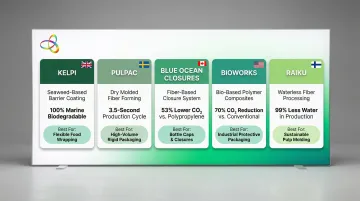
Kelpi is a UK-based startup founded in 2020 that developed a biomaterial coating from seaweed and plant oils. It performs like plastic—blocking water, oxygen, and grease—while remaining fully biodegradable and recyclable. The seaweed feedstock requires no land, freshwater, or fertilizers, sidestepping the food-versus-fuel conflict that undermines many bio-based alternatives.
What sets it apart: Most eco-friendly packaging alternatives sacrifice barrier performance, forcing brands to choose between sustainability and product protection. Kelpi doesn't. It maintains recyclability without drawing on food-crop feedstocks. The company earned B Corp certification in December 2023 and was selected for L'Oréal's inaugural €100 million sustainability accelerator in January 2026.
| Aspect | Details |
|---|---|
| Key Technology | Seaweed-derived biomaterial coating that replaces conventional plastic barriers on packaging substrates |
| Sustainability Claim | Fully biodegradable and recyclable; seaweed feedstock requires no land, freshwater, or fertilizers |
| Best Suited For | Primary and secondary packaging formats requiring moisture, oxygen, or grease barriers |
Pulpac
Pulpac is a Swedish startup founded in 2018 behind Dry Molded Fiber (DMF)—a patented process that forms cellulose from plant-based fibers without the water-heavy, energy-intensive steps of conventional paper manufacturing. Production cycle times run as fast as 3.5 to 3.8 seconds 17, making it viable at commercial scale.
Why it stands out: DMF is licensed to machine suppliers, converters, and material partners worldwide. Brands can access the technology without building proprietary lines—a significant scalability advantage. The process targets caps, trays, and compact formats where single-use plastic is most common. Pulpac was also selected for L'Oréal's L'AcceleratOR program in 2026.
| Aspect | Details |
|---|---|
| Key Technology | Dry Molded Fiber (DMF): patented cellulose-forming process without water-intensive steps |
| Sustainability Claim | Low-carbon alternative to single-use plastic; uses plant-based fibers from responsible sources |
| Best Suited For | Caps, trays, compact inserts, and outer packaging components replacing plastic molded parts |
Blue Ocean Closures
Blue Ocean Closures is a Swedish startup founded in 2021 that produces fiber-based caps and lids as a plastic-free alternative using a first-of-its-kind press-dry technology. The process converts plant-based fibers from responsibly managed forests into high-density 3D closure components compatible with existing production lines.
Why it stands out: The technology consumes approximately 10% of the energy used in traditional plastic molding and cuts CO2 emissions by up to 80% 24. Its compatibility with existing filling and capping lines also lowers the adoption barrier for brands switching from plastic closures—a pain point that sustainable packaging alternatives rarely address. An independent cradle-to-grave LCA by RISE verified that the fiber-based lid generates 0.022 kg CO2e, which is 53% lower than a comparable PP lid 23.
| Aspect | Details |
|---|---|
| Key Technology | Press-dry molding of plant-based fibers into high-density 3D caps and lids |
| Sustainability Claim | Uses ~10% energy of plastic molding and cuts CO2 by up to 80% per company data |
| Best Suited For | Bottle and jar closures across skincare, haircare, and personal care product lines |
Bioworks
Bioworks is a Kyoto-based materials company founded in 2015 behind PlaX, a bio-based packaging material derived from sugarcane. Compared to competing bio-plastics, PlaX is stronger, more heat-resistant, and easier to mold—while remaining compatible with existing production infrastructure.
The key differentiator: Bio-based plastics typically fail on heat resistance, moldability, or structural strength. PlaX solves all three, making it viable for primary containers that must survive filling, shipping, and in-use conditions—not just outer packaging. Company LCA data shows switching to PlaX cuts CO2 by ~70% in filament yarn production and ~50% in staple fiber versus polyester 27.
| Aspect | Details |
|---|---|
| Key Technology | PlaX: sugarcane-derived bio-based plastic with enhanced heat resistance and moldability |
| Sustainability Claim | ~70% CO2 reduction in filament production vs. petroleum-based plastics (company LCA) |
| Best Suited For | Primary containers (jars, bottles, tubes) requiring structural performance comparable to conventional plastics |
Raiku
Raiku is an Estonian startup founded in 2021 that converts responsibly sourced wood into coiled-spring packaging structures using a chemical-free, additive-free process. The output is fully compostable—and the production footprint is a fraction of conventional paper manufacturing.
Why it stands out: Raiku's modular production units can be installed in any warehouse, enabling localized production and real supply chain flexibility for brands managing sourcing risk. The process also tackles one of secondary packaging's stubborn problems: low recycling rates for conventional cardboard in beauty. According to company data, Raiku's process uses 99% less water, 98% less energy, and 10x less wood than paper and cardboard 35. The company was selected for both the LVMH Business Accelerator Program and L'Oréal's L'AcceleratOR program.
| Aspect | Details |
|---|---|
| Key Technology | Chemical-free wood coiling process producing compostable packaging structures |
| Sustainability Claim | 99% less water, 98% less energy, and 10x less wood vs. paper (company data) |
| Best Suited For | Secondary and outer packaging formats seeking compostable, zero-chemical alternatives to cardboard |
Key Innovation Areas Shaping the Future of Cosmetic Packaging
The Sustainability-First Imperative
Regulatory frameworks and consumer demand are converging to make recyclable, biodegradable, or compostable materials a business requirement rather than a brand differentiator. The EU Packaging and Packaging Waste Regulation (PPWR) entered into force on February 11, 2025, and will generally apply from August 12, 2026. It mandates that all packaging placed on the market must be recyclable by 2030 and establishes mandatory targets for recycled content in plastic packaging.
In the US, Extended Producer Responsibility (EPR) laws are reshaping the economics of packaging. California's SB 54 establishes the largest EPR program in the US, requiring producers to join a Producer Responsibility Organization and pay fees beginning in January 2027. The law mandates a 25% source reduction for plastic.
What this means for brands: Packaging suppliers must demonstrate regulatory readiness now. Brands evaluating packaging partners should request documentation showing compliance pathways for EU recyclability mandates and US state-level EPR fee structures.
The Smart Packaging Shift
The global smart packaging market was valued at $28.5 million in 2023 and is projected to reach $43.3 billion by 2030 according to Grand View Research. In cosmetics specifically, smart packaging is projected to hit $7.8 billion by 2030.
The progression has moved from passive packaging (QR codes, NFC tags) to active/interactive packaging:
- La Roche-Posay My Skin Track UV (2018): A battery-free wearable sensor that measures UVA and UVB rays, using NFC to relay data to a smartphone app
- YSL Rouge Sur Mesure (2023): A personalized lipstick generator powered by AI and color cartridges that dispenses thousands of bespoke lip colors on demand
- Too Faced NFC Samples (2022): Embedded NFC tags into 100,000 samples, allowing consumers to tap with their smartphone to access discounts
Brands investing in tech-integrated packaging need partners with both innovation capabilities and regulatory expertise. Smart packaging introduces compliance considerations around data privacy, electronic waste, and consumer safety that go beyond traditional materials review.
The Refillable/Circular Model Opportunity
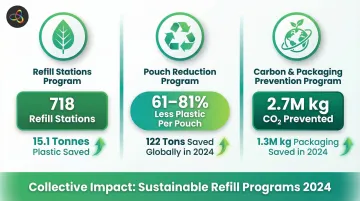
While smart packaging adds technology to the product experience, the refillable model takes a different approach — reducing material output entirely. The "permanent core + eco-refill" model is accelerating across premium beauty, cutting material waste while increasing consumer lifetime value. Commercially active refill programs demonstrate significant, quantifiable results:
- The Body Shop: 718 global refill stations saved 15.1 tonnes of plastic between April 2021 and December 2022
- Kiehl's: Refill pouches use 61-81% less plastic and saved 122 tons of plastic globally in 2024
- Rituals: Consumer adoption prevented 2,721,705 kg of CO2 emissions and saved 1,301,989 kg of packaging in 2024
Operational considerations brands must address:
- Reverse logistics infrastructure
- Consumer behavior change and education
- Refill format compatibility with existing production lines
- Economic viability at different price points
How We Chose These Startups
Each startup on this list was evaluated across four criteria — no pre-pilot or concept-only ventures made the cut:
- Technology maturity: pilot-ready or beyond, not theoretical
- Commercial scalability: proven ability to move past proof-of-concept
- Industry validation: accelerator participation, brand partnerships, or recognized certifications
- Relevance to US cosmetic brands: direct applicability to real sourcing and compliance needs
Common mistakes brands make when evaluating packaging startups:
- Supply chain readiness matters as much as the innovation itself — confirm the startup can meet your volume and timeline before committing
- Not every sustainable material works with every formulation; water-based products, oil-based creams, and volatile fragrances each have specific barrier requirements
- MOQ flexibility is often overlooked — many startups set minimums that price out early-stage brands entirely
- Even a brilliant material won't get through procurement if the startup can't provide safety data sheets, migration testing, and compliance documentation your legal team requires
Conclusion
The cosmetic packaging startup ecosystem is moving faster than at any point in the industry's history. Innovation alone, though, doesn't guarantee the right fit. The packaging partner a brand chooses still needs to align with its production timelines, formulation requirements, and distribution scale.
Treat packaging selection as a strategic decision. Before committing to a new format or partner, evaluate:
- Material compatibility with your specific formulations
- Scalability that matches your growth trajectory
- Regulatory readiness for your target markets
- Supplier reliability alongside their innovation credentials
For brands seeking an experienced packaging partner—from primary and secondary packaging selection through to co-manufacturing and fulfillment—Consolidated Design West brings over 34 years of experience working with both startups and established brands. Through their partnership with Respect Manufacturing, CDW offers turnkey co-manufacturing services from formulation to finished goods, alongside primary and secondary packaging, quality control, warehousing, and fulfillment. Reach out at consolidateddesignwest.com.
Frequently Asked Questions
What are the innovations in beauty packaging?
Major innovation categories include sustainable materials (seaweed coatings, fiber-based alternatives, bio-based plastics), smart/interactive packaging (NFC tags, biometric sensors, precision delivery technology), refillable/circular systems that reduce virgin plastic consumption, and minimalist mono-material design that simplifies recycling.
What is primary and secondary packaging in cosmetics?
Primary packaging is the container in direct contact with the product—bottles, jars, tubes, pumps, and dispensers. Secondary packaging refers to outer packaging such as cartons, boxes, and labels that protect and present the primary container during shipping and retail display.
What is the most sustainable cosmetic packaging?
Glass, aluminum, refillable systems, and certified compostable fiber-based packaging consistently rank among the top performers across environmental impact comparisons. That said, the best choice for your brand depends on formulation type and your customers' local recycling infrastructure.
How are startups disrupting traditional cosmetic packaging?
Startups are bringing new feedstocks (seaweed, sugarcane, wood fiber), new manufacturing processes (dry molded fiber, chemical-free forming), and new functionality (smart sensors, precision delivery) to market. Legacy suppliers have been slow to adopt these innovations, which creates clear partnership opportunities for forward-looking beauty brands.
What should cosmetic brands look for when partnering with a packaging startup?
Evaluate four practical criteria: material compatibility with your specific formulations, the startup's production scalability and MOQ flexibility, regulatory documentation readiness (safety data sheets, migration testing, compliance support), and evidence of successful commercial pilots with other brands.