The challenge is that commission structures vary widely by industry, role type, and sales cycle. A flat 5% works fine in high-volume retail but signals disrespect to an enterprise software rep closing six-figure deals over six months.
This guide breaks down average commission rates by industry, explains the most common compensation structures, and walks through how to determine what a fair rate looks like for your business.
Key Takeaways
- Commission rates range from 2% to 30%+ depending on industry, role, and structure — no single universal benchmark applies
- Longer sales cycles and higher deal complexity — think SaaS, pharma, financial services — support higher total compensation than high-volume, lower-margin roles
- The most common pay structure sits near a 60/40 split — 60% base salary, 40% variable commission
- Straight commission roles carry no base salary but higher per-deal rates — the standard for independent contractors and real estate agents
- Deal complexity, market competition, company size, and rep experience all shape what a fair rate looks like
What Are Sales Commission Rates?
A sales commission is a percentage of a sale's value paid to the rep who closed it — either on top of a base salary or as their sole income source. It ties a rep's paycheck directly to their output.
Most compensation plans combine two components:
- Fixed pay — a guaranteed base salary paid regardless of performance
- Variable pay — commission, bonuses, or incentives tied to sales results
The 60/40 Benchmark
WorldatWork's 2021 survey data shows most organizations cluster near a 60/40 pay mix. Specifically:
- Field new-account sellers: 57% base / 43% variable
- Inside outbound sellers: 59% base / 41% variable
- Hybrid new-account sellers: 55% base / 45% variable
This split balances stable income against performance incentive — enough guaranteed pay to attract reliable talent, enough variable upside to drive results.
Commission rates aren't universal. The "right" rate depends on:
- Sale complexity and deal size
- Length of the sales cycle
- Technical knowledge required
- How independently the rep operates
A rep closing transactional retail deals in high volume faces a fundamentally different workload than one managing a multi-month B2B packaging contract. Their compensation structures should reflect that difference.
Average Sales Commission Rates by Industry
Understanding industry benchmarks is the foundation of any competitive compensation plan. The table below uses BLS May 2024 wage data and 2025 Glassdoor figures to give you a realistic picture across ten major sales categories.
| Industry | Approx. Base Range | Additional/Variable Pay | Median Total Pay | BLS Wage Anchor |
|---|---|---|---|---|
| Advertising Sales | $62K–$92K | $37K–$69K | $125K | $61,460 |
| Auto Sales | $59K–$98K | $28K–$52K | $113K | — |
| Financial Services | $62K–$95K | $32K–$60K | $119K | $78,140 |
| Insurance | $64K–$111K | $31K–$59K | $126K | $60,370 |
| Real Estate | $77K–$132K | $58K–$108K | $177,846 avg | $58,960 |
| Retail Sales | $32K–$40K | $3K–$6K | $40K | $34,730 |
| Pharmaceuticals | $81K–$121K | $49K–$91K | $164K | $100,070* |
| SaaS/Software AE | $83K–$126K | $71K–$132K | $197K | — |
| Telecommunications | $42K–$63K | $17K–$32K | $74K | — |
| Wholesale & Manufacturing | $46K–$69K | $19K–$36K | $82K | $74,100 |
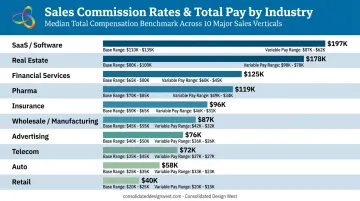
*Technical/scientific wholesale reps per BLS Wholesale and Manufacturing Sales Representatives. Glassdoor data sourced from 2025 salary pages for each role category.
The spread across these categories is wide — and it's not random. Here's what's actually driving the numbers.
What Drives the Pattern
The gap between SaaS ($197K median total) and retail ($40K median total) comes down to deal complexity. Industries with longer sales cycles, higher technical requirements, and more demanding client relationships command higher total compensation because:
- Reps close fewer deals per year and need each one to pay proportionally more
- Buyers require more education and trust-building before committing
- Competitive talent markets push rates upward to retain skilled sellers
High-volume, lower-margin categories like retail and telecom compensate differently — lower percentages per deal, but more opportunities to earn through transaction volume.
A Note on Wholesale and Manufacturing
For sales teams operating in packaging, commercial printing, or B2B manufacturing — the space where Consolidated Design West operates, recruiting independent reps to sell packaging components and co-manufacturing services — the wholesale and manufacturing benchmark is the right reference point. Independent contractor reps in this space operate on a different structure than W-2 employees. According to RepHunter, 90% of commissions paid to independent reps fall between 5%–20% of gross sales, with gross-margin-based arrangements running 20%–40%.
All figures represent averages — experience level, deal size, and geography create real variance within each category. Use these ranges as a starting benchmark, then pressure-test any specific offer against what the role actually requires you to do and close.
Common Sales Commission Structures
The commission rate percentage is only part of the story. How that rate is structured determines a rep's real earning potential, risk exposure, and day-to-day motivation.
Base Salary Plus Commission
The most widely used model. Reps earn a guaranteed salary alongside variable commission — typically following a 60/40 split.
Example: A rep with a $60,000 base and 8% commission on sales closes $500,000 in a year. Their total comp: $60,000 base + $40,000 commission = $100,000.
This structure attracts talent who want income stability while still rewarding performance. Most mid-market and enterprise sales teams use it as their default W-2 structure.
Straight (100%) Commission
Reps earn nothing unless they sell — but the per-deal rate is considerably higher to compensate for the absence of a safety net. Common for real estate agents, independent contractors, and direct sales reps.
In B2B manufacturing and packaging, straight commission structures can pay out a much larger share of deal value than typical W-2 roles. Consolidated Design West's 1099 rep model, for example, pays 60% of net profits per closed deal with no earnings cap — a rate built to attract experienced closers rather than entry-level reps building their book.
The tradeoff: income volatility during slow periods and ramp-up. This model works best for experienced sellers with strong pipelines and high close rates.
Tiered Commission
Performance above quota is rewarded at progressively higher rates. A common example:
- 5% on the first $100K in sales
- 7% on the next $150K
- 10% on everything above $250K
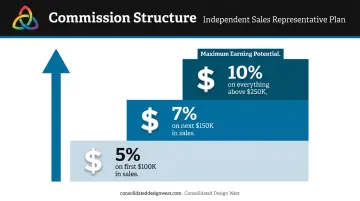
This is a strong motivator for top performers to push past their targets rather than coasting once they hit quota.
Residual Commission
Reps earn ongoing commissions for accounts that continue generating revenue. Common in SaaS, insurance, and subscription businesses. Instead of incentivizing just the initial close, this structure rewards reps for client retention and long-term relationship quality.
Draw Against Commission
A draw is an advance on future commissions — essentially a loan the rep repays by earning. It provides income stability during ramp-up or slow periods without committing to a full base salary.
Reps "earn back" the draw through commissions; any shortfall carries forward. Best suited for longer sales cycles where reps may go weeks between closes.
Key Factors That Influence Commission Rates
No industry benchmark tells the whole story. These four factors shape where a competitive rate actually lands for your specific role.
Sales Cycle Length and Deal Complexity
Deals requiring months of multi-touch relationship-building — enterprise software, capital equipment, B2B packaging contracts — justify higher commission rates. Reps invest significantly more time per close and have fewer earning opportunities per year. A flat 3% that works for a 15-minute retail transaction doesn't reflect the effort behind a six-month co-manufacturing deal.
Market Competitiveness and Talent Demand
In crowded markets where top reps have multiple employer options, commission rates get bid upward. Companies that don't stay competitive lose their best sellers to organizations that will pay them what they're worth.
Company Size and Business Goals
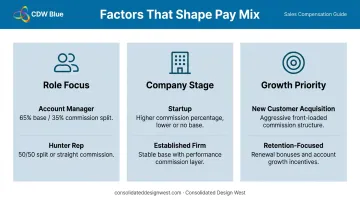
WorldatWork notes that pay-mix expectations shift significantly by role type. How a company structures that mix often depends on:
- Role focus: Account managers typically sit at 65/35 (base/commission); pure hunters may split 50/50 or go straight commission
- Company stage: Startups and smaller firms often offer higher commission percentages to offset lower or absent base salaries
- Growth priority: A company chasing new customer acquisition should structure pay differently than one focused on retention
Geographic Region
Base salary components in base-plus-commission models typically adjust for cost of living — reps in San Francisco or New York expect higher total comp than equivalents in lower-cost markets. For fully remote 1099 roles where commission is the only compensation, geography matters less to the rate itself but may affect how competitive the opportunity feels to local talent pools.
How to Set a Competitive Commission Rate for Your Business
Step 1: Research Your Industry Benchmarks
Start with credible, current data. Useful sources:
- BLS Occupational Outlook Handbook for wage medians by role
- Glassdoor salary pages for base, additional, and total pay ranges
- WorldatWork for pay-mix benchmarks and plan design practices
- RepHunter/MANA for independent manufacturer rep norms
- Betts Recruiting for tech-sales compensation guides
- Competitor job postings and exit interview data from your own team
Cross-referencing two or three sources gives you a defensible baseline rather than relying on any single number.
Step 2: Align Structure to Your Sales Process
The right structure follows the reality of how your reps actually sell. Ask:
- How long is the average deal cycle?
- How much prospecting does the rep handle independently?
- Is this a transactional close or a consultative, relationship-driven process?
If reps manage long, complex B2B sales — common in commercial printing, packaging, or manufacturing services — tiered commission or a meaningful base-plus-commission split makes more sense than a flat low-percentage rate designed for quick-turnaround retail.
Step 3: Test, Track, and Adjust
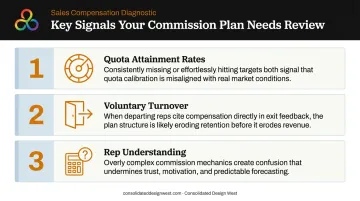
Commission plans need regular review. Key signals to watch:
- Quota attainment rates — if most of your team is consistently missing or if everyone always hits easily, the targets or rates need adjustment
- Voluntary turnover — exits citing compensation are direct feedback
- Rep understanding — if a rep needs a spreadsheet to calculate their commission, the plan is too complicated
Most companies review sales compensation annually, with roughly 10% reviewing more frequently. Build in a scheduled review rather than waiting for a crisis.
The right commission plan connects what reps earn directly to what they produce. For B2B companies in packaging, printing, and consumer goods — where deals are consultative and cycles run long — that means building plans around the actual complexity of the sale, not defaulting to averages designed for simpler transactions.
Consolidated Design West structures its 1099 sales roles exactly this way: experienced closers working warm leads, earning 60% of net profits per deal with no cap. It's one example of how performance-based models in B2B industries can be designed to reflect what high-output reps are actually worth.
Frequently Asked Questions
What is a good commission for a sales rep?
A "good" rate depends on structure and industry. Salesforce describes a 20%–30% gross-margin range as a common benchmark for commission-focused roles, while HubSpot notes base-plus-commission roles typically see 2%–15% on top of guaranteed pay. Deal size, sales cycle length, and fixed compensation all shift what "good" actually looks like.
What is the commission rate for independent sales reps?
Independent 1099 reps typically earn higher rates to offset the absence of a base salary and benefits. RepHunter data shows 90% of independent rep commissions fall between 5%–20% of gross sales, with gross-margin-based structures running 20%–40% depending on industry and product margin.
What is a straight commission compensation plan?
Straight commission means reps earn income solely through closed sales (no base salary, no guaranteed pay), which translates to a higher percentage per deal. It's common for real estate agents, independent contractors, and direct sales reps who prefer uncapped earning potential over income stability.
What is the formula for straight commission?
Sales Amount × Commission Rate = Commission Earned
Example: $50,000 in sales × 10% commission rate = $5,000 earned. For a 60% net-profit model, the calculation applies to net profit rather than gross sales value.
What is a 70/30 split in sales?
A 70/30 split means 70% of target compensation comes from base salary and 30% from variable commission. WorldatWork uses this as a standard pay-mix example — it's slightly more salary-heavy than the common 60/40 split and often used in roles where relationship management or account retention matters more than pure volume.
Is it better to be salaried or commissioned?
Salaried roles offer income stability, making them better suited for long sales cycles, support-heavy positions, or reps earlier in their careers. Commission-heavy or straight-commission roles offer higher earning potential and suit confident closers in product-driven or transactional environments.