

Some careers don't work that way. In performance-based and output-driven roles, your income scales with what you produce — no ceiling, no arbitrary limits.
This guide covers six career paths where that's genuinely true: three commission-based roles (sales, real estate, financial advising) and three output or ownership-based paths (freelancing, skilled trades contracting, entrepreneurship). Several require no four-year degree. All of them reward results over résumés.
Key Takeaways
- Commission roles (sales, real estate, financial advising) pay more each time you close a deal or grow a client base — no salary cap applies
- Output/ownership roles (freelancing, trades contracting, entrepreneurship) scale income by expanding client volume, team size, or business revenue
- Trades contractors and B2B sales reps are among the most accessible six-figure paths without a degree
- Top earners across all six careers share three skills: communication, process discipline, and financial self-management
- The right company or market accelerates income faster than career category alone — environment matters early
What "Unlimited Earning Potential" Actually Means
The phrase gets used loosely. Here's the precise definition: it's a compensation structure where income is not capped by a fixed salary but scales with output, commission volume, client base size, or business revenue.
In a salaried role, raises are incremental. They follow tenure, performance review cycles, and internal pay bands — not individual output. A top performer and a mediocre one often end up within a few percentage points of each other after annual reviews.
That gap between effort and reward is what makes commission-based and ownership models different. Two mechanisms create genuinely unlimited earning:
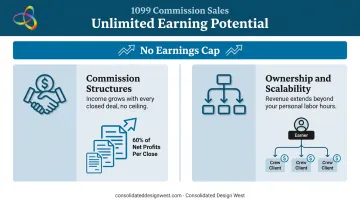
- Commission structures — each sale, deal, or placement generates income. The more you close, the more you earn. No employer-set ceiling applies.
- Ownership and scalability — income grows as a business, client roster, or portfolio expands, often without proportional increases in hours worked. A trades business owner earns from every technician on their crew, not just their own labor.
That said, high income in these roles is built over time — through skill development, relationship-building, and consistent output across years, not months. The upside is real and uncapped. Early-stage variability is equally real, and anyone entering these paths should plan for it.
6 Careers With Unlimited Earning Potential
Career 1: Sales Professional (B2B and Technology Sales)
Sales is the most accessible entry point into performance-based income. The structure is straightforward: base salary plus commission, with income scaling directly based on deals closed. There is no structural earnings cap.
According to compensation data from Betts Recruiting, entry-level tech Sales Development Representatives (SDRs) typically earn $60,000–$80,000 in total compensation, while experienced Account Executives at mid-market and enterprise level can reach $200,000–$400,000+ in on-target earnings. That gap reflects deal size, territory, and commission tier — not years of service.
No four-year degree is required. Communication ability, CRM proficiency, and process discipline drive results.
What separates top earners from average ones:
- Consistent prospecting habits (not bursts of activity)
- Confident objection handling built through repetition
- Pipeline discipline — managing 20–40 active deals simultaneously
- Reliable follow-up cadences that competitors skip
Senior sales professionals who advance into sales leadership roles earn override commissions on their entire team's production — adding a passive income layer on top of personal sales.
For experienced closers who want to skip the prospecting grind entirely, Consolidated Design West offers 1099 sales contractor roles paying 60% of net profits per closed deal, with no earnings cap. The company supplies warm leads and handles all order processing — the rep's only job is converting qualified prospects into customers.
Career 2: Real Estate Agent and Broker
Real estate agents earn a percentage of each property transaction. Every deal adds directly to income rather than contributing toward an annual salary figure that's already been decided.
The NAR's 2025 Member Trends report shows that agent income has remained steady even as transaction volumes fluctuate — agents in high-value markets with strong referral networks consistently outperform market averages because their average deal size compounds their per-transaction commission.
How income scales in real estate:
- Transaction volume × average sale price = annual gross commission income
- Commission percentage is negotiated per transaction (commonly 2–3% per side, though the post-NAR settlement landscape makes this more variable)
- High-value markets with $800K+ average sale prices generate $16,000–$24,000+ per transaction at standard rates
Moving from agent to broker to brokerage owner adds leverage at each stage. Brokers earn from their own transactions plus a share of their agents' commissions. Brokerage owners capture revenue from every transaction their team closes.
What moves real estate income from decent to exceptional is a referral-based business. Past clients and professional partners send new transactions without additional prospecting cost. That network takes years to build — but once established, it reduces acquisition costs to near zero.
Career 3: Entrepreneur and Brand Owner
Entrepreneurship has the highest theoretical income ceiling of any path on this list. The owner captures the full economic value of the business — not a percentage allocated by an employer. Income scales with customers served, products sold, and systems built.
Unlike commission roles, there's no employer limiting territory or deal size. The constraint is execution: solving a real market problem, building a repeatable system, and reinvesting early profits to fuel growth rather than pulling them out prematurely.
Product-based entrepreneurs — particularly those building brands in beauty, wellness, food and beverage, or apparel — face a specific operational trap: production complexity can stall growth faster than weak demand does. Coordinating manufacturing, packaging, formulation, and fulfillment while simultaneously acquiring customers is where many early-stage brands lose momentum.
Consolidated Design West addresses this directly. Through its partnership with Respect Manufacturing, CDW offers brand founders full co-manufacturing support — from custom formulation through finished goods, packaging design, quality control, and fulfillment. That's the same support structure CDW's sales contractors sell into, across beauty and wellness, food and beverage, electronics, pet care, and apparel.
Career 4: Financial Advisor and Wealth Manager
Financial advising creates a compounding income structure that's structurally different from pure transactional sales. Advisors earn commission on new products placed, plus ongoing fees tied to assets under management (AUM). As a client's portfolio grows and the advisor adds new clients, AUM fee income increases even without closing new business.
According to BLS data, the median annual wage for personal financial advisors is approximately $99,580, but top earners exceed $208,000. AUM fees typically range from 0.5%–1.5% annually on managed assets — meaning an advisor managing $50M in client assets generates $500,000–$750,000 in annual fee revenue before expenses.
The compounding effect works like this:
- Year 1: Acquire 10 clients, manage $5M AUM
- Year 5: Those clients' portfolios have grown + you've added 30 more clients
- Year 10: AUM fees alone fund a significant income base, before any new business commissions
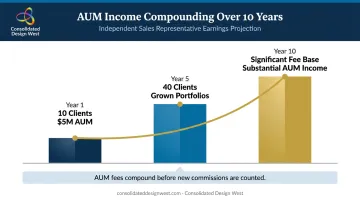
Junior advisors who move into senior and managing partner roles gain revenue-sharing on team production at each level. Advisors who focus on high-net-worth client acquisition can reach seven-figure income milestones within a decade — built through consistent relationship-building and compounding portfolio growth, not a single dramatic event.
Career 5: Freelance Digital Professional
Freelancing creates unlimited earning potential through output-based pricing: you set your own rates, control client volume, and raise prices as expertise grows. No employer salary band applies.
Top freelancers in high-demand specializations command strong project fees:
| Discipline | Typical Rate Range |
|---|---|
| SEO Consultant | $100–$300/hour; $2,000–$8,000/month retainers |
| UX/UI Designer | $75–$200/hour |
| Paid Media (PPC) Manager | $75–$150/hour; $1,500–$5,000/month |
| Copywriter (B2B/direct response) | $150–$500/hour; $5,000–$25,000/project |
Source: Moz SEO Pricing Report; YunoJuno Freelancer Rates Report
The income ceiling in freelancing is largely a positioning problem. Generalists compete on price. Specialists — particularly those known for specific outcomes in specific industries — command rates that make six-figure annual income achievable with 15–20 client hours per week.
Solo freelancers who productize their services or build small agencies add team leverage that removes the solo-hours constraint. That shift — from selling time to selling a system — is where freelance income stops being capped by a calendar.
Career 6: Skilled Trades Contractor
Licensed tradespeople who move from W-2 employment to self-employed contracting gain direct access to performance-based income. They bill clients directly, set their own rates, and capture the profit margin that previously went to their employer.
According to the Associated Builders and Contractors, the construction industry needs to attract 439,000 additional workers in 2025 to meet demand. That structural shortage gives licensed tradespeople significant pricing power — a dynamic that's expected to persist as the existing workforce ages.
W-2 employee vs. self-employed contractor earnings comparison:
| Role | W-2 Median | Self-Employed Potential |
|---|---|---|
| Electrician | ~$61,000/year | $90,000–$130,000+ |
| Plumber | ~$61,000/year | $85,000–$150,000+ |
| HVAC Technician | ~$57,000/year | $80,000–$120,000+ |
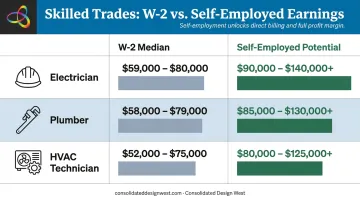
Contractors who build a trades business cross a key threshold: revenue comes from every technician on the team, not just personal labor hours. At that point, income scales with crew size and service area — not the number of hours one person can work in a week.
What Skills Drive Success in Careers With Unlimited Earning Potential
The skills that produce high earners are consistent across all six categories. None of them are personality traits you either have or don't.
Communication is foundational. The ability to explain value clearly, handle objections without flinching, and build genuine trust with clients separates high earners from average ones in every category here. This is a learnable skill, developed through deliberate practice and repetition — not a fixed trait.
Process discipline drives compounding results. Top earners prospect continuously, follow up reliably, and treat every client interaction as an investment in future revenue or referrals. Inconsistent earners often work hard in bursts but lack the systematic habits that produce consistent output.
One well-maintained CRM or client follow-up system, used without exception, beats any amount of unsustained effort.
Financial self-management is the skill salaried professionals rarely develop but performance-based earners must master:
- Understanding quarterly estimated taxes on commission income
- Managing income variability without lifestyle inflation in high-earning months
- Pricing work appropriately as expertise grows (most freelancers and contractors undercharge significantly in years one and two)
- Reinvesting in skill development and tools that multiply output
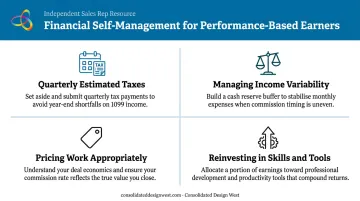
None of these are glamorous. But they're what separates earners who build lasting income from those who peak and plateau.
How to Break Into a Career With Unlimited Earning Potential
Match the Career to Your Actual Aptitude
Self-awareness matters here. An extrovert who genuinely enjoys persuasion and thrives on human interaction is well-suited for sales or real estate. A detail-oriented self-starter who prefers depth over volume may find financial advising or skilled trades a better fit. A systems thinker who wants full ownership of outcomes belongs in entrepreneurship or freelancing.
Research the day-to-day reality of your target role before committing — not the job posting, but what the job actually looks like. Informational interviews with people two to five years in are worth more than any career guide.
Identify the Right Credential (Not the Most Impressive One)
- Requires licensing: Real estate (state license), skilled trades (apprenticeship + journeyman/master license), financial advising (Series 65, Series 7, or CFP depending on focus)
- Rewards demonstrated skill: Sales, freelancing — credentials matter far less than a track record or portfolio
- Entry options: Industry-specific bootcamps, apprenticeships, and certification programs consistently provide faster and lower-cost access than four-year degrees for most of these paths
Defaulting to a degree as the safe option is often the slowest and most expensive route into performance-based income.
Choose the Right First Environment
This is underrated. A sales rep at a company with a strong product, a clear commission structure, and a real advancement path will outpace someone in a disorganized environment — even with identical skills. Research commission plan transparency, product-market fit, and advancement history for the specific roles you pursue.
That's what a well-structured environment actually looks like in practice. Consolidated Design West, for example, structures its 1099 sales roles around rep productivity from day one — warm leads are provided, order processing is handled internally, and the commission rate sits at 60% of net profits with no cap.
Frequently Asked Questions
What does "unlimited earning potential" mean?
It refers to roles where income is not capped by a fixed salary but scales with performance, output, or business revenue. Higher productivity or more clients directly translates to higher pay — there's no employer-imposed ceiling on what you can earn.
What career has the highest earning potential?
Entrepreneurship and business ownership have the highest theoretical ceiling since the owner captures full business value. In professional careers, enterprise technology sales, financial advising with large AUM, and senior medical device sales consistently produce the highest earners.
What job makes $10,000 a month without a degree?
B2B and tech sales, real estate, and self-employed skilled trades contracting are among the most accessible paths to $10,000+ per month without a four-year degree. Income in all three is tied to performance, not credentials.
How do you make $100,000 a year with no degree?
Licensed trades contractors, experienced sales reps, established real estate agents, and senior freelancers in high-demand disciplines routinely clear $100,000+ annually. The path involves building demonstrable skills, a client base, or a strong performance record — not a diploma.
Which jobs will survive AI displacement?
Sales professionals, licensed tradespeople, and financial advisors rank among the most resilient roles. Each depends on human judgment, physical presence, and relationship trust that automated tools can't replace.
What jobs make $1,000,000 a year?
Seven-figure income comes through business ownership, top-tier enterprise sales, or senior financial advising with a large book of business. In every case, it reflects years of compounding client relationships and deal volume — no one starts there.