For 1099 workers like commission-based sales representatives — including those who close deals remotely for companies like Consolidated Design West, earning 60% of net profits per sale with no employer withholding — understanding these deductions isn't optional. It's how you protect your take-home pay.
This guide covers 20 specific deductions available to 1099 workers and self-employed individuals for the 2026 tax year, along with the IRS forms used for each. Always consult a CPA or tax professional for advice tailored to your situation.
Key Takeaways
- Independent contractors deduct "ordinary and necessary" business expenses using Schedule C of Form 1040
- Key categories: home/office, vehicle and travel, business operations, and personal financial deductions
- The self-employment tax deduction and QBI deduction are the two most overlooked high-value deductions for 1099 workers
- Poor recordkeeping is the #1 reason deductions get disallowed; the IRS can audit returns up to three years back
What the IRS Considers a Deductible Business Expense
Under IRC Section 162, an expense must be both ordinary — meaning common and accepted in your field — and necessary — meaning helpful and appropriate for your work — to qualify as deductible. It doesn't need to be the cheapest option, but it can't be lavish or personal.
Once you know an expense qualifies, the next question is where to report it. Most sole proprietors and single-member LLCs report deductible expenses on Schedule C (Form 1040). A few deductions — health insurance premiums, retirement contributions, and the self-employment tax deduction — are claimed on Schedule 1 instead.
What you cannot deduct:
- Personal meals and living expenses
- Commuting costs between home and a regular workplace
- Political contributions
- Fines and penalties paid to a government agency
Home, Office, and Communication Deductions (Deductions 1–4)
Deduction 1: Home Office
Since CDW's 1099 sales reps work 100% remotely with no company-provided office, the home office deduction is directly applicable. It's one of the more valuable deductions available to remote contractors, so getting the calculation right matters.
Two IRS requirements apply: the space must be used regularly and exclusively for business, and it must be your principal place of business (per IRS Publication 587).
Two calculation methods:
| Method | How It Works | Max Deduction |
|---|---|---|
| Simplified | $5 per sq. ft., up to 300 sq. ft. | $1,500 |
| Actual Expense | % of rent, mortgage interest, utilities, insurance, depreciation based on office sq. ft. | No cap |
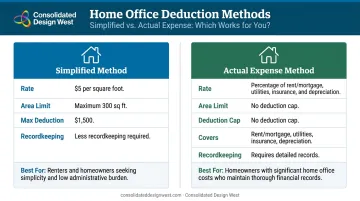
Reported on: Form 8829 (actual method) or Schedule C, Line 30 (simplified method)
Deduction 2: Phone and Internet
Only the business-use percentage of your cell phone and internet bills is deductible. If you maintain a dedicated second line or hotspot used exclusively for business, 100% of that cost qualifies.
- Internet expenses: reported on Schedule C, Line 25
- Cell phone and mixed-use costs: reported in Schedule C, Part V (Other Expenses)
Deduction 3: Separate Office or Studio Rent
If you work from a coworking space or rented studio instead of — or in addition to — your home office, you can deduct 100% of that rent, provided you don't hold an ownership interest in the property. Prepaid rent is only deductible in the year it applies.
Reported on: Schedule C
Deduction 4: Office Supplies and Furniture
Deductible supplies include paper, printer ink, postage, pens, and folders. Desks, chairs, and monitors used exclusively for business qualify too — though items lasting more than one year must be depreciated (see Deduction 11).
Reported on: Schedule C, Part V
Vehicle, Travel, and Meal Deductions (Deductions 5–8)
Deduction 5: Vehicle Expenses and Mileage
For contractors who drive for client meetings, site visits, or supply runs, the IRS confirmed the 2026 business standard mileage rate at 72.5 cents per mile, up 2.5 cents from 2025.
You can calculate your deduction using one of two methods:
- Standard mileage rate — 72.5 cents per mile, plus parking fees and tolls
- Actual expense method — tracks gas, repairs, insurance, depreciation, and lease payments by business-use percentage
The actual expense method takes more recordkeeping but can yield a larger deduction for high-mileage contractors with costly vehicles.
Commuting from home to a regular work location is never deductible. Reported on: Schedule C, Line 9
Deduction 6: Business Travel
Travel must be away from your "tax home" and require an overnight stay. Deductible costs include:
- Airfare and train tickets
- Hotels and Airbnbs
- Rideshares and rental cars
- Baggage fees and incidentals
Mixed business-personal trips? Only the business-related portion is deductible. Reported on: Schedule C, Line 24
Deduction 7: Business Meals
50% of qualifying meal costs is deductible. Eligible situations include:
- Client lunches and business dinners
- Meals at conferences and industry events
- Meals during overnight business travel
The meal can't be lavish or extravagant. You can use actual receipts or the GSA standard per diem rates for a simpler calculation.
Reported on: Schedule C, Line 24b
Deduction 8: Professional Dues, Publications, and Education
Deductible here:
- Trade association and professional organization fees (bar associations, industry groups)
- Subscriptions to business-relevant publications
- Tuition, books, seminars, and online courses that maintain or improve skills in your current line of work
Education that trains you for an entirely new career does not qualify. Reported on: Schedule C, Part V
Business Operations and Growth Deductions (Deductions 9–16)
These deductions cover the recurring costs of running and growing a contracting business — from marketing to equipment to professional help.
Deduction 9: Advertising and Marketing
Fully deductible advertising costs include:
- Digital ads (Google, Meta, LinkedIn)
- Website design and hosting
- Email marketing platforms
- Business cards and branded promotional materials
- Print, radio, and TV ads
For sales reps who build their own personal brand online to attract clients or promote their services, those costs — a personal website, LinkedIn ads, branded materials — qualify as deductible marketing expenses.
Reported on: Schedule C
Deduction 10: Business Insurance Premiums
Deductible business insurance types:
- General liability
- Professional liability (errors and omissions)
- Commercial property
- Commercial auto (business-use vehicles)
- Tools and equipment insurance
- Business interruption insurance
Note: health insurance is a separate deduction covered below. Reported on: Schedule C, Line 15
Deduction 11: Equipment, Depreciation, Section 179, and Bonus Depreciation
Equipment lasting more than one year is depreciated over its useful life. Two accelerated options exist for 2026:
- Section 179: Immediately expense qualifying equipment up to $2,560,000 (phase-out begins at $4,090,000 in total asset additions) per IRS Rev. Proc. 2025-32
- Bonus depreciation: 100% first-year expensing for qualified property acquired and placed in service after January 19, 2025
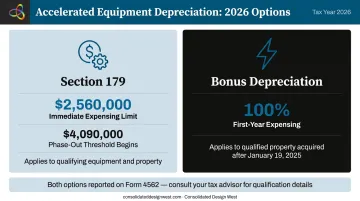
Form 4562 required; deduction flows to Schedule C, Line 13
Deduction 12: Startup Costs
New contractors can deduct up to $5,000 in startup costs in the first year — market research, attorney fees, ad spend before launch. The $5,000 cap reduces dollar-for-dollar once total costs exceed $50,000.
Organizational costs for forming an LLC or corporation may add another $5,000. Any remaining amounts are amortized over 180 months.
Reported on: Schedule C, Part V
Deduction 13: Business Loan Interest and Bank Fees
Interest on business credit cards, equipment loans, and lines of credit is deductible — but only the portion attributable to business use. Monthly service charges and fees on business bank accounts also qualify. The principal portion of any loan is not deductible.
Reported on: Schedule C, Line 16
Deduction 14: Contract Labor and Freelancer Payments
Fees paid to subcontractors or freelancers for services rendered to your business are fully deductible. If you pay a single contractor $600 or more in a year, you must issue them a Form 1099-NEC.
Reported on: Schedule C, Line 11
Deduction 15: Legal, Accounting, and Professional Service Fees
Deductible professional fees include:
- Attorney fees for business matters
- CPA and bookkeeping costs
- Consulting fees
- Tax preparation costs for your business return
Fees for personal legal or tax matters don't qualify — but the CPA you hire to file your business return is itself a deductible expense under this line.
Reported on: Schedule C, Line 17
Deduction 16: Business Licenses, Permits, and Regulatory Taxes
Deductible items in this category include:
- State and local business licenses
- Professional certifications (real estate licenses, contractor permits)
- Regulatory fees and occupational taxes
Some licenses must be amortized over multiple years rather than fully deducted in year one.
Reported on: Schedule C, Line 23
Personal Financial and Tax Deductions (Deductions 17–20)
These four deductions are unique to self-employed workers — and they directly offset the personal financial burden of being your own employer.
Deduction 17: Health Insurance Premiums
Self-employed contractors can deduct 100% of premiums paid for medical, dental, vision, and eligible long-term care insurance for themselves, their spouse, and dependents — as long as they weren't eligible for an employer-sponsored plan during those months.
2026 long-term care premium deduction limits (age-based):
| Age Before Close of Tax Year | 2026 Deductible Limit |
|---|---|
| 40 or under | $500 |
| Over 40 through 50 | $930 |
| Over 50 through 60 | $1,860 |
| Over 60 through 70 | $4,960 |
| Over 70 | $6,200 |
Source: IRS Rev. Proc. 2025-32
Claimed on: Schedule 1, Line 17; Form 7206 required for long-term care portion
Deduction 18: Retirement Plan Contributions
Contributing to a retirement plan reduces your taxable income now while growing tax-deferred. Key options for self-employed workers:
| Plan Type | 2026 Contribution Limit |
|---|---|
| SEP-IRA | Lesser of 25% of net self-employment income or $72,000 |
| SIMPLE IRA (elective deferral) | $17,000 |
| Solo 401(k) (employee elective deferral) | $24,500 |
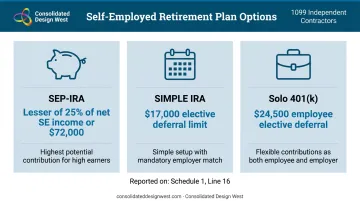
Reported on: Schedule 1, Line 16
Deduction 19: The Self-Employment Tax Deduction
Self-employed individuals pay 15.3% in self-employment tax — 12.4% for Social Security (on income up to $184,500 in 2026) plus 2.9% for Medicare. The IRS allows you to deduct 50% of this tax as an adjustment to income.
This doesn't reduce the SE tax itself, but it does lower your taxable income and your income tax bill. For a contractor earning $100,000 in net self-employment income, the SE tax runs roughly $14,130 — and half of that (~$7,065) comes straight off taxable income.
Calculated on: Schedule SE; deduction claimed on Schedule 1, Line 15
Deduction 20: Qualified Business Income (QBI) Deduction
Eligible self-employed individuals can deduct up to 20% of qualified business income under Section 199A. H.R.1 (Public Law 119-21, signed July 4, 2025) made the QBI deduction permanent.
2026 income thresholds (below which the full 20% deduction is available):
| Filing Status | Threshold | Upper Phase-In Limit |
|---|---|---|
| Single / all other non-joint | $201,750 | $276,750 |
| Married filing jointly | $403,500 | $553,500 |
Above these thresholds, limitations apply. Owners of specified service trades or businesses (SSTBs) — law, medicine, consulting — face additional restrictions on top of the phase-in limits.
Commission-based sales reps selling B2B products typically aren't classified as SSTBs, but confirm your classification with a tax professional before claiming the full 20%.
Calculated using: Form 8995 or Form 8995-A; claimed on Form 1040
How to Document and Maximize Your Deductions
The single most important rule: keep personal and business finances completely separate. A dedicated business bank account and business credit card create a clear, traceable paper trail for every deductible purchase.
Documentation to maintain for each deduction type:
- Mileage: Daily log with date, miles driven, and business purpose
- Business purchases: Itemized receipts (not just credit card statements)
- Contractors paid: Dated invoices and payment records
- Home office: Square footage measurements and floor plan
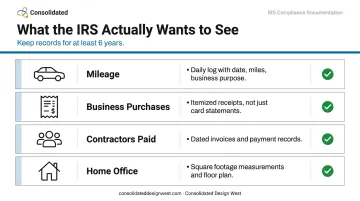
The IRS generally has three years to audit a return from the due date or filing date — extended to six years in cases of significant income underreporting, and with no time limit for fraudulent returns. Keep records for at least six years to cover the broadest audit window, even if you expect a clean return.
Use expense tracking software to auto-categorize purchases throughout the year — this makes year-end filing far less painful. For anything complex, a CPA is worth the cost. Their fees are themselves deductible, and a good tax professional will often identify deductions that more than offset what you pay them.
Frequently Asked Questions
What expenses can I write off as a 1099 independent contractor?
Any "ordinary and necessary" business expenses qualify — home office, vehicle use, phone and internet, insurance, travel, meals, equipment, and professional services. Most are reported on Schedule C, with health insurance and retirement contributions claimed on Schedule 1.
How does the new $6,000 deduction work?
The $6,000 provision in the One Big Beautiful Bill (Public Law 119-21) is a temporary deduction for individuals age 65 or older, available for tax years 2025–2028 and subject to income phase-outs — not a Schedule C item and not limited to the self-employed. A separate provision allows deducting up to $10,000 of qualified personal vehicle loan interest, also outside Schedule C.
What is the $2,500 expense rule?
The IRS de minimis safe harbor allows you to immediately deduct tangible property costing $2,500 or less per item or invoice rather than depreciating it — provided you have written accounting procedures in place at the start of the tax year. Contractors buying laptops, cameras, or equipment under this threshold can expense them outright on Schedule C, Part V.
What is the $400 rule for self-employed people?
If your net self-employment income is $400 or more, you must file a tax return and pay self-employment tax. This is one of the lowest income thresholds in the tax code and applies even if you owe no income tax.
What can you deduct from commission income?
Commission income reported on a 1099-NEC is treated as self-employment income on Schedule C, so all the same deductions apply — vehicle costs, home office, marketing, professional fees, and more.
What are common 1099 mistakes to avoid?
The most frequent errors: failing to track expenses year-round, mixing personal and business finances, missing quarterly estimated tax deadlines, claiming personal expenses as business deductions, and forgetting to claim the self-employment tax deduction or the QBI deduction — two of the highest-value deductions available to 1099 workers.