Introduction
Picture this: your B2B company is ready to scale sales, but adding a full quota of W-2 reps means committing to six-figure base salaries before a single deal closes. Commission-only starts to look appealing — fast.
The problem? Commission-only sales is widely misunderstood in B2B. Build it correctly and you get a lean, performance-driven sales channel. Build it wrong and you churn experienced reps, lose deals, and end up back where you started.
This guide covers what commission-only B2B sales jobs actually are, how they work in practice, where they thrive or fall apart, and how to build a plan that holds up long-term. Whether you're a company weighing this model or an experienced rep considering a 1099 role, you'll leave with a clear picture of when it works, when it doesn't, and what separates the two.
Key Takeaways
- Commission-only sales pays reps solely on closed deals — no base, no guaranteed income
- In B2B, this model works best in manufacturing, packaging, and rep-agency arrangements with shorter sales cycles
- SaaS AEs see a median commission rate of 11.5% of ACV at quota; manufacturer's rep rates vary by product, territory, and customer type
- High-performing, self-directed reps are drawn to this model — but income volatility and long B2B sales cycles are real risks to weigh
- Success requires competitive rates, clear payout triggers, and genuine sales support to back reps in the field
What Is a Commission-Only Sales Job in B2B?
A commission-only sales job pays reps exclusively through commissions on closed deals. No base salary, no hourly rate, no monthly guarantee. If you don't sell, you don't earn.
In B2B, these roles are commonly structured as 1099 independent contractor arrangements rather than traditional W-2 employment. That distinction matters. Independent contractor reps are running their own business — they set their own hours, work remotely, and often carry complementary product lines from multiple companies simultaneously. The relationship is a sales partnership, not conventional employment.
According to the IRS, the key test for classification is whether the hiring company controls both what the worker does and how they do it. Under IRS Topic 762, true independent contractors have financial independence, behavioral autonomy, and a separate business relationship — not an employment arrangement dressed up in contract language.
In practice, a commission-only B2B rep agrees on commission terms and territory with a company, then prospects, pitches, and closes deals to earn a percentage. Both exclusive and shared territory arrangements exist depending on the company and industry.
That's the model Consolidated Design West, an Anaheim-based packaging and commercial printing company, uses in practice. Reps work as 1099 contractors earning 60% of net profits per closed deal, with full schedule autonomy and no office requirement. Company-supplied leads cover the prospecting side, so reps focus on closing.
Who Works Commission-Only Sales Jobs in B2B?
The typical commission-only B2B rep is not entry-level. These roles attract:
- Experienced closers who are confident enough in their pipeline skills to trade salary security for uncapped earnings
- Industry specialists with established credibility in specific verticals like manufacturing, packaging, or financial services
- Portfolio reps who carry multiple complementary, non-competing product lines across a shared customer base
- Entrepreneurial sellers who value autonomy over structure and prefer results-based income
MANA (Manufacturers' Agents National Association) describes manufacturers' reps as independent, commission-based sales professionals — a model with thousands of active agencies across the U.S. and Canada. In manufacturing, packaging, pharmaceuticals, and direct B2B distribution, this model has dominated the channel for decades.
How Commission-Only B2B Sales Works
The mechanics are straightforward on paper: a rep and company agree on a commission percentage upfront, and the rep earns that percentage when a deal closes. What complicates it in B2B is timing. Commission triggers on contract signing or customer payment — not on generating a lead or moving a deal through stages.
Common B2B Commission Structures
| Structure | How It Works | Best For |
|---|---|---|
| Straight commission | Fixed % of gross sales value | Transactional, shorter-cycle deals |
| Gross margin commission | % of profit margin on the deal | Manufacturing, packaging reps |
| Tiered commission | Rate increases as quotas are hit | SaaS, technology sales |
| Accelerators | Bonus rate above quota threshold | High-volume AE roles |
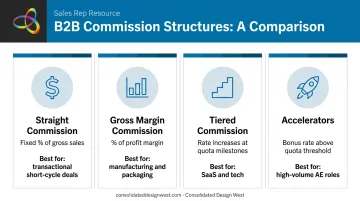
Each structure serves a different selling context. For independent manufacturer's reps specifically, gross margin-based structures are especially common. MANA notes that rates vary based on product type, customer category (OEM vs. distributor vs. end user), existing territory business, and the level of service the rep provides.
Typical B2B Commission Rates by Role and Industry
Rates vary by context. Here's what verified data shows:
- SaaS/technology AEs: A 2024 benchmark report covering 172 B2B SaaS companies found a median commission rate of 11.5% of ACV at quota, with a range of 11–14%. Median OTE was $190K on a 53:47 pay mix, with a quota-to-OTE ratio of 4.2x.
- Manufacturer's reps: MANA doesn't publish specific current rate ranges — their rate-setting guidance emphasizes that percentages depend on product complexity, customer type, and territory conditions. Avoid citing "20–40% of gross margin" as a verified benchmark; it circulates widely but lacks a current authoritative source.
- SaaS heuristic (10/10 model): Practitioner David Sacks describes a startup framework where AE quota equals 10x base salary and commission is 10% of new ARR. It's a useful planning reference, not a universal standard.
The Cash Flow Timing Problem
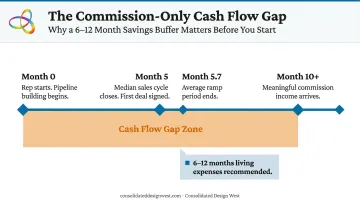
This is where commission-only gets hard for B2B reps. The same 2024 SaaS report shows a 5.0-month median sales cycle and 5.7-month average ramp period. That means a new rep could go 10+ months before meaningful commission income arrives, even with a full pipeline in motion.
This reality shapes who can realistically thrive in commission-only roles. Reps evaluating these positions should have at least 6–12 months of living expenses covered before their first deal closes — and should press any prospective company on average time-to-first-commission before signing on.
Pros and Cons of Commission-Only B2B Sales
Advantages
For companies:
- Converts fixed payroll costs to variable costs that scale with revenue
- Eliminates base salary overhead for reps who haven't yet closed
- Creates natural performance alignment — you pay when you win
- According to Alexander Group's 2024 Sales Compensation Trends Survey, 66% of companies are moving toward higher pay-for-performance alignment, and 91% planned compensation-plan adjustments in 2024
For reps:
- Uncapped earning potential — top performers can significantly exceed what salaried counterparts earn
- Full autonomy over schedule, approach, and territory management
- Often enables a portfolio business model — representing multiple complementary lines simultaneously
- Rewards consistent closers more than flat-salary structures
Disadvantages
For companies:
- Harder to control sales methodology or brand messaging when reps operate independently
- Reps may gravitate toward quick, easy wins rather than complex deals that matter strategically
- Attrition risk rises when quotas are unrealistic or payouts arrive late — ambiguous commission triggers are among the top reasons reps disengage
For reps:
- Income can swing sharply during ramp-up and in industries with long sales cycles
- No financial cushion during market slowdowns or slow periods
- Burnout risk when commission rates don't adequately compensate for deal complexity
Is Commission-Only Right for Your B2B Business?
Commission-only works well under specific conditions. In others, it creates turnover, misaligned reps, and stalled pipelines. The difference usually comes down to a few structural factors.
Good fit indicators:
- Shorter sales cycles — reps can generate income within 1–3 months of starting
- Clear, direct revenue attribution (it's obvious who closed the deal)
- Industries like manufacturing, packaging, and direct B2B distribution where the manufacturer-rep model is already the established channel
- Products or services with strong gross margins that support competitive commission rates
Warning signs:
- Sales cycles regularly exceed 4–6 months before a deal closes
- Reps require significant product training before they can sell effectively
- Consistent CRM usage and brand messaging are hard to enforce with 1099 reps
- Your buyer journey involves multiple stakeholders and long evaluation periods
For complex B2B and enterprise SaaS roles, the data supports hybrid structures over pure commission-only. The 2024 SaaS Sales Compensation Report shows median SaaS AE compensation at $100K base plus $90K variable — a 53:47 pay mix. Xactly's compensation planning research notes that consultative and strategic roles often use 80/20 to 90/10 pay mixes, reflecting that complex sales demand sustained effort that pure commission-only doesn't financially support.
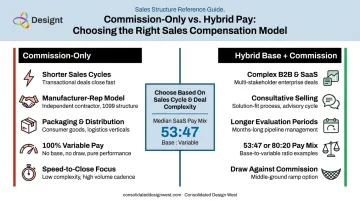
Draw-against-commission models offer a practical middle ground. Reps receive a recoverable advance against future earnings — providing cash flow during ramp while preserving performance incentives. Companies that want performance alignment without pure commission-only's turnover risk should treat this structure as a default starting point.
How to Build an Effective Commission-Only Plan for B2B
Set Competitive, Sustainable Rates
Commission rates need to account for deal complexity, the rep's role (full-cycle closer vs. support), and what comparable companies in your space are paying. Rates too low repel experienced reps. Rates too high erode your margins.
Research industry benchmarks before finalizing numbers. For SaaS, the 11–14% ACV range is a reasonable reference. For manufacturer's rep arrangements, consult MANA's guidance and factor in product type, margin structure, and territory conditions.
Define Payout Terms Clearly
Before anyone signs anything, document:
- What triggers payment — signed contract, full payment received, order delivery, or another milestone
- When payouts occur — weekly, monthly, or net-30 from trigger event
- Clawback conditions — canceled orders, customer non-payment, fraud, or unmet contract criteria
CaptivateIQ identifies these as the most common clawback triggers in commission plans. Ambiguity on any of these points erodes rep trust faster than almost anything else in a commission-only structure.
Provide Real Sales Infrastructure
Even independent contractors close more deals when they're properly equipped. The minimum:
- Clear product positioning and value proposition documentation
- Marketing collateral and case studies for key verticals
- Onboarding materials covering product knowledge and common objections
- CRM access and responsive internal support
Consolidated Design West addresses this directly — supplying warm leads and handling all order processing post-close, so reps focus on closing rather than prospecting or admin. In B2B packaging and commercial printing, where brand customers across beauty, wellness, and food & beverage need consultative guidance, that kind of operational support is what makes the rep partnership work.

That infrastructure investment also pays off at renewal time: reps who feel well-supported stay longer, and retention directly affects plan sustainability.
Review and Adjust Annually
Commission plans are not permanent contracts. Alexander Group found 91% of companies planned compensation changes in 2024, with profitability listed as the top design driver.
Track these KPIs and review them at least annually:
- Close rate and average deal size
- Sales cycle length
- Rep retention and attrition patterns
- Commission payout ratios vs. revenue generated
- Whether reps are pursuing the right deals or just the easy ones
Frequently Asked Questions
What is the typical commission for B2B sales?
Rates vary significantly by role. SaaS AEs average 11–14% of ACV at quota based on 2024 benchmarks. Manufacturer's rep rates depend on product type, customer category, and territory conditions; MANA doesn't publish a universal range. Most established B2B companies trend toward a 10/10 heuristic (quota at 10x base; 10% commission on new revenue) as a starting framework.
How does commission work in B2B sales?
Reps earn a percentage of the deal value — or gross margin — when a sale closes, typically triggered by contract signing or customer payment. B2B commission plans usually include territory agreements and quota targets, with payout timing defined in the rep agreement upfront.
What is a good sales compensation plan?
A good plan matches industry benchmarks, clearly defines payout triggers, and ties commission to metrics the rep can directly control. Most B2B companies use hybrid base-plus-commission structures to balance incentive pay with income predictability; pure commission-only works best in transactional, shorter-cycle environments.
What is the 70/30 rule in sales?
The 70/30 rule refers to a pay mix where 70% of a rep's OTE is base salary and 30% is variable/commission. Per Xactly's compensation research, this ratio is typical for account managers and renewal-focused roles where the rep has less direct control over generating new business.
What is the role of a B2B salesperson?
A B2B salesperson identifies business prospects, builds relationships, communicates value, and closes deals between companies. In commission-only roles, they typically manage the full sales cycle independently and may represent multiple complementary product lines under a 1099 contractor arrangement.
Are sales commissions considered an expense?
Yes. Under ASC 340-40, recoverable commission costs can be capitalized as an asset when recovery is expected. For 1099 contractor reps, you report commissions on Form 1099-NEC (Box 1) for nonemployee compensation of $600 or more — treatment differs from W-2 payroll, so consult your accountant for proper classification.