Introduction
Colorado and Oregon began enforcing Extended Producer Responsibility (EPR) compliance deadlines in 2025, and six additional US states now require producers to join Producer Responsibility Organizations and fund packaging recycling infrastructure. Eco-friendly packaging is no longer a brand differentiator—it's a compliance requirement.
Consumer pressure compounds the regulatory push. A 2024 PwC survey found shoppers willing to pay an average premium of 9.7% for sustainably produced goods, and McKinsey's 2025 research confirms younger, higher-income consumers are driving that demand.
Packaging design now directly impacts compliance, brand equity, and competitive positioning. The right eco-friendly packaging design service integrates sustainable material selection, structural and graphic design, compliance guidance, and prototyping into a cohesive solution.
For beauty, food & beverage, and electronics brands, where unboxing experience and regulatory scrutiny intersect, the wrong partner can mean costly redesigns, compliance penalties, or lasting damage to brand reputation.
The global sustainable packaging market reached $272.93 billion in 2023 and is projected to hit $448.53 billion by 2030, growing at 7.6% annually. Infrastructure investment, tightening regulation, and shifting consumer behavior have made verified, design-forward eco-packaging a straightforward business necessity.
Key Takeaways
- Eco-friendly packaging design services cover sustainable materials, structural design, and compliance support — not a simple box swap
- Evaluate providers on sustainability certifications (FSC, OK Compost), design depth, material transparency, MOQ flexibility, and US production capability
- The five featured services were chosen for verified eco credentials, design capabilities, and proven industry track records
- End-to-end capability matters: look at how a provider handles design, materials, production, and fulfillment together — not price per unit alone
- EPR requirements are expanding in 2026 and greenwashing enforcement is tightening — the window to get compliant is narrowing
What Are Eco-Friendly Packaging Design Services?
Eco-friendly packaging design services differ in scope and intent from general packaging suppliers. These specialized firms integrate structural and graphic design, sustainable material selection, compliance guidance, and prototyping into a unified offering—not simply fulfilling orders for pre-existing box templates.
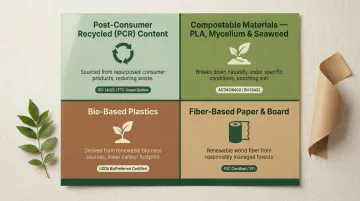
Core material categories in 2026 include:
- Post-consumer recycled (PCR) content sourced from the waste stream, with disclosed recycled percentages
- Compostable materials — PLA, mycelium, and seaweed-based options certified to ASTM D6400 or D6868 standards
- Bio-based plastics derived from renewable agricultural, marine, or forestry materials per USDA BioPreferred guidelines
- Fiber-based paper and board, driven by the industry's "paperization" shift toward recyclable substrates
Material choice must align with end-of-life infrastructure in your target market. While 60-64% of U.S. paper gets recycled, only 18.1% of the sampled population has access to composting programs that accept both food waste and compostable packaging. Choosing compostable mailers for customers without composting access delivers zero environmental benefit.
That gap between intent and impact is exactly why selecting the right design partner matters. The providers below are evaluated on how well they help brands navigate these trade-offs — from material sourcing to end-of-life outcomes.
Best Eco-Friendly Packaging Design Services in 2026
Providers were evaluated across five core dimensions:
- Verified sustainability credentials and third-party certifications
- Depth of design services (structural and graphic)
- Material transparency and recyclability claims
- US production capability
- Flexibility for both startups and established brands
Consolidated Design West
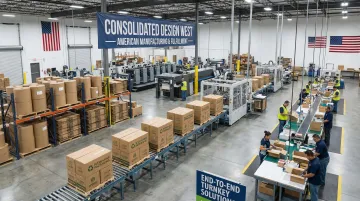
Consolidated Design West (CDW), headquartered in Anaheim, California, has delivered primary and secondary packaging solutions for over 34 years across beauty and wellness, food and beverage, electronics, pet care, and apparel. Through its partnership with Respect Manufacturing, CDW provides fully integrated turnkey services from custom formulation to finished goods.
What sets CDW apart is consolidated execution: US-based project managers handle design, quality control, co-manufacturing, fulfillment, and logistics under one roof. For brands that need eco-friendly packaging coordinated across primary and secondary layers, that single-vendor structure removes a significant operational burden.
| Sustainability Credentials | Design Services & Customization | Best For / Industries Served |
|---|---|---|
| Eco-friendly secondary packaging solutions prioritizing minimal environmental impact; recyclable substrates including corrugated boxes, folding cartons, rigid boxes; metal packaging (aluminum and steel) with strong recyclability; multiple printing methods (digital, offset, flexography) compatible with sustainable materials | End-to-end packaging design support including structural design, custom printing capabilities, and brand alignment across primary and secondary packaging formats; dedicated project managers oversee execution; comprehensive turnkey services from formulation to finished goods | Beauty and wellness, food and beverage, electronics, pet care, apparel, cosmetics, and pharmaceuticals; suitable for both startups and established brands requiring turnkey solutions with integrated fulfillment and logistics |
EcoEnclose
EcoEnclose, based in Colorado, is a purpose-built eco-friendly packaging company offering mailers, boxes, tape, labels, and padding—all made from recycled, recyclable, or compostable materials. They use algae-based inks for printing and ship across the US.
EcoEnclose's zero-plastic-waste mission is backed by genuine material transparency. Every product page discloses exact recycled content percentages—a practical safeguard against greenwashing claims. Custom printing with eco inks means brands don't have to trade visual impact for environmental integrity.
| Sustainability Credentials | Design Services & Customization | Best For / Industries Served |
|---|---|---|
| 100% recycled corrugate with 95% post-consumer waste (PCW); FSC® Recycled certified (SCS-COC-009926); compostable material options; HydroSoy Ink and carbon-negative Black Algae Ink™ for printing; zero-plastic-waste goals | Custom printing on packaging with eco-friendly inks; product range includes mailers, boxes, tape, labels, and padding; downloadable dielines provided for custom sizing; MOQs of 100 units for branded boxes and 500 for mailers with Algae Ink | E-commerce, DTC brands, subscription boxes, and any brand prioritizing verified material transparency and compostable options in their shipping packaging |
Arka
Arka is a US-based custom eco-packaging company offering FSC-certified boxes, compostable mailers, and recycled mailers at accessible price points. Founded by an industrial engineer, Arka is built for small to mid-sized brands, with MOQs as low as 1 unit for branded boxes and integrations with Shopify and major 3PLs.
Instant digital proofing, a dieline generator, and API-based auto-replenishment set Arka apart from lower-tech competitors. Locally sourced, US-produced materials round out a platform genuinely built for brands scaling volume without scaling complexity.
| Sustainability Credentials | Design Services & Customization | Best For / Industries Served |
|---|---|---|
| FSC Chain of Custody certified paper; compostable mailers meeting OK Compost certification standards; recycled mailer options; Made In The USA production; carbon-neutral packaging through EcoCart partnership; carbon-neutral fulfillment via ShipBob | Instant digital proofing tools, custom dieline generator via product pages, full-service design team; Shopify and 3PL API integration for seamless reordering; wide product range (boxes, mailers, inserts, tissue); non-toxic inks and digital printing | Startups, DTC/e-commerce brands, Shopify sellers, and SMBs that need low MOQs (1 unit for boxes, 1,000-10,000 for poly mailers), digital design tools, and eco-credentialed packaging at scale |
noissue
noissue is a global eco-packaging company offering compostable tissue paper, mailers, stickers, tape, and branded inserts—all printed with water-based inks and certified home-compostable or recyclable. Their Eco-Alliance program ties each order to tree-planting and other environmental impact initiatives.
noissue suits lifestyle, apparel, and beauty brands that need packaging to carry both aesthetic and sustainability weight. The Eco-Alliance program issues verifiable eco-badges—a concrete asset brands can use in marketing, not just a feel-good program in the background.
| Sustainability Credentials | Design Services & Customization | Best For / Industries Served |
|---|---|---|
| TUV Austria certified compostable mailers (commercial and home composting); FSC-certified paper products; water-based and soy-based printing inks; Eco-Alliance program partnered with One Tree Planted (over 40,000 trees planted to date) | Creative custom design on tissue paper, mailers, stickers, tape, and inserts; water-based ink printing; downloadable dielines and templates available on product pages; MOQs vary by SKU (e.g., 250 sheets for tissue) | Apparel, lifestyle, beauty, and DTC brands that prioritize branded unboxing experience and want compostable packaging with a verified community impact program |
PakFactory
PakFactory specializes in premium custom packaging design with an emphasis on rigid boxes, folding cartons, and structurally complex packaging formats—making them a strong choice for brands in cosmetics, electronics, and luxury goods that want eco-conscious materials paired with high-end structural design.
Their team includes structural packaging designers who work with clients to develop custom dielines, prototype samples, and finishing options (embossing, soft-touch lamination). PakFactory offers FSC®, PEFC®, and TÜV Austria OK Compost Home certifications, with Soy Ink Certification for printing.
| Sustainability Credentials | Design Services & Customization | Best For / Industries Served |
|---|---|---|
| FSC®, PEFC®, and TÜV Austria OK Compost Home certifications available; Soy Ink Certification for eco-friendly printing; eco-friendly packaging materials offered upon request with certifications | Full structural design service including custom dieline development, 3D mockups, physical prototyping, and premium finishing (embossing, soft-touch lamination); wide range of box styles (rigid, folding carton, mailer, display); dedicated structural engineering team | Cosmetics, electronics, luxury consumer goods, and brands where the unboxing experience is central to brand positioning and higher packaging investment is justified |
How We Chose the Best Eco-Friendly Packaging Design Services
Brands often make a critical mistake when selecting eco-packaging partners: focusing only on material type ("it's kraft, so it's green") without verifying certifications, recycled content percentages, end-of-life compatibility with local infrastructure, or whether design support is actually included—not just a template tool.
Our five evaluation criteria:
- Verified sustainability credentials: third-party certifications like FSC, OK Compost, and RecyClass — not vague "eco" claims
- Depth of design services: structural and graphic design with prototyping capability, not just graphic overlays on stock boxes
- Material transparency: disclosed recycled content percentages and end-of-life pathway documentation
- US production and supply chain reliability: domestic manufacturing to reduce lead times and carbon footprint
- Scalability: flexibility for startup MOQs and established brand volumes alike
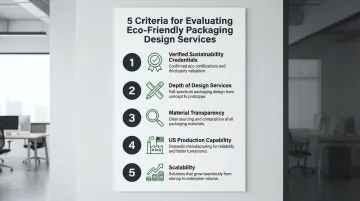
Beyond these five criteria, compliance documentation deserves its own scrutiny. As US state EPR programs expand in 2026, verified recyclability data is becoming a procurement requirement in regulated categories like food, beauty, and electronics. Providers who can't document material composition or end-of-life pathways don't just fall short on sustainability — they create real compliance risk.
Conclusion
Choosing the right eco-friendly packaging partner in 2026 comes down to verifiable material certifications, design experience in your product category, and production capacity that can grow with your brand.
Before signing any packaging contract, run through these steps:
- Request material transparency documentation — recycled content percentages, certifications, and end-of-life guidance
- Test with sample orders before committing to full production runs
- Confirm your provider can supply EPR compliance documentation if you operate in regulated states
If those criteria matter to your brand, Consolidated Design West covers all three. With over 34 years in commercial printing and packaging — spanning eco-material selection, structural design, co-manufacturing, and fulfillment — their US-based team works with everyone from startups to established brands. Visit consolidateddesignwest.com to discuss your eco-friendly packaging requirements.
Frequently Asked Questions
What is the difference between eco-friendly packaging design services and eco-friendly packaging suppliers?
Design services integrate structural design, material selection, prototyping, and brand guidance into the process, while suppliers primarily fulfill orders for existing packaging formats. Providers that combine both capabilities offer the most cohesive path from concept to shelf.
What certifications should I look for when evaluating an eco-friendly packaging design service?
Look for FSC (paper/board), OK Compost or TÜV Austria (compostability), RecyClass (verified recyclability), and PCR content disclosure. Vague terms like "eco-friendly" without certification backing are red flags and may violate FTC Green Guides.
Is eco-friendly packaging design more expensive than conventional packaging?
Costs vary by material, volume, and design complexity. At scale, eco-packaging costs are increasingly comparable to conventional options. Factor in EPR compliance costs and brand equity value when comparing total cost of ownership—not just unit price.
What is the difference between compostable and recyclable packaging?
Recyclable packaging re-enters material streams through curbside or drop-off programs. Compostable packaging breaks down under specific conditions (industrial or home composting), but delivers real environmental benefit only where that composting infrastructure exists for the consumer.
Can eco-friendly packaging still support high-quality custom branding and print?
Modern eco-packaging services support full custom printing using water-based, soy-based, or algae-based inks. These alternatives are vibrant and environmentally safer than petroleum-based options, with no compromise to brand presentation.
Which eco-friendly packaging materials are best suited for food and beverage brands in 2026?
Fiber-based high-barrier paper/board, PCR-content films, and compostable PLA-lined formats are strong 2026 options. Food contact compliance (FDA standards in the US) must be verified for any material chosen—the FDA has issued No Objection Letters for PCR HDPE, PET, PP, and PLA up to 25% recycled content.