Get the classification wrong, and the consequences go both ways: companies face significant penalties and back-tax liability, while reps risk losing the flexibility and tax treatment they signed up for. Understanding how California's rules actually work isn't just useful — it's necessary.
This article covers what 1099 status legally means in California, how the ABC test applies to sales reps, the critical direct salesperson exemption, your tax obligations, and what misclassification actually costs.
Key Takeaways
- California presumes workers are employees — companies must prove contractor status using the ABC test or a qualifying exemption
- Sales reps may qualify under the direct salesperson exemption, which shifts the classification test to the more permissive Borello standard — making it easier to maintain legitimate 1099 status
- 1099 reps owe federal self-employment tax (15.3%), federal income tax, and California state income tax — with no withholding done automatically
- Quarterly estimated tax payments are required by both the IRS and California's Franchise Tax Board
- If misclassified as a contractor when you should be an employee, you may be owed back wages, benefits, and protections — and companies face penalties up to $25,000 per violation under Labor Code section 226.8
What 1099 Independent Contractor Status Means for California Sales Reps
Working as a 1099 contractor means you receive payment without any tax withholding. Once you earn $600 or more from a single client in a calendar year, that client must issue you a Form 1099-NEC by January 31. You're then responsible for reporting that income, paying your own taxes, and covering your own benefits and business expenses.
This contrasts with W-2 employment, where your employer handles withholding and you're entitled to statutory protections:
| Protection | Statute |
|---|---|
| Minimum wage | Labor Code 1197 |
| Overtime (8+ hrs/day or 40+ hrs/week) | Labor Code 510 |
| Meal and rest breaks | Labor Code 512 / 226.7 |
| Workers' compensation | Labor Code 3600 |
| Unemployment insurance | UIC 621 |
None of these protections apply to true independent contractors. You gain scheduling flexibility and potentially higher gross earnings, but there's no safety net underneath you. That's the fundamental trade-off every 1099 rep accepts.
The Label Doesn't Make It Legal
California goes further than most states. Labor Code section 2775 requires that a worker be free from control both under the contract and in fact. A document that says "independent contractor" proves nothing if the actual working relationship looks like employment.
Classification disputes are especially common in sales for this reason. How a rep actually operates day-to-day carries more legal weight than anything written in their contract.
California's ABC Test and the Direct Salesperson Exemption
How the ABC Test Works
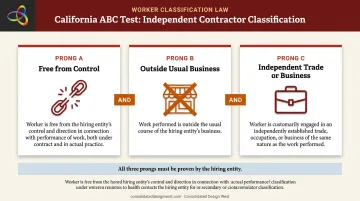
AB 5, effective January 1, 2020, codified California's presumption that all workers are employees. To classify someone as a 1099 contractor, the hiring entity must prove all three prongs of the ABC test:
- Prong A — The worker is free from control and direction in performing the work, both under the contract and in actual practice
- Prong B — The work is performed outside the hiring entity's usual course of business
- Prong C — The worker is customarily engaged in an independently established trade, occupation, or business of the same nature
For sales reps, each prong has practical consequences. Prong A asks whether the rep sets their own hours, methods, and customer approach without direction from the company. Prong B is typically satisfied when the company's core business is packaging or commercial printing — not sales representation itself. Prong C requires the rep to operate as an independent sales business, work with multiple clients, and hold themselves out publicly as a sales professional.
A rep who works exclusively for one company, under close supervision, with prescribed methods, may struggle to satisfy Prongs A and C.
The Direct Salesperson Exemption
This is the provision most relevant to commission-based sales reps. Labor Code section 2783, introduced through AB 5 and clarified by AB 2257 (effective September 4, 2020), exempts qualifying "direct salespersons" from the ABC test entirely.
To qualify under UIC section 650, a rep must meet all three conditions:
- Engaged primarily in in-person demonstration and sales of consumer products or services, away from a fixed retail or wholesale establishment
- Substantially all remuneration is directly related to sales or output, not hours worked
- Services are performed under a written contract stating the person won't be treated as an employee for state tax purposes
If those conditions are met, the ABC test doesn't apply. Classification is instead evaluated under the Borello multifactor test, which is more flexible and better suited to legitimately independent sales structures.
Consolidated Design West's rep model reflects many of these conditions: reps set their own schedules, work entirely remotely, and earn 100% on commission with no base salary or draw. Each rep relationship is evaluated on its actual terms to determine which test applies.
The Borello Test: How California Evaluates Exempt Sales Reps
When the direct salesperson exemption applies, California uses the Borello multifactor test — a right-to-control analysis established in S.G. Borello & Sons, Inc. v. Department of Industrial Relations, 48 Cal.3d 341 (1989).
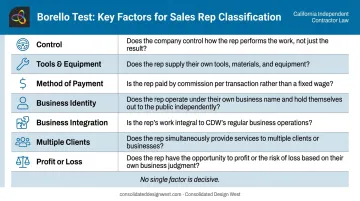
The primary question: does the hiring entity control the manner and means of how the work is performed? No single factor is decisive, but the following are most relevant for sales reps:
| Borello Factor | What It Means for Sales Reps |
|---|---|
| Right to control manner and means | Can the rep choose their own sales approach? |
| Supplies own tools/equipment | Does the rep use their own phone, computer, vehicle? |
| Method of payment | Paid by commission (job) rather than hourly |
| Distinct occupation or business | Does the rep operate independently, not as an extension of the company? |
| Work integral to principal's business | Is sales the company's primary activity, or incidental? |
| Multiple clients | Does the rep work with other companies simultaneously? |
| Opportunity for profit or loss | Does the rep's income depend on their own effort and decisions? |
The Exclusive-Client Risk
A rep working solely for one company with no other clients faces a meaningful challenge under Borello. Several factors — distinct occupation, multiple clients, independent business identity — become harder to satisfy when the rep's entire practice revolves around a single principal.
This doesn't make the classification automatically invalid, but it does make it more vulnerable to challenge. A well-drafted written independent contractor agreement is essential. That said, the agreement alone is never sufficient — the real-world working conditions must match what's on paper.
For a remote, commission-only rep with full schedule autonomy, several Borello factors point toward independent contractor status. Even so, each rep's individual circumstances — particularly whether they serve other clients — will shape how any classification analysis plays out in practice.
1099 Tax Obligations for California Sales Reps
No taxes are withheld from 1099 income. That means you're responsible for calculating, tracking, and paying taxes yourself — and the combined burden typically runs higher than most W-2 employees realize.
Federal Self-Employment Tax
1099 contractors pay both the employee and employer share of Social Security and Medicare:
- 12.4% Social Security (on earnings up to $184,500 in 2026)
- 2.9% Medicare (no wage cap)
- Total: 15.3% on net self-employment earnings
You can deduct the employer-equivalent half of SE tax when calculating your adjusted gross income. On $100,000 in net self-employment income, that deduction reduces your AGI by roughly $7,065.
California State Income Tax
California taxes all income, including 1099 commission income, using a progressive rate schedule. For 2025 (Schedule X, single filers):
| Taxable Income | Rate |
|---|---|
| Up to $11,079 | 1.0% |
| $11,079 – $26,264 | 2.0% |
| $26,264 – $41,452 | 4.0% |
| $41,452 – $57,542 | 6.0% |
| $57,542 – $72,724 | 8.0% |
| $72,724 – $371,479 | 9.3% |
| Over $371,479 | 10.3%–12.3% |
Federal income tax brackets apply on top of this, ranging from 10% to 37% depending on taxable income. Most working 1099 sales reps will see combined effective tax rates (SE tax + federal income + California state) between 35% and 50% before deductions.
Quarterly Estimated Payments
Because no taxes are withheld, you're required to make quarterly payments to both the IRS and the California Franchise Tax Board. Missing a deadline triggers underpayment penalties from both agencies — even if you pay the full amount at year-end.
Federal 2026 due dates:
- April 15, 2026
- June 15, 2026
- September 15, 2026
- January 15, 2027
California 2026 installment schedule (note: differs from federal):
- April 15, 2026 — 30% of estimated annual liability
- June 15, 2026 — 40%
- September 15, 2026 — 0%
- January 15, 2027 — 30%
Key Deductions to Track
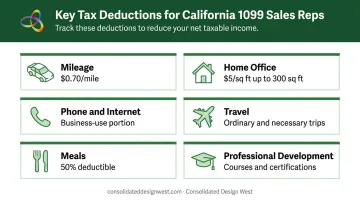
These can meaningfully reduce your taxable net income:
- Mileage: $0.70/mile for 2025 business driving (IRS Notice 2025-5); confirm the 2026 rate when the IRS publishes its annual update
- Home office: $5/sq. ft. up to 300 sq. ft. (simplified method), if used regularly and exclusively for business
- Phone and internet: Business-use portion only — document the allocation
- Travel: Ordinary and necessary trips away from your tax home
- Meals: 50% deductible when meeting with a client or business contact
- Professional development: Industry courses, certifications, trade publications
Misclassification Risks: What Sales Reps and Companies Must Know
For Companies
Labor Code section 226.8 sets out the stakes:
- $5,000–$15,000 per violation for willful misclassification
- $10,000–$25,000 per violation for a pattern or practice
Civil penalties are only the start. Companies may also face:
- Back payroll taxes and EDD-assessed interest
- Unpaid overtime and missed meal/rest break premiums
- Workers' compensation liability
All of these compound over the full period of misclassification.
California companies also have a specific reporting obligation: the DE 542 Report of Independent Contractors must be filed with the EDD within 20 calendar days of the contract date, or once aggregate payments reach $600. Failure to file carries penalties of $24 per missed report — or $490 if the failure is intentional or involves false information.
For Sales Reps
If you're later reclassified as an employee, you may be entitled to back wages, overtime, and missed benefits. But you'd also lose the tax treatment and flexibility of IC status — including deductions and the ability to work across multiple clients.
The more proactive move is to evaluate your working conditions honestly before a dispute arises. Key questions to ask yourself:
- Do I genuinely set my own schedule and sales methods?
- Do I work with clients or companies beyond this one?
- Do I operate under my own business identity?
- Does my written agreement reflect what actually happens day-to-day?
If there's meaningful uncertainty, consult a California employment law or tax attorney before a problem surfaces — it's far less costly than resolving one once it's already a dispute.
Frequently Asked Questions
Does California allow 1099 contractors?
Yes — California permits independent contractor arrangements, but imposes stricter classification standards than most states. Under AB 5, the hiring entity bears the burden of proving a worker qualifies as a contractor, not the other way around.
What is the new law for independent contractors in California?
AB 5 (effective January 1, 2020) codified the ABC test and established the default presumption of employee status. AB 2257, effective September 4, 2020, refined AB 5 with dozens of industry-specific exemptions, including the direct salesperson carveout.
Is a 1099 required for an independent contractor?
Businesses must issue Form 1099-NEC to any contractor paid $600 or more in a calendar year for services. Receiving a 1099 does not legally establish contractor status — that determination still depends on the applicable classification test.
How much tax do I pay on 1099 income in California?
You'll owe federal self-employment tax (15.3%), federal income tax (10%–37%), and California state income tax (1%–12.3%). Reps earning $75,000–$150,000 net typically see combined rates between 35% and 50% before deductions. Consult a CPA for your specific situation.
Do sales reps qualify for the direct salesperson exemption under California's AB 5?
Some do. Under Labor Code section 2783 and UIC section 650, qualifying direct salespersons are exempt from the ABC test and evaluated under Borello instead. To qualify, reps must sell consumer products away from a fixed retail location, earn compensation tied primarily to output, and hold a written contract specifying non-employee tax treatment.