
Introduction
FDA restrictions on PFAS-based coatings, expanding extended producer responsibility (EPR) programs, and growing retailer sustainability mandates have made coating selection a business-critical decision for food packaging buyers. The wrong choice no longer just affects shelf appeal.
A regulatory hold at the border or a barrier failure in the field can erase margin faster than most brands anticipate.
Water-based coatings have moved from a sustainability talking point to a practical alternative with measurable operational advantages. This article explains what they actually do in food packaging, where they perform best, and what food brands and packaging buyers should know before specifying them.
Key Takeaways
- Water-based coatings are polymer-dispersion barrier layers that resist moisture, grease, and liquids without thick plastic lamination
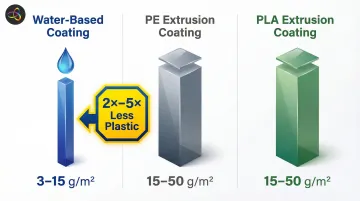
- They use 2–5× less plastic per square meter than PE or PLA linings with comparable performance for short-to-medium contact
- Advantages include strong barrier performance, better recyclability, lower VOC emissions, and FDA food-contact compliance alignment
- Best suited for short-contact formats: cups, takeaway boxes, bakery cartons, and bowls
- Selecting the right coating means matching formulation, drying process, and substrate to food type, temperature, and local recycling infrastructure
What Are Water-Based Coatings for Food Packaging?
Water-based coatings are functional barrier layers made from polymer dispersions—typically acrylate, styrene-acrylic, or polyurethane-based—suspended in water. They're applied to paper or paperboard and dried to form a thin, continuous film that blocks moisture, oils, and liquids from penetrating the substrate.
Where They're Applied
These coatings appear in high-volume food service formats:
- Hot and cold beverage cups
- Soup and noodle bowls
- Takeaway food boxes
- Bakery bags and pastry cartons
- Pizza collars and cake boards
- Paper trays for prepared foods
Any format where paper needs barrier protection but where a thick plastic laminate would compromise recyclability works well with water-based coatings.
How They Work Differently from PE or PLA
Unlike extrusion-based plastic laminates that add a thick separate layer, water-based coatings behave more like functional paint. They're absorbed partially into paper fibers and form a uniform film on the surface. This is why they require far less material and create less friction in paper recycling infrastructure.
Material weight comparison: Water-based coatings typically require 3–15 g/m² dry coat weight, while traditional PE or PLA extrusion coatings need 15–50 g/m² to achieve a continuous, pinhole-free film—a 2× to 5× reduction in plastic material usage.
Water-based coatings extend the functional life of a paper pack during food contact, protect structural integrity, and give brands a practical path away from heavy plastic construction—without overhauling the entire substrate.
Key Advantages of Water-Based Coatings for Food Packaging
Each advantage below translates directly to cost, compliance, or operational outcomes—the metrics that determine whether a packaging material works in real production environments.
Advantage 1: Effective Barrier Against Moisture, Liquids, and Grease
A well-formulated water-based coating creates a continuous, low-porosity film on paper that prevents liquids like coffee, soup, or sauces from penetrating the substrate and weakening its structure. This prevents the failure mode that causes leaky cups, soggy boxes, and customer complaints.
How the barrier is created: Polymer particles in the water-based dispersion bond together during controlled drying to form a pinhole-free film. Grease resistance is tuned using specialty polymers and fluorine-free additives matched to the fat content and temperature of the food being packaged.
Performance benchmarks:
- Water resistance (Cobb test): < 5–10 g/m² after 30 minutes
- Moisture vapor transmission rate (MVTR): 7–22 g/m²/day at 23°C, 85% RH
- Grease resistance (Kit test): Up to Level 12 (maximum rating)
Why this matters:
Barrier performance in water-based systems is achieved at much lower coating weights than PE or PLA. Research and industry data confirm that water-based coatings can require 2–5× less material per square meter while meeting equivalent hold-time performance for short-contact applications. Lower coating weight directly reduces material cost per unit and the plastic content embedded in each package, which affects both cost structure and brand sustainability reporting.
KPIs impacted:
- Leakage rate per production run
- Consumer complaint volume related to packaging failure
- Material cost per square meter
- Coating weight (grams/m²) relative to barrier performance benchmarks
When this advantage matters most: High-volume, short-contact formats—hot drinks, soups, sauced takeaway items—where structural failure within the consumption window is unacceptable but long-term liquid immersion is not required.
Advantage 2: Recyclability and Reduced Plastic Footprint
Because water-based coatings form a thin surface film rather than a bonded plastic laminate, coated paper can often be processed through standard paper pulping and fiber-recovery systems more cleanly than PE- or PLA-laminated substrates. This supports recyclability claims and reduces mixed-material contamination in paper recycling streams.
How pulping works with water-based coatings: In paper recycling, thick plastic laminates must be mechanically separated—a process that requires specialized equipment and reduces fiber quality and commercial value. A thin water-based coating layer disperses or removes more easily during pulping, allowing more fiber to be recovered at higher commercial value.
In 2024, 60–64% of all paper and 69–74% of cardboard available for recovery was recycled in the US—approximately 46 million tons total. Contamination from non-repulpable laminates reduces both volume and value.
Why this is an advantage:
- Packaging regulations across the US and globally are increasingly restricting single-use plastics, PFAS-based coatings, and non-recyclable packaging
- Water-based systems can be formulated without PFAS (per- and polyfluoroalkyl substances), which the FDA confirmed are no longer being sold in the US as of February 2024
- Brands using water-based coatings are already positioned for regulations currently in effect and those taking effect through 2032
- Reduced exposure to extended producer responsibility (EPR) fees, plastic taxes, and retailer sustainability requirements
EPR eco-modulation impact:
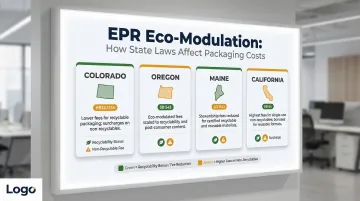
| State | Legislation | Fee Structure Impact |
|---|---|---|
| Colorado | HB22-1355 | Mandates eco-modulation bonus schedule to lower dues for highly recyclable designs |
| Oregon | SB 582 | Higher fees apply to products not accepted by local recycling programs |
| Maine | LD 1541 | Producer payments adjusted based on recyclability and toxicity |
| California | SB 54 | Requires 100% recyclable or compostable packaging by 2032 |
KPIs impacted:
- Percentage of plastic content per packaging unit
- Recyclability classification by market
- EPR compliance cost
- Consumer sustainability perception scores
When this advantage matters most: Brands operating in markets with active plastic reduction legislation, retail chains with mandatory recyclability standards, or product lines where "fiber-based" or "paper-first" positioning is part of the commercial strategy.
Advantage 3: Food Contact Safety and Regulatory Alignment
Water-based coatings, when properly formulated and tested, can be designed to meet FDA food-contact requirements such as 21 CFR 176.170 without the restrictions that come with coatings containing high-scrutiny organic solvents, heavy fluorochemicals, or compositions that trigger specific food-type or temperature-use limitations.
How this works in practice: Because water is the primary carrier, formulations avoid organic solvents associated with higher regulatory scrutiny. Polymer selection and additive composition can be tuned to meet positive lists and migration limits in different regulatory frameworks—FDA in the US, EU food contact regulations—simplifying compliance management across multi-regional distribution.
Regulatory context:
- 21 CFR 176.170: Governs components of paper and paperboard in contact with aqueous and fatty foods
- 21 CFR 177.1010: Covers acrylic and modified acrylic polymers cross-referenced in 176.170
- FDA Food Contact Notification (FCN) process: Evaluates novel polymer dispersions for safety
- PFAS phase-out: FDA revoked 35 FCNs for PFAS grease-proofers effective January 2025
Why this matters for your operation:
Non-compliant packaging coatings expose brands to product recalls, import rejections, and reputational damage. Water-based coatings offer a more transparent formulation pathway because the ingredient categories—polymer dispersions, functional additives—are well-documented across regulatory frameworks.
Faster regulatory approval means new packaging SKUs reach market sooner. Formulations designed within known regulatory parameters require less iterative testing, which shortens the approval cycle for each new product launch.
KPIs impacted:
- Regulatory approval timeline
- Number of formulation revisions required per market
- Compliance cost per SKU
- Incident rate related to packaging-food migration
When this advantage matters most: Food brands launching across multiple US and international markets simultaneously, or those currently using PFAS-based or solvent-based coatings facing phase-out timelines.
What Happens When Coatings Are Overlooked or Poorly Chosen
Packaging coating decisions are often treated as a supplier specification rather than a brand-level risk item, but incorrect or inadequate choices create real exposure across operations, compliance, and sustainability commitments.
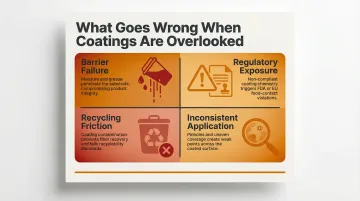
Common failure scenarios:
- Barrier failure: Under-performing coatings allow moisture or grease to penetrate the substrate, causing leaking cups, soggy takeaway boxes, and consumer complaints that generate returns
- Regulatory exposure: PFAS-containing or otherwise non-compliant coatings risk product holds or market withdrawals as EPA and state-level chemical regulations tighten
- Recycling friction: Heavy plastic laminates chosen for performance create EPR liabilities and conflict with retailer sustainability mandates — a growing risk as extended producer responsibility rules expand across US states
- Inconsistent application: When coating type is mismatched with the production line or substrate, pinholes and uneven barrier zones appear, making quality control reactive rather than systematic
How to Get the Most Value from Water-Based Coatings
Water-based coatings deliver consistent results when the coating formulation, production process, and end-use requirements are aligned from the start. Getting that alignment right upfront avoids the most common (and costly) failure points.
- Match the coating to actual food type and contact conditions — hot or cold, greasy or lean, short hold-time or extended storage. A formulation optimized for a hot coffee cup will not perform the same way in a frozen-food tray, and mismatches are the most common cause of real-world failures.
- Validate production line compatibility before committing. Drying temperature, airflow, coating weight control, and forming/converting settings all need to be tuned to the specific water-based system in use. Converters running existing extrusion-coating setups may need drying capacity upgrades before transitioning.
- Verify recyclability claims against local infrastructure. Water-based coatings support better pulping compatibility by design, but actual recyclability depends on what regional mills and facilities accept. Validate claims against local guidance before communicating them to consumers or retailers.
- Work with packaging partners who understand both the material science and production realities. Consolidated Design West has spent over 34 years helping food and beverage brands evaluate coating choices against compliance, performance, and converting constraints — which cuts trial-and-error cycles and reduces the risk of mid-production corrections.
Conclusion
Water-based coatings are no longer a niche alternative — they're a proven packaging technology with a practical track record. The case for them rests on functional barrier performance, reduced plastic dependency, and regulatory alignment that traditional PE or PLA laminates struggle to match in high-volume, short-contact food formats.
The advantages of water-based coatings compound when applied consistently: the right formulation matched to the right substrate, production process, and food contact scenario delivers reliable results across production runs, not just in lab conditions.
As regulations tighten, recycling infrastructure matures, and consumer expectations evolve, brands that integrate water-based coatings now avoid the costly scramble of reformulating packaging under regulatory pressure. The infrastructure investment made today becomes a competitive advantage when compliance deadlines move — and they will.
Frequently Asked Questions
Frequently Asked Questions
What coating is food safe?
A coating is food-safe when its ingredients — polymer types, additives, and processing aids — comply with FDA food-contact regulations like 21 CFR 176.170. Water-based coatings can meet this standard, but compliance is specific to the food type, contact temperature, and duration, so each formulation requires individual verification.
What is water-based barrier coating?
A water-based barrier coating is a thin functional layer made from polymer dispersions carried in water, applied to paper or paperboard to create resistance to moisture, oils, and liquids. Once dried, the polymer particles fuse into a continuous film that blocks contaminants without requiring thick plastic lamination.
What are the 4 types of coatings?
The four common coating types used in food packaging are water-based (aqueous) coatings, solvent-based coatings, UV-cured coatings, and extrusion coatings such as PE or PLA lamination. They differ in application method, environmental profile, and end-of-life recyclability.
How do water-based coatings compare to PE or PLA coatings for food packaging?
PE coatings deliver strong barriers but complicate recycling; PLA is bio-based yet heat-sensitive and reliant on composting infrastructure. Water-based coatings use less material overall, work more cleanly with paper recycling streams, and sit better with current PFAS and plastic reduction regulations.
Are water-based coatings recyclable?
Water-based coatings are designed for better compatibility with paper pulping than plastic laminates, but actual recyclability depends on local infrastructure and what grades mills accept. Validate recyclability claims against regional guidelines before using them in consumer-facing messaging.
Do water-based coatings meet FDA food contact regulations?
Yes — water-based coatings can comply with FDA food-contact regulations, including 21 CFR 176.170, when polymer types and additives meet applicable positive lists and migration limits. Compliance must be verified per formulation, covering the specific food types, temperatures, and contact conditions involved.