
This guide covers both sides of the equation. If you're a business looking to hire 1099 sales reps, you'll find guidance on pay structures, IRS classification rules, sourcing channels, and contract requirements. If you're a sales professional considering independent work, you'll find a practical roadmap for setting up and landing clients.
Quick definition: An independent contractor sales rep sells products or services on behalf of a company but operates as their own business entity — no payroll, no benefits, no employer withholding. They earn commissions, manage their own taxes, and control how they work.
Key Takeaways
- Contractor reps receive Form 1099-NEC and pay their own taxes, including 15.3% self-employment tax — no payroll withholding on your end
- IRS classification depends on behavioral control, financial control, and type of relationship; a written contract alone doesn't establish contractor status
- Post-termination commission deadlines are strictly enforced in several states (California, Illinois, New York, Texas) — violations carry significant statutory damages
- Source reps through MANA, RepHunter, AIM/R, or LinkedIn; the best candidates already sell into your target buyer type
- Misclassification exposes you to back taxes, IRS penalties, and FLSA liquidated damages equal to unpaid wages
What Is Independent Contractor Sales?
An independent contractor sales rep sells on a company's behalf without being on its payroll. They operate as their own business, earn income through commissions or project fees, cover their own expenses (travel, software, insurance), and file taxes independently.
The legal distinction matters: according to the IRS, a worker is an independent contractor when the payer controls only the result of the work — not what will be done or how it will be done.
In practice, a company can tell a rep "close $50,000 in deals this quarter." It cannot dictate their hours, scripts, or daily structure without creating employee-status risk.
Industries That Use the Model Most
The independent rep model is most common where national reach matters but fixed sales headcount doesn't make economic sense:
- Technology and SaaS — reps with existing enterprise or SMB relationships sell software into their networks
- Consumer packaged goods (CPG) — regional brokers carry multiple complementary lines for the same retailer buyers
- Beauty and wellness — specialty reps with established retail or distributor contacts move products into salons, spas, and e-commerce channels
- Food and beverage — category-experienced reps call on grocery, foodservice, and distributor accounts
- Packaging and manufacturing — reps like those who sell for Consolidated Design West carry commercial printing and packaging solutions into brand and procurement contacts across beauty, wellness, food and beverage, electronics, and pet care categories
The common thread: companies want the rep's existing relationships, not just their sales skills. A closer who already has the buyer's cell number moves faster than one starting cold — that network is the actual asset being contracted.
How Independent Sales Reps Get Paid
Commission Structures
The commission-only model is standard. Reps earn a percentage of each sale with no base salary. Rates vary by industry, product margin, sales cycle length, and whether the rep handles demand generation or only account maintenance.
Because primary public data by industry isn't definitively verified, treat any specific percentage range as a negotiated benchmark rather than a universal rule. MANA's 2024 commission survey confirms rates vary by product classification, customer type (OEM, distributor, end-user), and territory maturity.
Two structures come up most often in independent rep agreements:
- Commission-only (flat rate): A fixed percentage on every closed deal, regardless of volume. Simple to administer and easy to project.
- Tiered structures: Reps earn a higher percentage after hitting defined thresholds — aligning incentives so the company gets motivated performance beyond baseline and the rep has a clear earnings target to chase.
- Profit-share models: Some companies pay a percentage of net profit rather than gross revenue. Consolidated Design West, for example, offers a flat 60% of net profits per closed deal with no earnings cap — among the higher-commission structures available to independent reps.
Tax Obligations: What Every Rep Needs to Know
Once you know how you'll earn, you need to know what you'll owe. Independent contractor tax responsibilities are more involved than W-2 employment — here's a quick breakdown:
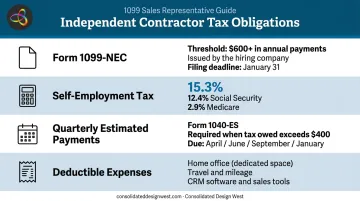
- Form 1099-NEC: Companies must issue this form to any contractor paid $600 or more in a calendar year. The deadline is January 31. Collect a W-9 before making any payment.
- Self-employment tax: Reps owe 15.3% — 12.4% Social Security plus 2.9% Medicare — covering both employee and employer portions. The 2025 Social Security wage base is $176,100.
- Estimated quarterly payments: Use IRS Form 1040-ES. Net self-employment income of $400 or more triggers a filing requirement.
- Deductible expenses: Home office, travel, CRM subscriptions, phone, and professional services all reduce taxable income when they're ordinary and necessary business expenses (IRS Publication 334).
State Commission Statutes
Several states impose specific rules on when commissions must be paid — including after termination:
| State | Post-Termination Payment Deadline | Penalty |
|---|---|---|
| California | 30 days | Up to treble damages for willful failure |
| Illinois | 13 days | Exemplary damages up to 3x commissions owed, plus attorney fees |
| New York | 5 business days | Double damages plus attorney fees |
| Texas | 30 working days (if contract is silent) | Actual damages, attorney fees, and costs |
Written contracts should specify payment timing explicitly. Don't assume industry custom will cover disputes.
IRS Classification: What Makes Someone an Independent Contractor?
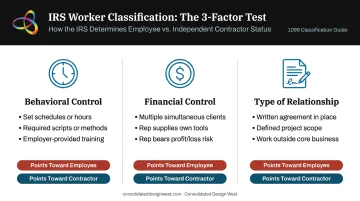
The IRS groups classification evidence into three categories: behavioral control, financial control, and type of relationship. A written contract helps establish intent — but it won't override these tests if an agency or court investigates. Understanding where you fall matters before you sign anything.
Behavioral Control
This is the most scrutinized category. If a company controls how and when work gets done — sets daily schedules, requires specific scripts, provides ongoing formal training — that points toward employee status. Independent contractors should control their own methods. The company focuses on outcomes (closed deals, revenue), not process.
CDW structures its contractor roles around this principle — reps set their own hours, work fully remote, and answer to results rather than a timesheet.
Financial Control and Type of Relationship
Financial control indicators supporting contractor status:
- Works for multiple clients, not exclusively one company
- Invests in their own tools (CRM, phone, travel expenses)
- Bears genuine profit-or-loss risk based on their own business decisions
- Offers services to the general market, not a single employer
Type-of-relationship factors:
- A written commercial contract defines the engagement
- Scope or territory is defined — not open-ended indefinite employment
- The work sits outside the company's core business operations
Misclassification carries real financial exposure. The IRS states that a business with no reasonable basis for treating an employee as a contractor may be liable for employment taxes. Under the FLSA, the DOL can recover back wages plus an equal amount in liquidated damages, with a three-year limitation period for willful violations. The DOL issued updated enforcement guidance on this in May 2025.
How to Find and Hire Independent Sales Reps
Sourcing Channels
The best independent reps are already working. They're carrying complementary, non-competing lines and calling on the exact buyer type you need to reach. Your job is to find them in those channels:
- MANA RepFinder — searchable database of thousands of active rep agencies by territory, product classification, or keyword
- RepHunter — platform specifically for manufacturers' rep recruiting
- AIM/R RepLocator — directory for reps in plumbing, heating, and cooling
- LinkedIn Sales Navigator — useful for identifying reps by territory and industry keyword
- Industry trade associations and shows — reps active in your category often participate in these
- Referrals from existing distribution partners — warm introductions from people who already know the rep's track record
What a Strong Rep Agreement Must Include
California and New York statutes require written contracts for covered independent sales reps. Beyond legal compliance, a well-drafted agreement prevents disputes:
- Defined territory or named account list
- Commission rate, calculation method, and payment schedule
- Lead and account ownership rules
- Exclusivity or non-compete terms (and their limits)
- Termination notice requirements that comply with applicable state statutes
Evaluating Candidates
The strongest candidates share a few consistent traits:
- Already have established relationships with buyers in your target market
- Carry complementary (not competing) product lines
- Have a defined territory with verifiable track record
- Understand your product category — not just general sales experience
Onboarding and Enablement
Reps carrying multiple lines will naturally focus on the products they can sell most confidently. Give them every reason to lead with yours. Provide:
- Product training materials and competitive positioning guides
- Pricing sheets and sample proposals
- Clear escalation contacts for product questions
The ERA's best practice guidance recommends onboarding that introduces stakeholders and internal support processes, similar to how you'd bring on a new employee but adapted for contractor independence. Consolidated Design West, for example, handles order processing and supplies warm leads directly to reps, so the rep's focus stays on closing rather than administrative work.
Performance Management
Solid onboarding sets the foundation, but consistent structure keeps the relationship productive over time:
- Set clear revenue targets upfront
- Maintain a regular check-in schedule (weekly or biweekly)
- Define in the contract what happens to in-progress deals and commissions owed at termination
How to Become an Independent Contractor in Sales
Setup Steps
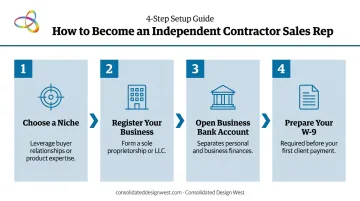
- Choose a niche where you have existing buyer relationships or deep product knowledge — category expertise matters more than general sales ability
- Register your business — a sole proprietorship is the simplest structure; an LLC protects personal assets from business liabilities (check your state's requirements)
- Open a dedicated business bank account to separate personal and business finances, which simplifies tax filing and supports legal compliance
- Get a W-9 ready before your first client engagement — payers require it for information reporting
Finding Companies That Hire 1099 Sales Reps
Target growth-stage businesses that want geographic expansion without full-time hires. Your pitch should lead with:
- Your territory and coverage area
- Existing buyer relationships you bring to the table
- Complementary product lines you already carry
Some companies go further than just offering commission. Consolidated Design West, for example, recruits experienced 1099 closers and supplies warm leads along with full backend order processing, so reps spend their time selling rather than prospecting or chasing paperwork.
Tools Every Independent Rep Needs
| Purpose | Tools |
|---|---|
| Pipeline tracking | HubSpot, Zoho CRM, Salesforce |
| Meeting scheduling | Calendly |
| Contract execution | DocuSign, PandaDoc |
| Prospecting | LinkedIn Sales Navigator, Apollo.io |
Pros, Cons, and Best Practices
Advantages and Disadvantages at a Glance
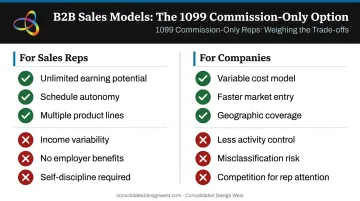
For reps:
- ✅ Unlimited earning potential — income scales with performance, not salary bands
- ✅ Schedule autonomy — no fixed hours, often fully remote
- ✅ Ability to carry multiple complementary product lines
- ❌ Income variability — no guaranteed base pay
- ❌ No employer-provided benefits (health, retirement, paid leave)
- ❌ Self-discipline requirement — no manager driving accountability
For companies:
- ✅ Variable cost model — pay only when deals close
- ✅ Faster market entry through reps' established relationships
- ✅ Geographic coverage without centralized headcount
- ❌ Less direct control over rep activity and prioritization
- ❌ Misclassification risk if the relationship isn't structured correctly
- ❌ Top reps prioritize lines that convert fastest — you compete for their attention
Best Practices to Protect Both Sides
The advantages above are real — but they depend on structuring the relationship correctly from day one.
- Use a written contract with state-compliant termination clauses and explicit commission payment provisions
- Define revenue targets and outcomes — not daily schedules, methods, or tools. Behavioral control is the fastest path to misclassification
- Review the classification periodically; scope creep toward employee-like oversight is a common and costly mistake
- Spell out commission payment timelines explicitly — courts in states with explicit commission-payment statutes (California, Illinois, New York, Texas) won't assume silence favors either party
- Don't use 1099 status to avoid payroll costs alone — both the IRS and DOL treat cost-avoidance as insufficient grounds for contractor classification
Frequently Asked Questions
Can a sales representative be an independent contractor?
Yes. Sales representatives can legally operate as independent contractors when the hiring company controls only the outcome — closed deals and revenue results — not the methods, schedule, or tools the rep uses. The IRS's behavioral and financial control tests determine the classification, not job title.
What does the IRS require to determine if a person is an independent contractor?
The IRS evaluates behavioral control (how work is done), financial control (whether the person operates as an independent business), and type of relationship (contract terms, benefits, permanence). A written agreement alone does not establish contractor status if other factors point toward employment.
How do independent sales reps get paid?
Typically through commissions on closed sales, reported to the IRS via Form 1099-NEC with no salary or benefits. Commission rates, payment timing, territory, and calculation method should be defined in a written agreement, particularly given state-specific payment deadline statutes.
How much do independent sales reps make?
The BLS reports May 2024 median wages of $66,780 for wholesale/manufacturing reps (non-technical) and $100,070 for technical/scientific product reps — though this data includes employees, not contractors exclusively. Actual contractor earnings depend on industry, commission structure, territory, and deal size. Higher-ticket or technical product lines typically yield higher totals.
How do you find independent sales reps?
Primary sourcing channels include MANA RepFinder, RepHunter, AIM/R's RepLocator, LinkedIn Sales Navigator, and referrals from existing distribution partners. The strongest candidates already serve your target buyer type — prioritize reps with proven relationships in your category over general sales experience.
Can you hire someone as a 1099 contractor?
Yes, but the working relationship must satisfy IRS classification criteria. Misclassification can result in back taxes, penalties, and FLSA liquidated damages equal to back wages owed. The DOL's 2024 final rule tightened the economic reality test, so review arrangements against current guidance, not just a written agreement.