Introduction
Most sales jobs trade your ceiling for a floor — a base salary in exchange for capped upside. Independent sales agents take the opposite deal: no guaranteed income, but no ceiling either, with earnings tied directly to what they close.
That tradeoff draws a lot of experienced sales professionals in. But many transition to independent work without a clear picture of how the role differs from a W-2 position, what day-to-day responsibilities actually look like, or how pay structures vary across industries.
This guide covers the full picture — what the role requires, how compensation actually works (with specific commission benchmarks by industry), and the practical steps to get started.
TL;DR
- Independent sales agents are 1099 contractors who sell on behalf of companies and keep a percentage of each deal
- Core duties include prospecting, product presentations, negotiation, account management, and order documentation
- Commission rates vary widely by category — MANA benchmarks range from 4.5% (health & beauty) to 12.2% (packaging equipment)
- ZipRecruiter reports average annual pay of $100,576 for independent sales reps as of May 2026
- Top earners represent multiple complementary product lines and close high-value B2B accounts
What Is an Independent Sales Agent?
An independent sales agent (ISA) is a self-employed contractor who sells products or services on behalf of one or more companies without being their employee. They operate under a 1099 arrangement rather than a W-2 — meaning the company controls the result, not how the work gets done. Per IRS common-law rules, that distinction is what separates a contractor from an employee.
MAFSI (Manufacturers' Agents Association for the Food Service Industry) defines a manufacturers' representative as an independent business of sales, marketing, and customer service professionals representing two or more related but non-competitive products in a defined territory, compensated primarily by commission.
Who Hires Independent Sales Agents?
ISAs sit between manufacturers or service providers and end buyers. Companies bring them in because they arrive with an existing network and industry knowledge that an in-house team would take years to build.
Industries that rely heavily on ISAs include:
- Commercial printing and packaging
- Beauty, wellness, and health & beauty aids
- Food and beverage
- Consumer electronics and apparel
- Pharmaceuticals and pet care
Companies in these sectors prefer ISAs because they pay only when deals close — no salaries, no benefits, no fixed overhead.
Core Duties and Responsibilities of an Independent Sales Agent
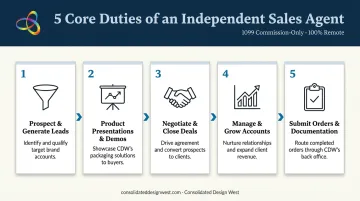
Prospect and Generate Leads
ISAs identify potential clients through cold outreach, trade shows, referrals, and business directories. Consistent prospecting drives income directly — a thin pipeline shows up immediately in a rep's paycheck. According to the BLS, reps use business directories, leads from existing clients, and trade shows as primary prospecting channels.
Conduct Product Presentations and Demos
The ability to tailor a pitch to a specific buyer's needs separates average reps from top earners. ISAs must know their products deeply enough to answer technical questions and connect features to each client's pain points — sometimes across multiple product lines simultaneously.
Negotiate Pricing and Close Deals
ISAs negotiate terms with clients and the companies they represent, balancing competitive pricing with their own commission margins. Deal-closing ability is the most direct lever on income. A rep who closes at a higher rate on higher-value deals earns disproportionately more, which makes deal selection and closing discipline more important than in salaried roles.
Manage and Grow Existing Accounts
The role doesn't end at the first sale. ISAs follow up with clients, handle reorders, resolve complaints, and build long-term relationships that generate repeat business. MAFSI notes that reps also provide market development information, sales analysis, and product improvement feedback — all of which deepen client relationships and create value beyond the initial close.
Submit Orders and Maintain Documentation
The administrative side matters: accurately completing purchase orders, customer contracts, and sales activity reports keeps operations running smoothly for both the ISA and the companies they represent. Some companies handle order processing internally — Consolidated Design West, for example, processes all orders after a rep closes a deal, freeing reps to stay focused on selling.
Sample Independent Sales Agent Job Description Template
Use the template below as a starting point — adjust the bracketed fields to match your company's product category, territory, and commission structure.
Job Title: Independent Sales Representative (1099 Commission-Only)
Role Summary: [Company name] is a [brief descriptor] seeking experienced sales professionals to represent our [product/service category] to [target buyer type]. Reps operate independently, set their own schedule, and earn commission on every deal closed with no cap on earnings.
Responsibilities:
- Prospect and qualify potential clients within the [industry/territory]
- Present products and conduct demonstrations tailored to each buyer's needs
- Negotiate pricing and close deals with B2B buyers
- Manage existing accounts to maximize repeat business and referrals
- Submit accurate order documentation and maintain client records
Requirements:
- Minimum [X] years of B2B sales experience in [industry]
- Demonstrated track record of closing deals independently
- Proficiency with CRM tools (Salesforce, Microsoft Dynamics, or equivalent)
- Valid driver's license if travel is required
- [Preferred: CPSP or SMEI SCPS certification]
Compensation:
- Commission-only, 1099 contractor role
- [X]% commission on [gross sales / net profits], paid [monthly/biweekly]
- No cap on earnings; top performers earn [$X–$X] annually
How Independent Sales Agents Get Paid
Commission-Only Structure
Most ISAs earn a straight percentage of each sale. Rates vary significantly by category. According to MANA's commission survey data:
| Category | Channel | Average Commission % |
|---|---|---|
| Packaging Equipment | End-user | 12.2% |
| Packaging Products & Services | End-user | 7.8% |
| Food & Beverage Products & Services | End-user | 8.0% |
| Food & Beverage Service Equipment | End-user | 9.5% |
| Health & Beauty Aids | End-user | 4.5% |
| Wholesale Consumer Products | End-user | 4.0% |
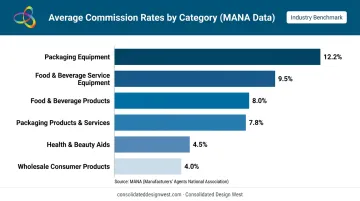
These figures reflect a wide spread — packaging equipment pays nearly three times what wholesale consumer products do. Choosing the right niche matters.
Draws, Bonuses, and Ramp-Up Support
Some companies offer a recoverable draw during the early months — money advanced against future commissions, then repaid from earnings as pipeline builds. Others layer in performance bonuses tied to quarterly quotas, rewarding reps who hit or exceed targets.
Some roles skip both entirely. Consolidated Design West's independent sales agent positions are commission-only — no base, no draw — but the company supplies warm leads and handles all order processing, which cuts ramp-up time considerably for the right closer.
How Earnings Scale
ISAs who represent multiple complementary, non-competing product lines can multiply income from the same client relationships. A rep calling on food & beverage brands can layer packaging products, co-manufacturing services, and commercial printing into a single conversation — closing more dollars per visit without adding clients.
Average Annual Earnings
Salary data varies by source and methodology:
- ZipRecruiter: $100,576 average annual pay (May 2026); top earners reach $152K
- Indeed: $75,930 average base salary (May 2026)
- BLS proxy: $74,100 median for wholesale/manufacturing sales reps (May 2024) — includes W-2 and contractor roles
Reps who land toward the top of that range typically work higher-margin categories, carry multiple complementary lines, and operate in industries with larger deal sizes.
Tax and Self-Employment Considerations
As 1099 contractors, ISAs are responsible for:
- Self-employment tax: 15.3% (12.4% Social Security + 2.9% Medicare) per IRS Topic No. 554
- Quarterly estimated payments: Required if you expect to owe $1,000+ after withholding and credits
- Expense tracking: Business costs (CRM subscriptions, travel, home office) are deductible — track them from day one
Factor this in before leaving a salaried role — gross commission figures look significantly different once self-employment taxes are applied.
How to Write an Independent Sales Agent Job Description
A weak job description attracts the wrong candidates and repels the strong ones. Here's what each section needs to do.
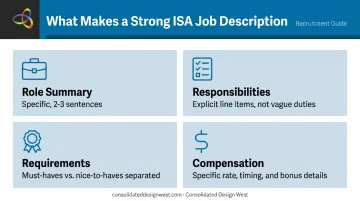
Start With a Specific Role Summary
Two to three sentences describing what your company does, what the ISA will sell, and what success looks like. Vague summaries — "exciting opportunity in a growing industry" — signal that the employer hasn't thought through the role.
Good example: "CDW is a 34-year-old Anaheim-based packaging and commercial printing company seeking experienced B2B closers to sell packaging solutions and co-manufacturing services to beauty, food & beverage, and consumer electronics brands."
Responsibilities Section
List specific sales activities rather than boilerplate duties. Candidates need enough detail to self-qualify — vague language like "drive revenue growth" tells them nothing useful.
Industry sources including MAFSI and the BLS recommend listing these as explicit line items:
- Prospect within defined territory and target customer types
- Present solutions and conduct product demonstrations
- Prepare and submit quotes and proposals
- Manage accounts through the full sales cycle
- Coordinate order documentation and hand-offs
Requirements Section
Once responsibilities are clear, separate must-haves from nice-to-haves. This single structural move cuts unqualified applications significantly:
Must-have examples:
- Minimum years of B2B sales experience in a relevant industry
- Proven track record of closing independently
- Valid driver's license (if travel required)
Nice-to-have examples:
- CPSP certification (NASP's Certified Professional Sales Person program)
- SMEI SCPS (Certified Professional Salesperson) credential
- Familiarity with CRM tools like Salesforce or Microsoft Dynamics
Compensation and Benefits Section
Be specific about commission rate, payment basis, and timing. LinkedIn Talent Solutions notes that including salary ranges has a significant impact on whether candidates apply. Indeed's employer guidelines advise descriptions like "$18/hr plus monthly commission" and explicitly discourage vague phrases like "unlimited earning potential."
Top ISAs skip listings that hide pay details. When a strong closer sees a listing without pay specifics, they move on — your best candidates won't wait around to ask.
What to include:
- Commission rate (e.g., "60% of net profits per closed deal")
- Payment frequency and basis
- Draw availability (or absence thereof)
- Bonus structure, if any
How to Become an Independent Sales Agent
Step 1: Pick a Niche You Know
Choose industries where you already have contacts, product familiarity, or genuine interest. Niche expertise commands higher commission rates and builds buyer trust faster than generalism. A rep who spent five years in food & beverage sales will close packaging deals in that sector far faster than someone starting cold.
Step 2: Build Credentials and Quantify Your Track Record
Certifications worth pursuing:
- CPSP (Certified Professional Sales Person) — NASP's flagship credential for practicing sales professionals
- SCPS (SMEI Certified Professional Salesperson) — issued by the Sales & Marketing Executives International
Equally important: assemble a one-pager that quantifies past results. Revenue generated, quota attainment percentages, deal sizes, and client retention numbers are exactly what prospective principals look for.
Step 3: Find Companies to Represent
Once your credentials are in order, finding principals comes down to working the right channels:
- MANA's Find New Lines directory — hundreds of manufacturers actively seeking reps
- Industry trade shows — direct introductions to principals who are already in buying mode
- LinkedIn outreach targeting VP- and Director-level contacts at manufacturers in your niche
Before signing any contract, review: commission rate, territory exclusivity, payment timing, and termination clauses. Negotiate these terms — most principals expect it.
Step 4: Set Up Your Business Infrastructure
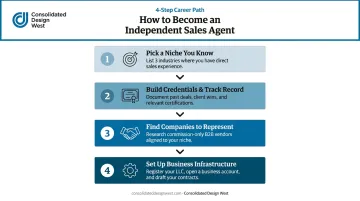
- A sole proprietorship is sufficient to start. An LLC adds liability protection and a more professional appearance — the SBA business guide outlines the tradeoffs.
- CRM tools commonly used in the rep world include Salesforce, Microsoft Dynamics, and ACT (per MANA's CRM guidance).
- Build a prospecting routine before you need it — don't wait until the pipeline is empty.
Frequently Asked Questions
What is an independent sales agent and what do they do?
An independent sales agent is a self-employed 1099 contractor who sells products or services on behalf of one or more companies in exchange for commission. They manage their own schedule, client relationships, and sales strategy without being a direct employee of the companies they represent.
What are the main duties of an independent sales agent?
Core responsibilities typically include:
- Prospecting and qualifying new clients
- Conducting product presentations and demos
- Negotiating and closing deals
- Managing existing accounts and renewals
- Handling order documentation and follow-up
Some companies handle order processing internally — CDW does this, for example — so reps can stay focused on closing.
How do independent sales agents get paid?
ISAs are typically paid a percentage commission on each sale they close. Some arrangements also include a recoverable draw during the ramp-up period or performance bonuses tied to quarterly targets. Commission rates vary by industry and product category.
How much do independent sales agents make?
ZipRecruiter reports an average of $100,576 annually as of May 2026, with top earners reaching $152K. Indeed puts the average closer to $75,930. Earnings vary widely based on industry, deal volume, and how many product lines a rep carries.
Do I need an LLC to work as a freelance sales agent?
No — a sole proprietorship is legally sufficient to start. An LLC can offer liability protection and a more professional business image, but it's not required. Consult a business attorney or accountant to find the right structure for your situation.
What is the 30-60-90 rule in sales?
The 30-60-90 rule is a planning framework where a salesperson sets goals across three phases. The first 30 days focus on learning the product and market, days 31–60 on building pipeline, and days 61–90 on closing deals and hitting early targets.