
Introduction
Finding the right co-packer for a pet product is harder than it looks. The global pet CPG market is projected to reach $500 billion by 2030, but that growth comes with manufacturing requirements that standard food production simply isn't built to handle.
Pet products occupy their own regulatory and formulation category. A few examples illustrate why:
- Pet supplements require palatability standards that human protein shakes don't
- Wet food pouches need barrier specs distinct from soup or sauce packaging
- AAFCO nutritional adequacy statements have no equivalent on human food labels
This guide serves as a practical roadmap for brand owners and CPG companies seeking a qualified co-packer for pet product manufacturing. We'll cover what co-packers do, the regulatory landscape governing pet products, how to evaluate potential partners, and which packaging and formulation factors matter most when bringing your pet brand to market.
Key Takeaways
- The pet CPG market is projected to reach $500 billion by 2030, driven by premiumization—with manufacturing and regulatory standards distinct from human food
- Pet product co-packers manage formulation, ingredient sourcing, production, packaging, and fulfillment under your brand
- Key regulations include FDA oversight, AAFCO guidelines, the "95% rule" for ingredient naming, and GMP/HACCP facility certifications
- Evaluate co-packers on pet-specific experience, regulatory knowledge, packaging flexibility, MOQ alignment, and turnkey capabilities
- Brands move fastest with a co-packer offering integrated packaging, co-manufacturing, and formulation under one roof
Why the Pet CPG Market Demands Specialized Co-Packing Expertise
The pet industry reached $152 billion in U.S. spending alone in 2024, with projections climbing to $500 billion globally by 2030. That growth is driven by a measurable shift in how Americans think about their pets. In 2024, 98% of pet owners consider their pet an important part of the family, and that emotional bond translates directly into purchasing behavior.
41% of dog owners and 38% of cat owners upgraded to premium food in 2024, representing a 5% and 9% increase from 2023 respectively. Pet owners now apply the same standards to pet products as they do to their own food and wellness items — natural, organic, limited ingredients, human-grade, and premium. That raises the formulation and manufacturing bar significantly, and pet product manufacturing is not a simple extension of human CPG production.
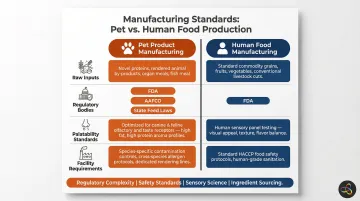
Key differences include:
- Raw material inputs like raw meat, animal by-products, and novel proteins (including insect protein, which saw over 60 new SKUs launched globally in 2024)
- Different regulatory bodies with distinct enforcement mechanisms
- Palatability standards based on canine and feline sensory preferences, not human taste
- Facility requirements addressing species-specific contamination risks and USDA oversight for meat-handling operations
Each of those differences has real operational consequences. For established CPG brands in food, wellness, or supplements, the pet space represents a significant opportunity — but success requires a co-packer with genuine pet-specific expertise, not just general food manufacturing capability. The formulation, regulatory compliance, and quality control demands are distinctly different.
What Does a Pet Product Co-Packer Actually Do?
A pet product co-packer is a third-party manufacturer that produces, packages, or both, finished pet products under your brand label. The terminology can be confusing, so let's clarify:
- Co-packing (contract packaging): Handles packaging only—filling, sealing, labeling finished bulk product you provide
- Contract manufacturing (co-manufacturing): Handles full production from raw ingredients through finished goods
- Turnkey partners: Offer both services under one roof, managing the entire process
Core Services Pet Product Co-Packers Offer
Most co-packers handle formulation through in-house nutritionists or partner food scientists who develop recipes that meet AAFCO nutritional adequacy standards. Your formula must hit specific nutrient profiles for the life stages you're targeting—growth, adult maintenance, or all life stages—to legally make "complete and balanced" claims.
Ingredient sourcing is another core function. Co-packers manage procurement of proteins (beef, chicken, salmon, novel proteins), supplements (glucosamine, probiotics, omega fatty acids), and specialty inputs. Sourcing quality directly affects both palatability and regulatory compliance.
Production formats they typically support:
- Wet food (cans, pouches, trays)
- Dry food (kibble, freeze-dried)
- Treats and chews
- Supplements (powders, soft chews, tablets)
Packaging operations include:
- Filling and sealing (primary packaging)
- Labeling with AAFCO-compliant information
- Secondary packaging (boxes, sleeves, display-ready cases)
Strong co-packers also handle supply chain coordination — ingredient procurement, production scheduling, quality control checkpoints, and finished goods inventory — so you're managing a relationship, not a production floor.
Understanding MOQ (Minimum Order Quantity)
MOQ varies widely across co-packers. Startup-friendly facilities may accept runs as low as 500-1,000 units, while large-scale manufacturers require 10,000+ units per SKU. Align your co-packer choice with your current volume needs and expected growth. A facility sized for enterprise runs may not accommodate early-stage volumes — and one built for startups may cap out before you do.
Navigating Pet Product Regulations and Safety Standards
FDA Oversight: The Legal Baseline
The FDA regulates pet food under the Federal Food, Drug, and Cosmetic Act (FD&C Act). All ingredients must be either generally recognized as safe (GRAS), approved food additives, or meet other regulatory criteria. The brand bears ultimate responsibility for compliance—which makes your co-packer's regulatory knowledge a critical part of your risk management.
Under the FDA Food Safety Modernization Act (FSMA), 21 CFR Part 507 establishes baseline requirements for animal food facilities. Covered facilities must follow Current Good Manufacturing Practices (CGMPs) and establish a written food safety plan that includes hazard analysis and risk-based preventive controls.
AAFCO Guidelines: State-Level Enforcement
The Association of American Feed Control Officials (AAFCO) is a voluntary membership association of local, state, and federal agencies. AAFCO itself has no regulatory authority, but most states adopt AAFCO Model Pet Food Regulations into their own state feed laws. This makes AAFCO standards the practical legal requirement for interstate commerce.
AAFCO sets model regulations for:
- Pet food labeling requirements
- Nutritional standards for "complete and balanced" claims
- Ingredient definitions and naming conventions
- Guaranteed analysis formatting
The AAFCO Naming Rules: How They Impact Formulation Costs
AAFCO's strict naming conventions dictate formulation costs directly.
| Rule | Requirement | Example |
|---|---|---|
| 95% Rule | Named ingredient must be 95%+ of product (excluding water), or 70%+ including water | "Salmon Dog Food" |
| 25% (Dinner) Rule | Named ingredient must be 25-95% of product (excluding water), or 10%+ including water; requires descriptor | "Chicken Dinner," "Beef Entrée" |
| 3% (With) Rule | Named ingredient must be 3%+ of product | "Dog Food with Salmon" |
| Flavor Rule | No minimum percentage; must be detectable; "flavor" must be same size/font as ingredient name | "Chicken Flavor Dog Food" |
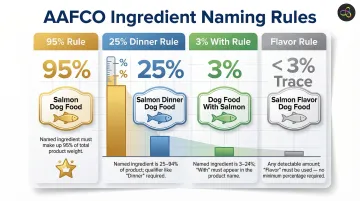
Why this matters: Calling your product "Beef Dog Food" requires 95% beef—expensive. Calling it "Beef Dinner" requires only 25%. Calling it "Dog Food with Beef" requires just 3%. Finalize your marketing and naming strategy before formulation, as these rules dictate minimum inclusion rates of costly protein ingredients.
Required Facility Certifications
Those naming and formulation decisions only hold up if your co-packer can actually produce to spec within a compliant facility. Certifications determine which retailers will carry your product—and which will turn it away at the dock.
| Certification | What It Covers | Why It Matters |
|---|---|---|
| HACCP | Identifies and controls critical food safety hazard points throughout production | Required for raw meat handling; foundational for any pet food facility |
| GMP / FSMA Part 507 | FDA-mandated baseline covering facility design, sanitation, personnel, equipment, and process controls | Legally required for all covered animal food facilities |
| SQF / BRCGS (GFSI-recognized) | Third-party audited food safety standards beyond basic FDA compliance | Major retailers and distributors require these as a condition of supply—not optional if you're targeting retail |
| USDA / FSIS | Oversight for facilities handling meat from amenable species (cattle, swine, poultry, sheep, goats) | Dual-jurisdiction applies if the facility also handles human-grade or USDA-regulated meat products |
How to Choose the Right Pet Product Co-Packer
Key Evaluation Criteria
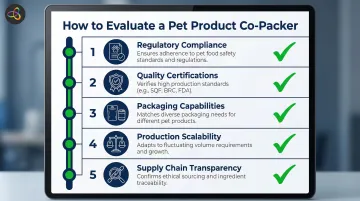
Vet every potential co-packer against these five criteria before signing anything:
- Pet-specific experience — Confirm documented work in pet products, not just general food manufacturing. Species-specific nutritional requirements, palatability testing, and AAFCO compliance nuances require specialized knowledge.
- Regulatory track record — Request facility certifications (HACCP, GMP, SQF, or BRCGS). Ask directly about FSMA Part 507 compliance, state feed law registrations, and any FDA warning letters. Walk away from any co-packer with unresolved regulatory issues.
- Packaging format flexibility — Verify they handle your target formats: pouches, cans, bags, trays, stand-up pouches. Pouches captured 42.30% of the pet food packaging market in 2025, driven by e-commerce growth and premium shelf appeal. Confirm pouch capability early in your vetting process.
- MOQ alignment — Match their minimum order quantities to your production stage. A co-packer requiring 50,000-unit runs won't work for a brand launching with 2,000 units.
- Ingredient sourcing transparency — Ask where they source proteins, supplements, and specialty inputs. Request certificates of analysis and confirm they work with GRAS-affirmed ingredient suppliers.
Communication, Project Management, and Quality Control
A qualified co-packer should offer:
- Clear production timelines with milestone updates
- Proactive status communication (not just reactive responses)
- Defined QC checkpoints at each production stage
- Documented quality control procedures with batch testing protocols
Consolidated Design West has served pet care, food and beverage, and beauty brands for over 34 years. Through its partnership with Respect Manufacturing, it offers turnkey co-manufacturing alongside primary and secondary packaging—meaning fewer handoffs, fewer delays, and one point of contact across production.
Red Flags to Watch For
- Co-packers without pet-specific experience or certifications
- Vague answers about ingredient sourcing or supplier relationships
- No clear QC documentation or batch testing protocols
- Inability to scale as your brand grows
- Lack of secondary packaging and fulfillment capabilities (forcing you to coordinate multiple vendors)
- Poor communication during the quoting or sampling phase (it won't improve during production)
Packaging That Performs: What Pet Brands Need to Know
Pet food packaging must protect against moisture, oxygen, and contamination while meeting strict labeling requirements. The format you choose—stand-up pouch, flat-bottom bag, can, tray, or box—affects both product protection and shelf presence.
Required Label Elements
Under FDA regulations (21 CFR Part 501) and AAFCO Model Regulations, pet food labels must include:
- Product name adhering to AAFCO percentage rules
- Species designation (e.g., "Dog Food")
- Net quantity statement in correct units
- Guaranteed analysis (minimum crude protein/fat, maximum crude fiber/moisture)
- Ingredient list in descending order by weight
- Nutritional adequacy statement (if claiming "complete and balanced")
- Feeding directions (for complete and balanced products)
- Manufacturer/guarantor name and address
Your co-packer must have the QA capabilities to ensure labels meet all eight requirements, as misbranding violates the FD&C Act and state feed laws.
The Premium and Sustainable Packaging Shift
40% of pet owners prioritized sustainable packaging in 2024, up from 24% in 2023. However, only 12-16% are willing to pay more for environmentally friendly pet food. This creates a balancing act: consumers expect sustainable packaging but remain price-sensitive.
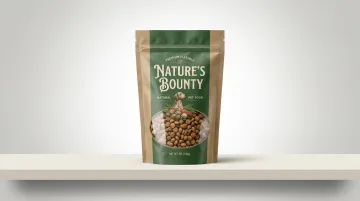
The market is responding with recyclable mono-material plastics (like mono-PE), bio-based alternatives, and reduced-plastic formats. Flexible pouches have become the go-to format within this shift, displacing traditional metal cans and multiwall paper bags due to lighter weight, superior graphics, resealability, and e-commerce durability.
Secondary Packaging for Retail and E-Commerce
Each secondary packaging format carries its own structural and print specifications:
- Display-ready cases — designed for retail floor placement with branded print panels
- Shelf-ready packaging — engineered for easy stocking and clean in-aisle presentation
- Club store formats — built to handle bulk quantities with reinforced construction
- E-commerce shipper boxes — optimized for transit protection and unboxing experience
A co-packer with both print and packaging expertise keeps primary and secondary packaging aligned, reducing handoff errors across filling, automation, and retail presentation.
From Formulation to Finished Goods: The Turnkey Advantage
A turnkey partner manages every step from custom formulation and ingredient sourcing through production, packaging, and logistics—eliminating the need to coordinate multiple vendors and cutting time-to-market significantly.
That's the model Consolidated Design West has built over 34 years in commercial printing and packaging. Through its partnership with Respect Manufacturing, CDW offers pet care brands a single-source solution covering co-manufacturing, fulfillment, and integrated inventory management—built to serve both startups launching their first SKU and established brands scaling production.
This integrated approach means:
- A single point of contact across formulation, production, packaging, and fulfillment
- Timelines coordinated across every production stage — no gaps, no finger-pointing between vendors
- Unified quality control from raw ingredients through finished goods
- Less vendor management overhead and fewer communication breakdowns
- Faster time-to-market with fewer coordination delays
For pet brands working through AAFCO compliance, facility certifications, and packaging regulations, having one partner accountable across every stage means fewer delays, cleaner audit trails, and a faster path from concept to shelf.
Frequently Asked Questions
What is the 95 rule for pet food?
The AAFCO "95% rule" states that if an ingredient appears in the product name without a qualifier (e.g., "Beef Dog Food"), it must make up at least 95% of the total product by weight, excluding water. When water is factored in, that ingredient must still account for at least 70% of the product.
What flavor is irresistible to dogs?
Dogs rely heavily on smell to make food choices, often selecting their preferred diet before tasting it. Studies show dogs prefer beef and pork over chicken, with palatability driven by lipid degradation and Maillard reaction products that create roasted, meaty aromas.
What is the difference between a co-packer and a contract manufacturer for pet products?
A co-packer handles packaging and filling of finished bulk product, while a contract manufacturer handles full production from raw ingredients through finished goods. Many pet product partners now handle both services end-to-end, making it easy to consolidate production under a single vendor.
What certifications should a pet product co-packer have?
Key certifications include HACCP, GMP (CGMP under FSMA Part 507), and GFSI-recognized standards like SQF or BRCGS. Facilities handling meat must meet USDA requirements, and state feed law registration may apply based on product type and distribution territory.
How do I find a co-packer that works with small pet product brands or startups?
Look for co-packers that explicitly offer low MOQ runs, have documented experience with startup brands, and can scale as you grow. Prioritize partners with dedicated project management support — startups benefit most from hands-on production oversight from day one.
Do I need different packaging for pet products compared to human CPG products?
Yes. While some formats overlap, pet products have unique regulatory labeling requirements (AAFCO statement, guaranteed analysis) and different functional demands (moisture barriers, resealability for kibble). Working with a co-packer experienced in both areas helps brands navigate compliance and shelf appeal at once.