
Introduction
The independent workforce has grown — MBO Partners reports 72.9 million U.S. independents in 2025, with 5.6 million earning over $100,000 annually. Experienced sales professionals are a major part of this shift, trading W-2 roles for independent practices that offer more control, better earning potential, and freedom from salary caps.
The appeal cuts across career stages:
- Seasoned reps ready to monetize their networks directly
- Industry specialists who want to offer strategic value without a corporate intermediary
- Closers who've hit commission ceilings and want earnings tied to what they actually produce
This guide covers what becoming a self-employed sales consultant actually involves — from defining your niche and pricing model to handling the legal setup and winning your first clients. Each step builds on the last, so you'll leave with a clear path forward.
Key Takeaways
- A self-employed sales consultant advises businesses on sales strategy, sells products on their behalf as a 1099 contractor, or does both
- Success requires a defined niche, real demand validation, and a pricing model that covers your costs and taxes
- Business registration, contracts, and quarterly taxes are non-negotiable from day one
- Starting with a clear niche and warm contacts cuts your path to first revenue
What Is a Self-Employed Sales Consultant?
A self-employed sales consultant is an independent professional who either helps businesses improve their sales operations or sells products and services on their behalf as a 1099 contractor — or operates as a hybrid of both.
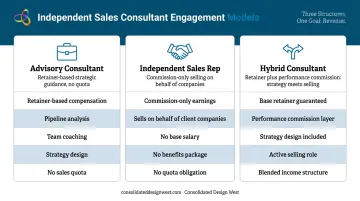
The role isn't a single job title. It's a flexible engagement model with three common variations:
- Advisory consultants work on retainer, analyzing pipelines, coaching teams, and designing sales strategy without carrying a quota
- Independent sales reps sell products directly on behalf of companies, earning commission on every deal they close — no base salary, no benefits
- Hybrid consultants combine both: a base retainer for strategy work plus performance commission on deals influenced or closed
The legal distinction matters. Self-employed consultants are not employees. They receive 1099 forms, not W-2s, and are responsible for their own taxes, contracts, tools, and benefits. That single shift — from employee to contractor — changes how you price, bill, and plan for income gaps between deals.
That structure plays out differently depending on who you work with. Consolidated Design West is a working example of the 1099 rep model. The company recruits experienced sales professionals as independent contractors to sell commercial printing and packaging solutions into beauty, wellness, food and beverage, and other consumer brand categories. Reps earn 60% of net profits per closed deal with no cap — a structure built entirely around performance, not hours logged.
What to Know Before You Start
Self-employment looks different from the inside than it does from the outside. A few realities worth understanding before you commit:
Income Will Be Uneven Early
There's no verified formula for exactly how long it takes to reach stable income — but the data is clear that unpredictability is the norm. MBO Partners' research found that 53% of full-time independents cited unpredictable income as a significant challenge, with 33% concerned about their future project pipeline.
Commission-based and project-fee models mean income tracks deal activity directly. Slow months hit hard; strong months can more than compensate. The consultants who stabilize fastest start with a defined niche and an existing book of contacts.
Administrative Work Falls Entirely on You
Unlike an employee role, every task that a company used to handle is now yours:
- Tracking invoices and following up on late payments
- Filing quarterly estimated taxes
- Drafting and managing client contracts
- Purchasing and maintaining your own tools
This overhead adds up fast, especially in the first few months when you're also trying to close business.
Prior Experience Isn't Optional
Companies hiring independent consultants expect results quickly. They're not in a position to bring someone up to speed on the job. A proven sales track record and a real professional network are the baseline requirements — not differentiators. Most consultants who struggle early were missing one or both going in.
Why Become a Self-Employed Sales Consultant?
This path makes sense for specific people at specific points in their career. It's not a universal upgrade from employment.
When the Math Works in Your Favor
Experienced consultants working on commission — particularly those selling manufactured products on commission — can earn significantly more than their salaried counterparts. ZipRecruiter's May 2026 data shows the average Independent Sales Representative earns $100,576 annually, with the 90th percentile reaching $152,000. Compare that to the average Sales Consultant base salary of $67,928 reported by PayScale — a meaningful gap, especially once you factor in uncapped structures.
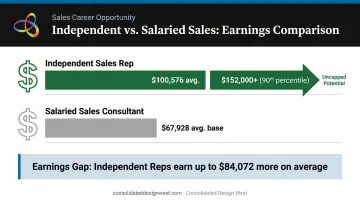
The spread widens further in high-commission models. Reps selling manufactured products under a performance-only arrangement — like the 60% net profit structure CDW offers — face no cap on annual earnings.
Consistent Demand for External Sales Expertise
Businesses across industries regularly bring in outside sales talent rather than hiring full-time. MANA's analysis confirms that manufacturers can either hire direct employees or outsource the sales function entirely by contracting with independent sales rep businesses — and many choose the latter specifically to avoid fixed headcount costs.
Categories with active independent rep markets include:
- Consumer goods (beauty, wellness, food and beverage, pet care)
- Commercial printing and packaging
- Technology and SaaS
- Manufacturing and industrial products
Control That Compounds Over Time
Self-employed consultants choose their clients, their industries, and their schedules. Over time, that autonomy builds into something tangible: a differentiated practice with a reputation in a specific niche, rather than a role that resets every time you change employers.
That's a different career trajectory — one where experience accumulates into equity, not just tenure.
How to Become a Self-Employed Sales Consultant — Step by Step
Each step here builds on the last. Skipping validation or legal setup creates problems that are harder to fix once you're in market.
Step 1 – Choose Your Niche and Define Your Value Proposition
Generalist positioning is the most common reason early conversations don't convert. Buyers hire specialists, particularly in competitive categories where they need someone who already understands their market, their buyers, and their sales cycle.
Pick one industry or problem type and go deep:
- What specific problem do you solve? (Pipeline strategy, team coaching, direct selling, lead generation)
- What outcomes can clients expect, and in what timeframe?
- What's your proof that you can deliver those outcomes?
For consultants selling into product-heavy categories (consumer goods, beauty, food and beverage, packaging), understanding the full supply chain sharpens your value proposition. Reps who can speak to packaging solutions, co-manufacturing capabilities, or category-specific compliance have a clear edge in those conversations.
Step 2 – Validate Demand Before You Formalize Anything
Talk to 10–15 potential clients before registering a business or building a website. You're trying to answer two questions:
- Is the problem you solve a current priority for them?
- Do they have budget or commission appetite to act on it now?
"Interest" in your offer is not validation. Find out what they currently spend on sales support and what they expect to pay for results. If your pricing model doesn't match their reality, that's essential to know before you've committed to a structure.
Step 3 – Handle Legal, Tax, and Business Setup
Get this done before your first engagement. It's straightforward, but skipping it creates liability.
Business structure: Register as a sole proprietor or LLC. The SBA notes that sole proprietors carry personal liability for business obligations, while an LLC generally protects personal assets from business-related lawsuits. Many consultants start as sole proprietors and convert to an LLC as income grows.
Taxes: As a 1099 contractor, you owe both the employee and employer portions of Social Security and Medicare. The IRS sets the self-employment tax rate at 15.3% — 12.4% for Social Security and 2.9% for Medicare. Estimated tax payments are due quarterly: April 15, June 15, September 15, and January 15.
Deductible expenses (ordinary and necessary per IRS rules) may include:
- CRM and sales tools
- Home office (simplified method: $5/sq ft up to 300 sq ft)
- Business travel and phone
- Professional development
Contracts: Before starting any engagement, get everything in writing — commission rates, payment timelines, lead ownership, scope of work, and termination terms. Verbal agreements offer no protection if a dispute arises.
Step 4 – Set Your Pricing Model
Three structures cover most independent sales consulting arrangements:
| Model | Best For | Structure |
|---|---|---|
| Commission-only | Reps selling products on behalf of companies | % of closed deal value or net profit |
| Retainer | Advisory, strategy, team coaching | Fixed monthly fee |
| Hybrid | Longer sales cycles with ongoing involvement | Base retainer + performance commission |
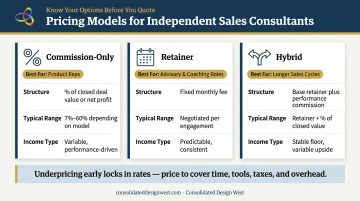
For manufactured products, RepHunter notes that commission rates commonly run 7%–15% of sales price, or 20%–40% of gross margin when paid on margin. High-commission models in product categories can run higher still.
The most common mistake: underpricing to win early clients and then being unable to raise rates. Your price needs to cover your time, tools, taxes, and overhead — not just beat the next option.
Step 5 – Go to Market and Win Your First Clients
Start with existing relationships. Former colleagues, past clients, and industry contacts are the fastest path to early engagements. Don't wait for inbound before reaching out directly.
Once you have initial traction, build visible credibility:
- Post on LinkedIn about what you do and for whom, with specific outcomes
- Build case studies — even informal ones describing problems solved and results delivered
- Ask satisfied clients for referrals; they're your most efficient source of new business
- Join associations and attend events in your target category
For consultants in product-heavy industries, relationships with reliable vendor partners matter too. Reps who can connect brand clients with trusted packaging specialists, commercial printers, or co-manufacturers expand their perceived value well beyond pure sales execution.
If you're evaluating specific 1099 rep opportunities rather than a solo advisory practice, Consolidated Design West offers a structure worth considering: company-supplied warm leads, company-handled order processing, and 60% of net profits per closed deal — with no cap on earnings.
How to Sustain and Grow Your Consulting Practice
Getting to consistent income is one milestone. Staying there requires a different set of habits.
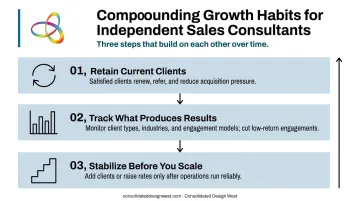
Three habits separate consultants who plateau from those who keep compounding their growth:
- Keep current clients performing well. Satisfied clients renew, refer, and reduce the constant pressure of new business acquisition. Retention is almost always faster than acquisition.
- Monitor what actually produces results. Track which client types, industries, and engagement models generate the best income. Use that data to tighten your positioning — and cut engagements that drain time without strong returns.
- Stabilize before you scale. Add clients, raise rates, or expand services only after current operations run reliably. Scaling an unstable foundation multiplies problems, not revenue.
Frequently Asked Questions
What is a self-employed sales consultant?
A self-employed sales consultant is an independent professional who either advises businesses on sales strategy or sells products on their behalf as a 1099 contractor. Unlike an employee, they handle their own taxes, contracts, and business expenses, and are compensated through commission, retainer fees, or a combination of both.
Can you be a self-employed sales consultant?
Yes — provided you have relevant sales experience, a defined service or niche, and the willingness to manage the business and administrative side of independent work. Most successful consultants bring an established track record and a professional network to their first clients.
How much do self-employed sales consultants make?
Income varies significantly by niche, engagement model, and experience. ZipRecruiter's May 2026 data shows Independent Sales Consultants averaging $66,210 annually, while Independent Sales Representatives average $100,576, with top earners exceeding $152,000. Commission-only roles in high-value product categories can push well beyond these figures.
How do independent sales consultants get paid?
The three main structures are commission on closed deals, a monthly retainer for advisory work, or a hybrid of both. Payment timelines and commission calculation terms should always be locked into a written contract before work begins.
What type of sales rep makes the most money?
Sales engineers and technical wholesale reps tend to earn the most among salaried roles — BLS data puts their medians at $121,520 and $113,520 respectively. Among independent roles, ZipRecruiter shows Sales Representatives averaging over $100,000, with strong performers in high-commission categories earning considerably more.
Do you need a license to be a self-employed sales consultant?
Most sales consulting work doesn't require a specific license. However, selling insurance, securities, or real estate does require state or federal licensing. All self-employed consultants should properly register their business and meet federal and local tax obligations regardless of industry.