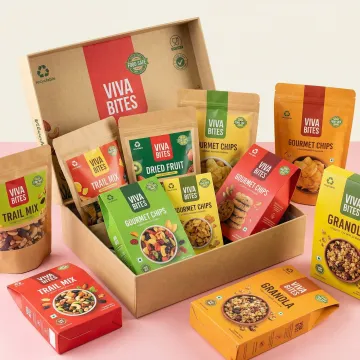
What makes packaging truly recyclable for snack foods?
Truly recyclable snack packaging uses materials accepted by municipal recycling programs—typically mono-material structures like corrugated cardboard, paper-based pouches, or specific plastic resins (PET, HDPE) that can be sorted and reprocessed. We work with substrates that meet food-safe barrier requirements while maintaining compatibility with existing recycling infrastructure. Our team helps you navigate material selection, ensuring your packaging protects product freshness, meets sustainability goals, and can actually be recycled by your customers—not just theoretically recyclable.
How do you ensure food-safe printing on recyclable materials?
Food safety is paramount in snack packaging production. We use FDA-compliant inks and coatings specifically formulated for indirect food contact applications. Our quality control protocols include migration testing, allergen management, and adherence to Good Manufacturing Practices (GMP). Every production run undergoes rigorous inspection to verify that printed materials meet food industry standards. Additionally, our partnership with Respect Manufacturing provides access to state-of-the-art facilities with comprehensive regulatory compliance expertise, ensuring your recyclable packaging is both safe and sustainable.
What printing methods work best for recyclable snack packaging?
The optimal printing method depends on order volume, substrate, and graphic complexity. Flexographic printing excels for large runs on flexible films and corrugated materials, offering excellent speed and cost-efficiency. Digital printing suits shorter runs or variable data applications with quick turnaround and no plate costs. Offset printing delivers superior color accuracy for folding cartons and rigid packaging. Our multi-method capabilities allow us to recommend the best approach for your specific recyclable packaging needs, balancing quality, sustainability, budget, and timeline considerations.
Can you match our brand colors on eco-friendly materials?
Absolutely. Color consistency is critical for brand recognition, and our experienced press operators achieve precise color matching across various recyclable substrates. We use spectrophotometers and standardized color management systems to ensure your Pantone colors or custom brand palettes remain accurate from proof to production. While some recyclable materials have different absorption properties than conventional substrates, our finishing treatments and ink formulations compensate for these variations. We provide press-check opportunities and color drawdowns so you can approve samples before full production runs.
What's the typical timeline from design to delivered packaging?
Project timelines vary based on complexity, order quantity, and material selection. Simple reprints on standard recyclable materials can be completed in 2-3 weeks, while custom designs with specialized finishes may require 4-6 weeks. Our turnkey project management approach includes clearly defined milestones: design approval, proof review, production, finishing, and delivery. We maintain transparent communication throughout, keeping you informed of progress at every stage. Rush services are available for time-sensitive launches. Contact us with your specific requirements for an accurate timeline tailored to your snack packaging project.
Do you offer warehousing and fulfillment for finished packaging?
Yes. Our comprehensive solutions include warehousing services with integrated inventory management support, allowing you to store finished packaging until needed. This approach reduces your facility burden and enables just-in-time delivery to your production lines or co-packers. We also provide fulfillment services and logistics coordination, managing the entire supply chain from our facility to your destination. This end-to-end approach simplifies operations, reduces handling damage, and ensures your recyclable packaging arrives when and where you need it—all managed by a single trusted partner.
What minimum order quantities do you require?
Minimum order quantities vary by printing method and substrate. Digital printing accommodates shorter runs—sometimes as low as 500-1,000 units—making it ideal for product testing or limited editions. Flexographic and offset printing typically require higher minimums (5,000-10,000+ units) due to plate and setup costs, but deliver lower per-unit pricing for larger volumes. We'll work with you to identify the most cost-effective production strategy for your specific needs. Our project managers analyze your launch plans, storage capabilities, and budget to recommend quantities that balance efficiency with inventory management.
How do your prices compare for recyclable versus conventional packaging?
Recyclable packaging costs have become increasingly competitive as sustainable materials gain market adoption. While some eco-friendly substrates may carry slight premiums over conventional options, advancements in material science have narrowed the gap significantly. Additionally, many recyclable solutions offer operational efficiencies—lighter weight reduces shipping costs, and mono-material structures simplify production. We provide transparent quotes that compare options, helping you understand total cost of ownership beyond just material pricing. Many brands find that the marketing value and consumer preference for recyclable packaging justifies any incremental investment.