Introduction
If you're building a sales team and trying to figure out what to pay a high ticket closer, you've probably hit a frustrating wall of conflicting answers. Some forums say 10%, others say 20%, and a few gurus claim 15% is the universal standard. None of them explain where that number actually comes from.
Commission rates vary based on offer price, lead quality, closer experience, and deal structure. Without clear benchmarks, you either overpay someone who underdelivers — or pitch a structure that experienced closers walk away from.
This guide covers:
- Verified rate ranges pulled from real job market data
- What drives commission percentages up or down
- How the main commission models compare
- How to structure a deal that works for both sides
Key Takeaways
- High ticket closer commission rates typically fall between 10% and 20% per closed deal, based on current job market postings
- The "15% industry average" lacks a verified primary source — use it as a ballpark, not a hard benchmark
- A closer at 20% with a strong conversion rate often beats one at 10% with weak close ratios — percentage alone doesn't tell the full story
- No commission structure rescues a broken funnel — consistent lead flow and a validated offer are prerequisites before hiring a closer
- CDW's 1099 sales roles offer 60% of net profits per closed deal with no earnings cap, positioning it far above standard market rates
What Commission Rate Do High Ticket Closers Charge?
There's no single fixed rate — and that's the first thing to understand before entering any negotiation. Commission structures in high ticket sales depend on offer price, margin, lead quality, payout timing, and whether the closer carries any risk around refunds or chargebacks.
Setting rates without market context creates real problems: you may overpay inexperienced closers who can't document their results, or you structure a deal that vetted closers won't accept because it doesn't reflect the value they bring.
Typical Commission Rate Ranges
Entry-level / newer closers: 8%–12%
Closers without a documented track record or niche-specific experience typically land in this range. Expect to provide more structure — scripting, call reviews, supervision — and set clear performance milestones before committing to longer terms.
Mid-range / experienced closers: 12%–15%
Closers with verified close rates, industry experience, and a portfolio of past results commonly negotiate here.
Current job postings confirm this: a ZipRecruiter listing for a coaching offer priced $10,000–$100,000 showed commissions between 7.5% and 17.5%. An Indeed posting for high-ticket coaching and consulting roles listed 10% commission on cash collected.
Premium / elite closers: 15%–20%+
Top performers with documented conversion rates, specific niche expertise, and a reputation for reliability can command 15%–20%. Some arrangements at this tier include a hybrid structure combining a modest retainer with a lower commission percentage. A ZipRecruiter posting showed one tiered structure paying 12% on deals under $20,000 and 15% on deals above that threshold — an example of how deal size itself can shift the rate.
What these ranges include and exclude:
- ✅ Commission on closed revenue
- ❌ Lead generation or cold outreach
- ❌ Follow-up sequences or CRM management
- ❌ Offer refinement or funnel work
- ❌ Marketing or ad management
Earnings Context: What These Rates Mean in Practice
The math shifts fast as deal size grows. Here's what a 15% commission rate looks like at two common offer prices with 10 closed deals per month:
| Offer Price | Deals/Month | Closer Earns | Business Nets (pre-cost) |
|---|---|---|---|
| $5,000 | 10 | $7,500 | $42,500 |
| $10,000 | 10 | $15,000 | $85,000 |
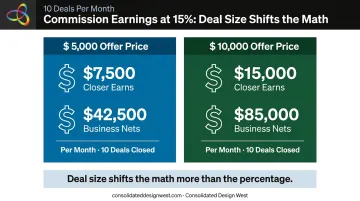
Deal size changes the math more than the percentage does.
For context on what closers expect to earn: Glassdoor's 2026 salary data shows average total compensation for a high ticket sales closer at approximately $111,908 per year, with a typical range of $89,000–$144,000. Secondary industry guides suggest monthly ranges of roughly:
- Beginners: $3,000–$5,000/month
- Mid-level closers: $5,000–$10,000/month
- Experienced high-performers: $10,000–$30,000+/month
Note: those monthly figures are not primary survey data — treat them as directional benchmarks, not hard targets.
Use these figures to set realistic expectations going into recruiter conversations — and to structure offers that attract closers worth hiring.
Key Factors That Influence High Ticket Closer Commission Rates
The final rate in any deal reflects variables from both the business and the closer. Getting clear on each one before negotiations start prevents the misaligned expectations that sink otherwise good arrangements.
Offer Price and Margin
Higher-priced offers can support higher commission percentages without destroying profitability. A 15% commission on a $15,000 offer produces $2,250 per close — a strong incentive for a closer without eating deeply into margin. On lower-margin or lower-priced offers, the math tightens quickly, and businesses often need to negotiate toward the lower end of the range or shift to a hybrid model.
Lead Quality and Volume
Closers don't just evaluate commission percentage — they also evaluate what they're walking into on each call. Warm, pre-qualified, inbound leads that show up ready to buy justify a lower rate. Cold or poorly vetted traffic requires more work per close, so closers will demand more to compensate for conversion difficulty.
Consistent call volume gives businesses negotiating leverage. A closer who knows they'll get 20 qualified calls per week has a reason to accept a slightly lower rate than someone being handed 4 uncertain ones.
Industry and Niche
Commission norms shift across niches based on average deal size, buyer sophistication, and conversion difficulty:
- Coaching and consulting: High variability in offer price; commission on $10,000–$100,000 offers typically ranges from 7.5% to 17.5%
- B2B packaging and manufacturing: Large wholesale accounts with recurring relationships; retainer + commission structures are common because they align accountability with long sales cycles
- Agency retainers: Deal sizes of $4,000–$20,000+ monthly; closer commission structures are negotiated separately from client contract value
- B2B SaaS: High ticket closer roles exist, but no validated commission benchmark is available separate from standard AE OTE structures
Niche data is most useful as a negotiation anchor — it tells you what's reasonable to propose, not what the final number must be.
Closer Experience and Documented Close Rate
A closer who can show verified conversion data from comparable offers has negotiating leverage. Businesses evaluating closers should ask for documented close rates on similar offer types — not just a claimed percentage — and factor in refund rates and no-show rates when assessing real performance.
HireBasis notes that employers evaluate remote closers on show rate, close rate, average deal size, and speed to close — not commission percentage alone. Paying more per deal to a closer who consistently converts is a better outcome than chasing a lower rate from someone whose track record is thin.
Exclusivity and Commitment Level
A closer working exclusively with one brand — full schedule, full focus — is worth more per deal than a part-time contractor splitting time across three clients. Multi-client freelancers need higher per-deal returns to offset divided focus, while dedicated closers are typically open to lower percentages in exchange for volume and stability. When a closer is building their entire income around your offer, a retainer component — even a modest one — can lock in that commitment without requiring a higher commission ceiling.
High Ticket Closer Commission Models Compared
Choosing the wrong model for your business stage is one of the most common structural mistakes founders make. Here's how each model works and when it fits.
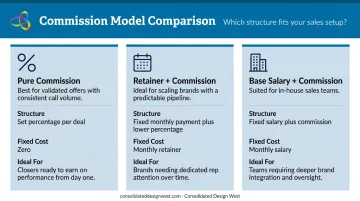
Pure Commission Model
The closer earns a set percentage of each deal. No base, no retainer, no fixed payment regardless of results.
Best fit: Businesses with consistent booked call volume and a validated offer. The closer carries all income risk, which motivates performance — but only if calls are actually happening.
- Pros: Zero fixed cost, performance-aligned, easy to scale up or down
- Cons: Good closers hesitate when call volume is uncertain; no guaranteed income makes retention harder; no built-in accountability mechanism
Retainer Plus Commission Model
A fixed monthly payment plus a lower commission percentage per closed deal. The retainer creates predictability for the closer while reducing the per-deal payout for the business.
Ideal for: Scaling brands with predictable pipeline that need structured performance tracking and a closer who shows up consistently. It also fits B2B contexts — beauty, wellness, and food and beverage brands closing large wholesale or distribution accounts — where relationship continuity matters over time.
Consider this over pure commission when:
- You're asking for more of the closer's time on a consistent basis
- Your offer is new and conversion rates are still being established
- You need someone integrated into your operations, not just dialing on demand
Base Salary Plus Commission Model
A fixed salary or contracted base combined with a commission percentage. This is standard for in-house closers on a W-2 or structured contractor arrangement within a full sales team.
Most relevant when: You're building an internal sales function, not just outsourcing one. The fixed cost is higher, but retention is better and the closer can be managed, trained, and integrated into broader team processes. This model rarely applies to freelance high ticket closer arrangements but becomes relevant as businesses grow past a single-closer setup.
Lower vs. Higher Commission Rates — What's the Actual Difference?
The right metric isn't the commission percentage — it's the cost per closed deal.
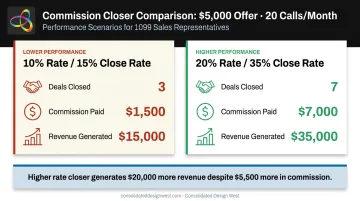
A closer charging 20% who converts 35% of calls produces very different economics than a closer at 10% converting 15%. On a $5,000 offer with 20 calls per month:
Lower-rate closer (10% / 15% close rate):
- 3 deals closed
- Commission payout: $1,500
- Revenue generated: $15,000
Higher-rate closer (20% / 35% close rate):
- 7 deals closed
- Commission payout: $7,000
- Revenue generated: $35,000
The higher-rate closer costs $5,500 more in commission but generates $20,000 more in revenue. The cost per acquired customer is lower despite the higher percentage.
Where lower-rate closers make more sense:
- Businesses still validating their offer and conversion process
- Low or irregular call volumes where commission-only risk is manageable
- Offers with thin margins that can't support 15%+ per deal
- Trial periods before committing to a performance partner
Where higher-rate closers justify the premium:
- Proven offer with consistent lead flow ready to scale
- Offer prices above $5,000 where per-deal commission dollars are significant
- Businesses that have data on their funnel and need a closer who can match it
- Situations where replacing an underperforming closer costs more than paying for quality upfront
A cheaper closer doesn't save money if they're burning qualified leads. Poor conversations damage pipeline trust and stall momentum in ways that don't show up in the commission line — but show up clearly in monthly revenue.
How to Structure a Fair Commission Deal
The right commission structure aligns the closer's incentives with the business's growth goals. Both parties need a clear stake in the outcome — the closer earns more when they perform, and the business pays only for results it can measure.
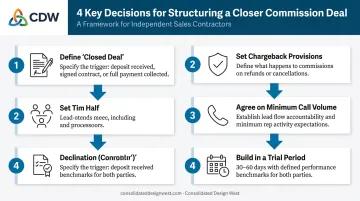
Key Decisions Before Setting a Rate
- Define what counts as a closed deal — is it deposit received, contract signed, or full payment collected? This affects commission timing and dispute risk.
- Set chargeback and clawback provisions — as HireBasis recommends, any written comp plan should define what happens to earned commissions when refunds or cancellations occur.
- Agree on minimum call volume — a closer can't be held accountable for results if leads aren't showing up consistently.
- Build in a trial period — 30–60 days with defined performance benchmarks before long-term terms are locked in.
What Most Businesses Miss
- Focusing only on commission percentage without defining close rate expectations
- Ignoring the cost of low-quality leads that drain a closer's time and motivation
- Skipping the trial period and committing to long-term terms before performance is proven
- Treating the closer like a vendor rather than a performance partner — the best closers expect to be managed, given feedback, and brought into the sales process
Evaluating Whether the Deal Is Working
Once the deal is structured, the next question is whether it's actually working. Track these within the first 60–90 days:
- Close rate — what percentage of calls are converting
- Cost per acquisition — total commission paid divided by customers acquired
- Revenue per call — total revenue generated divided by calls taken
If these three numbers trend in the right direction through the trial period, you have a deal worth formalizing on longer terms.
Frequently Asked Questions
What percentage do high-ticket closers get?
Current job market data shows rates ranging from 7.5% to 17.5% depending on offer price and lead quality, with many postings at 10%–15%. The right percentage depends on your offer price, lead quality, and the closer's documented experience — there's no single verified industry standard.
What is the average commission for high-ticket sales?
In coaching, consulting, and B2B service niches, most commission-only arrangements fall between 10% and 15%. Hybrid models with a retainer component typically pair a lower commission (8%–12%) with a fixed monthly payment. Treat any cited average as a starting benchmark — your offer price and lead quality should drive the final number.
Is 20% commission high?
At 20%, expectations should match the rate — documented close rates, niche experience, and clear accountability built into the agreement. It can erode profitability on low-margin offers but is entirely reasonable on premium, high-converting ones.
What is a good close rate for high-ticket sales?
Close rate benchmarks vary by offer price, lead source, and niche. A meaningful number for your business comes from your own funnel data — show rates, lead source, and offer clarity all shift the result significantly.
How much do high-ticket remote closers make?
Glassdoor data shows average annual compensation around $142,000 for high ticket closers, while secondary guides suggest monthly ranges from $3,000–$5,000 at the beginner level up to $10,000–$30,000+ for top performers. Income is entirely dependent on call volume, commission rate, and offer price — not tenure or title.